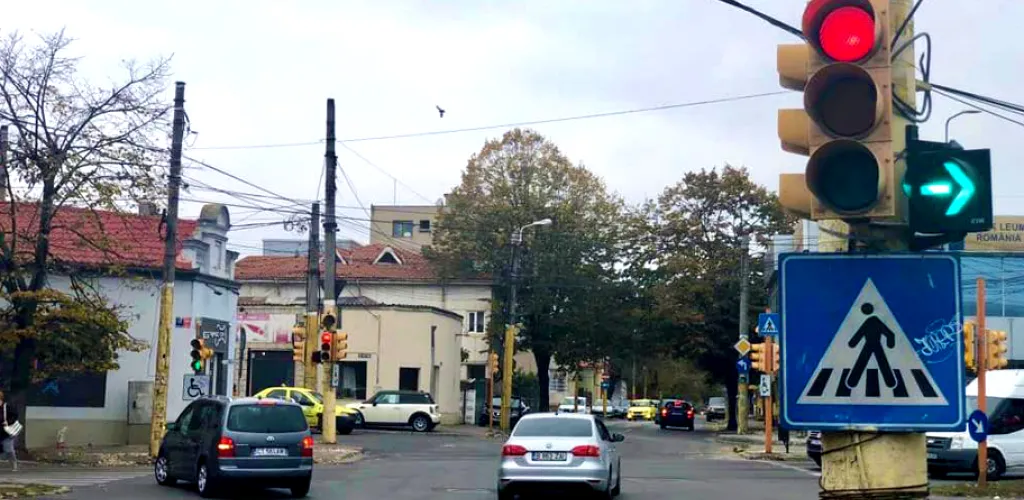
- Flashing green arrow allows movement in its direction regardless of main signal.
- Lane 1 can be used for straight if marked and main light is green.
- If lane 1 is exclusively for right turns, staying straight is a violation.
- Turn-right: position early, signal, confirm lane permits right turn, yield to pedestrians.
In urban intersections across Romania, the flashing green signal for the right turn has become an increasingly common solution to improve traffic flow. However, its presence generates daily confusion and controversy among drivers, often leading to tense situations on the road. Understanding the rules correctly can prevent both accidents and costly fines.
This article explains what the flashing green right-turn signal means, the essential exception, and practical guidance to navigate intersections safely and legally.
What the flashing green signal means
According to Emergency Ordinance no. 195/2002 on public road traffic, the flashing right-turn signal is defined as follows:
“When a three-color traffic light has an additional blinking green light mounted at the same level as the normal green light of the signal, in the form of a green arrow on a black background, with the tip pointing to the right, its illumination signifies permission for vehicles to continue straight in the direction indicated by the arrow, regardless of the color of the main traffic light.”
Essential condition: priority to vehicles and pedestrians who have the right of way.
Technical characteristics
- Shape: green arrow on a black background
- Position: at the same level as the normal green light
- Operation: independent of the color of the main signal
- Purpose: to streamline traffic in busy intersections
The controversy of lane 1: who is right
Typical situation
A common scenario at intersections: a driver waits on the first lane to turn green and go straight, while the flashing green signal for the right turns is active. From behind, another driver honks insistently, demanding the release of the lane for a right turn.
What the law says
The answer is clear: drivers waiting on lane 1 to go straight do not break the law, even if there is a flashing green to the right. This is because:
- If the marking assigned to the first lane allows straight movement, drivers have the right to use it
- They can only proceed when the signal is green for the straight direction
- The flashing signal is a facility, not an obligation to occupy the lane
Important exception
Attention! There is one situation in which drivers are not allowed to stay on lane 1:
- When lane 1 is exclusively reserved for a right-turn (marked with signs or arrows on the road)
- In this case, stopping with the intention of going straight constitutes a violation
How to proceed correctly at intersections
For turning right
- Positioning: Align yourself on the first lane well in advance
- Signaling: Use your turn signal
- Checking: Ensure the lane permits the right turn
- Priority: Give priority to pedestrians legally crossing
- Caution: Check for vehicles coming from the left
For going straight
- Markings: Check if the lane allows straight movement
- Stopping: Wait for the main green light
- Calm: Ignore unjustified honking from behind
- Cooperation: If possible and safe, facilitate traffic
Types of intersections and specific rules
Intersections with mixed lanes (straight + right)
- Allows both directions
- Drivers may choose to wait for the main signal
- It is not mandatory to use the flashing green
Intersections with dedicated lane (right turn only)
- The lane is marked exclusively for a turn
- You must follow the indicated direction
- Misalignment carries a penalty
Complex intersections with multiple lanes
- First lane: often mixed
- Second lane: may be dedicated only to the right
- Check markings for each lane
Abusive honking: rules and penalties
What the law says about honking
According to the Road Code:
“Horn devices must be used from a distance of at least 25 meters from those to whom they are addressed, for a period of time that ensures the signal is perceived and without forcing them to execute maneuvers that may endanger traffic safety.”
Legal exception
Honking can be used only to avoid an immediate danger, not to force other vehicles to move at the signal.

Penalties for abusive honking
Drivers who honk to push the vehicle in front to pass the signal with a flashing green may be fined with:
- 4-5 penalty points
- Fines between 580-725 lei
- License suspension in case of accumulation of points
Common mistakes and how to avoid them
Driver mistakes
- Ignoring road markings on the road surface
- Assuming all intersections operate the same
- Failing to yield to pedestrians turning right
- Late positioning on the appropriate lane
- Unjustified honking by other participants
Practical tips
- Study the intersection before approaching
- Read markings and signs carefully
- Plan your lane position in advance
- Respect safety distances
- Stay calm in tense situations
- Use navigation apps for up-to-date information
Special situations and particular cases
Intersections with tram
- Give priority to public transport vehicles
- Respect tram-dedicated lanes
- Be mindful of passengers alighting
Adverse weather conditions
- Increase safety distances
- Slow down on bends
- Be extra attentive to pedestrians
Heavy traffic
- Patience and extra caution
- Avoid blocking the intersection
- Cooperate with other drivers
Legal aspects and responsibilities
Possible offences
- Incorrect positioning on a dedicated lane: fine + penalty points
- Failure to yield to pedestrians: major fine + points
- Disobeying road signs: fine + points
- Abusive honking: 580-725 lei + 4-5 points
Liability in case of an accident
Noncompliance with the rules for the flashing signal can affect:
- Determination of fault
- Calculation of compensation
- Insurance coverage
Tips for safe and civilized driving
For drivers turning right
What to do:
- Position yourself early on the correct lane
- Signal your intention to turn
- Respect pedestrians’ priority
- Check blind spots
- Keep speed reduced
What to avoid:
- Do not force entry onto a legally occupied lane
- Do not honk abusively
- Do not overtake on the right at intersections
For drivers going straight
What to do:
- Check if the lane allows straight movement
- Respect the main traffic light
- Stay calm when others honk
- Cooperate when possible and safe
What to avoid:
- Do not position yourself on a lane dedicated only to the right
- Do not ignore road markings
- Do not respond aggressively to provocation
Modern technologies and future developments
Smart traffic signals
- Real-time adaptation to traffic
- Communication with connected vehicles
- Automatic optimization of signal cycles
Mobile apps
- Information about signaling
- Optimized routes for intersections
- Alerts for temporary changes
Core principles for proper driving
The flashing green for the right turn is an effective tool to ease traffic, but its optimal functioning depends on understanding and respecting the rules by all road users.
Remember these fundamental rules:
- Know the law – do not improvise in traffic
- Read the markings – each intersection may have specifics
- Respect priority – safety is more important than speed
- Stay calm – aggression does not solve traffic problems
- Cooperate civilly – traffic works better with mutual understanding
Remember: If in doubt, follow road markings and signs, give right of way as required by law, and maintain a safe following distance. A safe intersection is everyone’s responsibility, and knowing the rules protects you from both accidents and fines.
The flashing signal is not a reason for quarrel, but an opportunity to demonstrate that you drive civilly and responsibly.