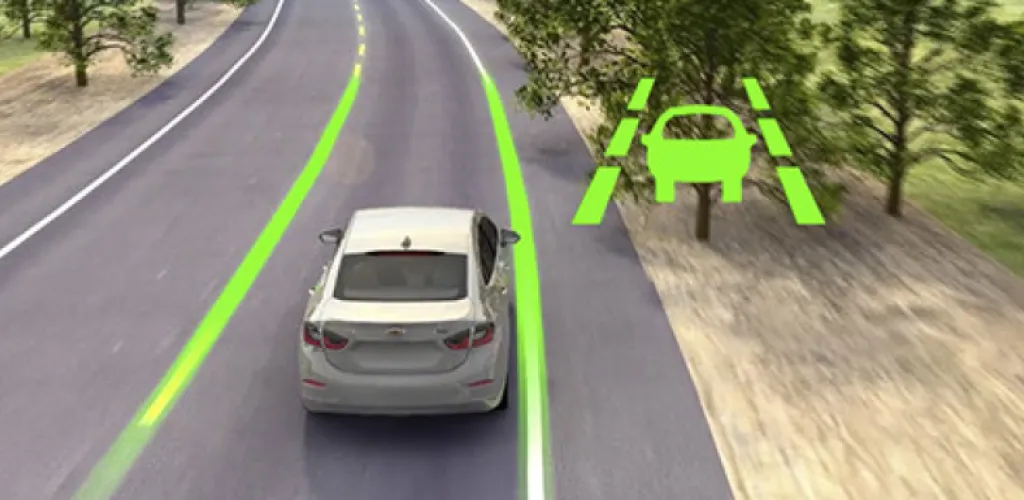
- Lane Assist uses windshield cameras to detect lane markings and keep the vehicle in lane.
- Active Lane Assist can steer the car back and even brake to center the lane.
- Lane Departure Warning provides visual/audible alerts when drifting; driver remains responsible.
- The most advanced version is Lane Centering Assist, which centers the car between road markings.
In an era when drivers are more distracted than ever behind the wheel, leaving the lane and drifting into the adjacent lane, into the barrier, a ditch, or oncoming traffic, has become an increasingly present danger on the roads. Traffic statistics show that at least one third of road accidents are caused by uncontrolled lane changes or entering a busy road, with a quarter of them due to fatigue.
Reasons for these incidents vary: fatigue, inattention, poor visibility, phone use at the wheel, and many others, all resulting in hundreds of accidents each year. To combat this growing problem, the automotive industry has developed Lane Assist technology, an active safety system that helps the driver stay within the lane under all conditions.
What is the Lane Assist system?
Lane Assist is an active safety technology designed to provide visual and/or audible warnings to the driver when the car leaves the lane in which it is traveling, without signaling. Although this technology has existed for some time, it has been significantly improved in recent years, to the point of near-total autonomy in certain situations, where the vehicle can return to the correct lane on its own, without driver intervention.
The most advanced iteration of this technology is Lane Centering Assist, which not only keeps you in your lane but also centers the car between the road markings, providing a higher level of safety and comfort.
How Lane Assist technology works?
Main components of the system
Most Lane Assist systems use a windshield-mounted video camera, usually near the rearview mirror, which continuously scans the road markings. Some more advanced models have additional cameras mounted at the rear of the vehicle for complete coverage.
Detection and response process
The information provided by the camera is analyzed in real time by the car’s on-board computer, which uses advanced image recognition algorithms to identify:
- Road markings (solid and dashed)
- Road edge
- Vehicle direction
- Lateral speed
The computer will react instantly if the car does not stay in its lane, sending alerts to the driver or taking control of the steering, as is the case with Active Lane Assist.

Types of Lane Assist Systems
Lane Departure Warning (LDW)
This basic system offers only visual or audible warnings when the vehicle leaves the lane. The driver remains responsible for correcting the trajectory.
Active Lane Assist (Lane Keeping Assist)
Active Lane Assist emerged because inattentive drivers ignore traditional Lane Assist warnings, so they are warned of danger but not protected from it. Active Lane Assist systems intervene actively and steer the car back onto the lane by:
- Direction correction: applying a light steering torque to bring the vehicle back to the center of the lane
- Intervention on the braking system: selective braking of certain wheels to correct the trajectory
- Power modulation: temporary reduction of engine power to facilitate correction
Lane Centering Assist
The most advanced type, which actively keeps the vehicle centered between road markings, offering partial autonomy in certain traffic conditions.
Operating conditions and limitations
Requirements for optimal operation
Camera-based systems work only when the following conditions are met:
- Windshield is clean and free of obstacles in the camera area
- Road markings are visible and in good condition
- Weather conditions permit visibility (not optimal in dense fog, heavy snowfall)
- Lighting is adequate (performance may be reduced at night in some conditions)
Activation parameters
These generally activate at speeds between 60 and 180 km/h and must be activated in advance by the driver. Most systems are designed not to alert the driver to lane changes at low speeds (below 60 km/h), where lane changes are typically voluntary.

Automatic deactivation
The system automatically deactivates when:
- The driver signals (assumes the driver intends to change lanes)
- Sudden evasive maneuvers are detected
- The system detects that the driver is firmly gripping the steering wheel
Limitations and technical challenges
However, no system is infallible and can become confused due to:
- Unusual roads with non-compliant markings
- Lack of lane markings on certain stretches of road
- Ongoing roadworks that temporarily modify lane configurations
- Extreme weather conditions
- Strong reflections that can confuse cameras
In these situations, the driver may be misled into a lane change or the system may not work at all.
Evolution of technology and adaptability
The most intelligent modern systems are capable of perfectly adapting to the driver’s style and intervene only when appropriate. They learn:
- The driver’s preferences for lane position
- The driving style in curves
- The frequency and manner of lane changes
- Reactions to warnings
Future outlook and regulations
Currently Lane Assist technology, along with other safety technologies, is optional for automakers. However, industry forecasts expect them to become mandatory in the near future.
The European Union has already introduced regulations that will make Lane Assist systems mandatory on all new vehicles starting in 2024. Many manufacturers expect this feature to dramatically improve accuracy as technology advances, integrating with:
- Satellite navigation systems
- Vehicle-to-vehicle (V2V) communication
- Vehicle-to-infrastructure (V2I)
- Artificial intelligence for more precise environment recognition
Road safety benefits
Widespread adoption of Lane Assist technology can significantly reduce:
- Fatigue-related accidents – up to 25%
- Head-on collisions – up to 40%
- Run-off-road events – up to 35%
- Costs associated with road accidents
This technology represents a major step toward autonomous vehicles and a substantial improvement in overall road safety.