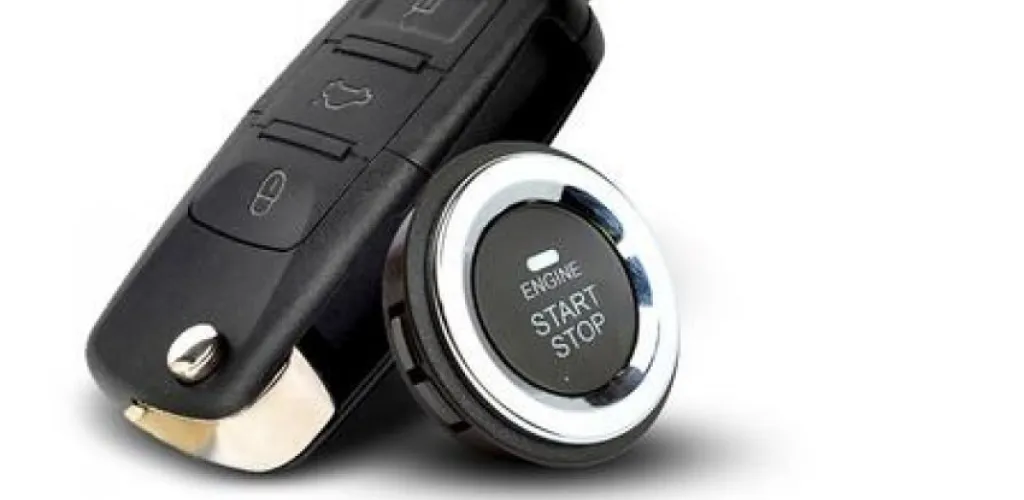
- Keyless start enables ignition via a proximity key fob and a start button.
- System uses external, internal, and steering area antennas to verify fob inside car.
- Authentication checks fob code against vehicle database before unlocking and starting.
- Emerged mid-1990s, Siemens pioneered; Mercedes-Benz popularized Keyless Go.
Keyless start systems have revolutionized how we interact with modern cars, eliminating the need to use a traditional physical key. This sophisticated technology combines elements of advanced security with user convenience, turning a simple gesture—pressing a button—into a complex process of authentication and vehicle activation.
Technology has evolved considerably from traditional keyed ignition systems and the classic ignition switch, which are now widely replaced with modern push-button keyless start systems. These are not only incredibly easy to operate, but they also offer superior security compared with conventional methods.
History and evolution of keyless systems
The keyless start system was initially developed in the mid-1990s by the technology giant Siemens and was first implemented in vehicles by Mercedes-Benz under the name Keyless Go. This innovation marked the start of a new era in automotive technology, where convenience and security merged in a revolutionary way.
Since its launch, the popularity of this technology has grown exponentially, being adopted by nearly all major automakers. Each brand has developed its own version and nomenclature for these systems.
Commercial names of the system
- SMART Key - Toyota, Lexus
- Keyless Go - Mercedes-Benz
- FAST Key - Mitsubishi
- Intelligent Key - Nissan, Infiniti
- Comfort Access - BMW
- Advanced Key - Mazda
- Push Button Start - Hyundai, Kia
- Proximity Key - Ford
How the system’s technology works
Key fob component
The key fob (remote in the form of a keychain) represents the heart of the system and contains:
- A radio transmitter with a specific frequency (usually 125 kHz or 13.56 MHz)
- A unique electronic tag (transponder)
- A small battery (usually CR2032 or CR2025) that powers the signal
- An encrypted chip with vehicle-specific security codes
Vehicle antenna system
The vehicle is equipped with multiple antennas placed strategically:
- External antennas: placed around the door handles to detect proximity
- Internal antennas: located in the cabin to confirm presence inside the vehicle
- Antenna in the steering wheel area: for final communication with the start button
Authentication and starting process
When you are near the vehicle, antennas around the car continuously emit low-level radio signals. The key fob detects these signals and responds with its own unique identification code.

The system checks this code against the vehicle’s internal database. If the code is valid, the system allows unlocking the doors with a simple touch of the handle (if the vehicle is equipped with this feature).
When you enter the car, interior antennas detect the key fob’s presence in the cabin and perform comparative calculations to determine its exact position. This triangulation process ensures the key fob is indeed inside the vehicle, not just nearby.

Engine start process
When you press the start button, the following sequence is triggered:
- Final verification of the key fob: the system confirms presence and authenticity of the remote
- Immobilizer deactivation: the receiver disables the engine immobilizer system
- Starting circuit activation: the electrical circuit required for starting is activated
- Engine start: the system engages the starter and the engine starts
Common problems and solutions
Dead key fob battery
If the key fob battery is dead, you may not be able to unlock the doors or start the car. Symptoms include:
- Delayed or nonexistent response to commands
- Having to hold the key fob very close to the vehicle
- A battery low indicator on the dashboard
Emergency solutions:

- Most manufacturers include a backup power source for starting
- The key fob usually contains a hidden physical key that can unlock the driver’s door
- Many vehicles have a dedicated area where the key fob can be placed to allow starting even with a dead battery
Loss of key fob
If you lose the key fob, the vehicle cannot be started using the standard system. In this situation:
- Contact an authorized service center to program a new remote
- The process typically involves erasing old codes from the system
- Costs can vary between 200-800 lei, depending on the vehicle make
Advantages and disadvantages of the system
Advantages:
- Superior comfort: no need to take the key out of your pocket
- Improved security: encrypted codes are hard to duplicate
- Additional features: many systems also support remote start
Disadvantages:
- Battery dependence: the key fob becomes useless when the battery dies
- High replacement costs: remotes are expensive to replace
- Vulnerabilities to electronic attacks: hackers can amplify the signal for theft
Future technologies
The auto industry is continually developing new technologies to improve keyless systems, including:
- Biometric authentication: fingerprint or facial recognition
- Smartphone integration: using the phone as a key fob
- AI-based systems: that learn user habits
Keyless start systems are a perfect example of how modern technology can improve the driving experience while offering a higher level of security and comfort.