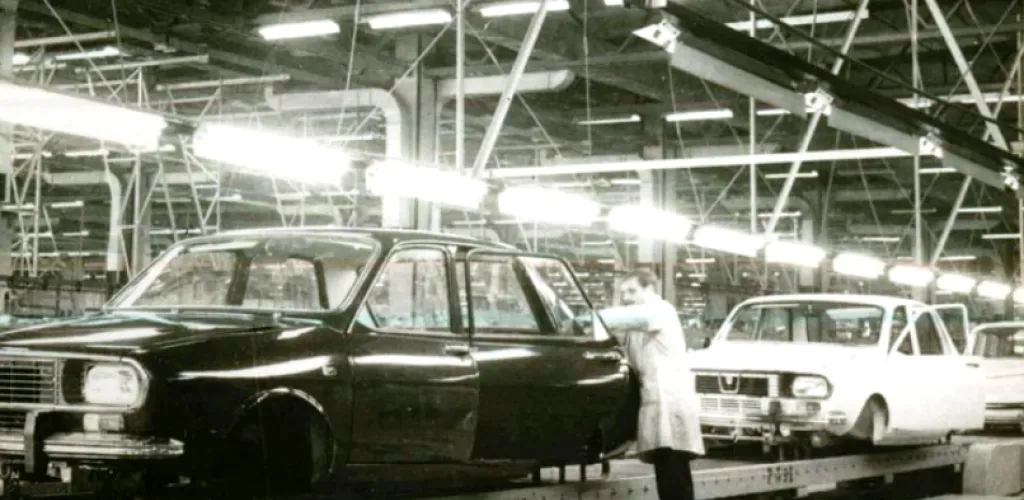
- Dacia signified social status; demand far outpaced supply and high costs.
- Official route: deposit at CEC and wait on long, opaque lists.
- Savings passbook offered car winnings: 2% of 4% annual interest, minimum 5,000 lei.
- Draws provided a chance to own car; many faced uncertainty and delays.
During the final decades of the communist regime, acquiring a Dacia was a near-impossible dream for most Romanians. Although demand far exceeded supply, astronomical costs and bureaucratic procedures turned car ownership into a real challenge. A car cost the equivalent of a full apartment, and for those without political connections or influence, the path to owning a vehicle was paved with almost insurmountable obstacles.
This article examines the official channels, social dynamics, and economic peculiarities of car purchases in late communist Romania, drawing on historical studies and archival sources.
The Economic and Social Context of Romanian Automobile Ownership
In the 1980s, Dacia had become a symbol of middle-class aspirations in Romania. The car was not merely a means of transport; it represented social status and freedom of movement in a society tightly controlled. Without a broad system of nepotism, connections, or political influence, for most people, even substantial financial effort did not guarantee the realization of this dream.
A detailed, well-documented study on Romanians’ attempts to purchase a locally produced automobile was published in 2013 in Caietele CNSAS (the semiannual journal published by the National Council for the Study of the Securitate Archives). The research, titled “Under the Temptation. The Automobile, Romanians and the Securitate in the 1970s–80s,” by historian Valentin Vasile, reveals the difficult and costly process ordinary Romanians endured to acquire a car.
Official Ways to Purchase a Dacia
Depositing at CEC with Waiting Lists
The first and most common method involved depositing money at the Casa de Economii și Consemnațiuni (CEC). According to Vasile’s study, “buying a new Romanian-made car was carried out within a clearly organized framework; those willing deposited at CEC either the full sum or a down payment of at least 50% and enrolled on waiting lists.”
This procedure meant waiting on interminable lists, where position and wait time depended on multiple factors, not always transparent. Many Romanians saw a lifetime’s savings blocked on these lists, with no guarantee they would ever receive the desired car.
Savings Passbook with Car Winnings
A more promising variant was the savings passbook with interest and winnings in cars. This financial instrument offered lucky individuals the unique chance to own a car without endless queues and waiting lists.
The system operated according to era-specific principles: “the savers of the respective passbook benefited as follows: from the 4% annual interest, 2% was awarded as winnings in automobiles, through quarterly draws, and 2% in cash,” explains historian Vasile.
To participate in these draws, the passbooks had to maintain a minimum balance of 5,000 lei, derived from deposits prior to the quarter for which the draw was made. In practice, this amount represented a down payment toward receiving the won automobile.
IDMS Auctions for Used Vehicles
The third option was auctions organized by Întreprinderea de Desfacere a Materialelor Sportive (IDMS). These events allowed interested buyers to purchase a vehicle already in circulation, with the advantage of possible installment payments.
This option was often preferred by those who could not wait years for a new car, opting to buy used vehicles at still considerable prices.

The Installment System and Social Differentiation
The communist regime had implemented a complex system of installment payments that differentiated between social categories. Workers and artisans, regardless of wage level or other incomes, could make a minimum down payment of 50% and pay the remainder in up to 20 monthly installments.
For other categories of staff with salaries up to 4,000 lei per month, conditions were stricter: a minimum down payment of 60%, followed by repayment of the remaining amount in up to 18 monthly installments, plus an annual interest of 5%.
Price Trends and Comparisons with Imports
The Prohibitive Cost of a Dacia
The price of a car manufactured in Pitești was truly prohibitive for the era. The cost started at 70,000 lei and, by the late 1980s, had reached 95,660 lei for the Dacia 1320 Standard. To grasp the magnitude of these sums, one must recall that the average salary was around 2,000–3,000 lei per month.
In 1974, during a meeting of the Central Council for Worker Control of Economic and Social Activity, the situation of sales and retail prices for the Dacia 1300 was discussed. The analysis showed that “the sale of automobiles was unsatisfactory, including on installments, due to the high price of the product.”
The Paradox of Cheaper Imports
A paradox of the planned economy was that imported cars were often cheaper and better equipped than the local production. A Moskvich 412 with a radio (1357 cm³, 50 HP, 5 seats) cost 59,500 lei, while a Dacia 1300 without a radio (1289 cm³, 54 HP, 5 seats) cost 70,000 lei.
This situation highlights the inefficiencies of the communist economic system, where market logic was subordinated to centralized planning and political objectives.
Attempts to Lower Prices and the Authorities’ Response
Because sales were unsatisfactory, auto industry specialists proposed a logical solution: lower prices. Increasing efficiency and sales volumes could be achieved by reducing prices from 70,000 lei per unit to 55,000 lei, with distribution through the company’s service units.
The proposal was forwarded to the head of state, Nicolae Ceaușescu. The response was categorical and revealing of the era’s mentality: “IT IS NOT advisable to reduce prices,” according to documents cited in the CNSAS study.
Special Models and the Privilege System
Despite the high prices for the ordinary population, there were exceptions for the privileged categories of society. Constantin Stroe, former director at Dacia, revealed in 2011 to Adevărul the existence of customized models for officials or influential individuals.
“I investigated who pushed this idea, and it’s the same people from party politics, those in the intelligence system who wanted to curry favor with the bosses in Bucharest: ‘Lie low, comrade, your car will be watched by me,’” Stroe said.
Stroe explained that “the individual’s psychological experience was living with the illusion that his car would be superior to the standard model.” In reality, most of the “watched” cars suffered unseen damage and subtle interventions that made them run worse than standard models.
Social and Economic Consequences of This System
The system for purchasing cars during the communist period had deep effects on Romanian society. On one hand, it created a black market and a parallel system of exchanges and favors. On the other hand, it contributed to widening social inequalities, where access to luxury goods depended more on political connections than merit or financial means.
The growing demand for the Dacia 1300 in the second half of the 1980s, despite prohibitive prices, demonstrates Romanians’ desire to improve their quality of life and to gain a certain degree of mobility in a tightly controlled society.
For ordinary Romanians, buying a Dacia was not only a major financial commitment but also an act of hope for a better future — a hope that, for many, remained unfulfilled until the fall of the communist regime in 1989.