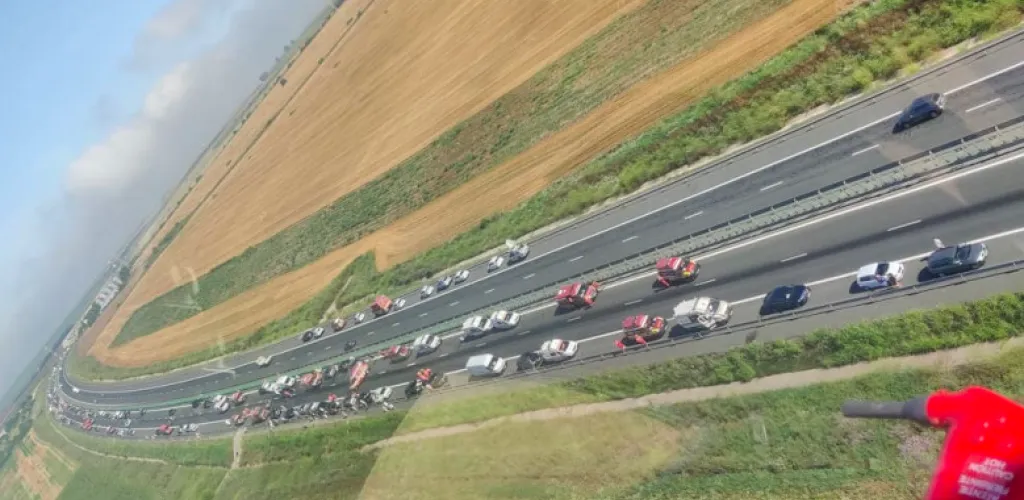
- Maintain 50–130 km/h, reduce to 80 in bad weather; adapt to traffic.
- Prepare entry: signal early, use acceleration lane, reach 90–100 km/h before merging.
- Merging priority: yield to lane 1 traffic; don’t force entry; check mirrors/blind spots.
- After entering, stay in lane 1; lane 2 is for overtaking only.
Romania records a troublingly high number of highway accidents, even though these roads are modern, with no intersections and excellent visibility. Paradoxically, the very characteristics that should make the highway safer become dangerous when drivers do not follow traffic rules. High speeds, abrupt maneuvers, and failure to respect priorities turn minor errors into serious accidents. In this comprehensive guide, we explain step by step how to drive correctly and safely on the highway.
Speed on the Highway - Limits and Recommendations
- Minimum speed: Never drive slower than 50 km/h on the highway. Slow vehicles pose a major danger as they create large speed differences between road users.
- Legal maximum speed: 130 km/h under normal road and visibility conditions.
- Speed in adverse conditions: Reduce speed to a maximum of 80 km/h when weather is unfavourable (heavy rain, fog, snow, or ice).
Note that speed must be continuously adapted to traffic conditions, not only to legal limits. Even if the law allows 130 km/h, if traffic is heavy or visibility is reduced, your speed should be lower.
How to Enter the Highway Safely
Preparation for Entry
- Signal your intention to enter the highway well in advance by activating the left turn signal.
- Use the acceleration lane at maximum capacity — it is specifically designed to help you reach the required speed.
- Accelerate strongly until you reach approximately 90–100 km/h before merging onto lane 1.
Merging into Traffic
- Give absolute priority to vehicles already traveling in lane 1. They have the right of way and are not obliged to yield to you.
- Do not force entry; if there isn’t enough space, continue on the acceleration lane until you find a safe gap.
- Visually check using your mirrors and by blind-spot observation to ensure you do not cause anyone to brake suddenly or change lanes.
- Never stop at the end of the acceleration lane. If you have not managed to merge, proceed with caution but do not use the emergency lane to wait.
After Entering the Highway
- Stay in lane 1 until you reach a stable speed that allows you to drive in flow or safely perform overtakes.
- Do not merge directly onto lane 2 after entering — that lane is for overtaking, not normal traffic flow.
Essential Rules for Highway Driving
Correct Use of Lanes
Lane 1 (the right-hand lane) is the main driving lane. You should drive here normally, even if you are alone on the highway and there are no vehicles in front.
Lane 2 (the left-hand lane) is exclusively for overtaking. Do not drive continuously on this lane! After you have completed the overtaking, return to lane 1. Prolonged driving on lane 2 is illegal and extremely dangerous, because:
- It blocks faster vehicles trying to overtake
- It forces other drivers to overtake you on the right, which is dangerous
- It exposes you to fines and penalty points
Lane changes and overtakes
- Always signal your intention to change lanes a few seconds before the maneuver.
- Check three times: rearview mirror, side mirror, and blind spot with a direct glance.
- Do not rely on speed limits — even if you travel at 130 km/h (the legal max), there may be vehicles going faster. Ensure no one is approaching from behind at higher speed before entering lane 2.
- Let faster vehicles pass — after they have overtaken, you can safely move into the overtaking lane.
- Complete the overtaking and return to lane 1 only after you have safely passed the target vehicle.
Watch for vehicles entering the highway
- Be careful with vehicles trying to enter the highway from the acceleration lanes.
- Do not brake abruptly to allow entry — this can cause chain rear-end collisions.
- If possible and safe, switch to lane 2 to facilitate their entry, but only if you can do so without compromising safety.
- If you cannot change lanes, maintain a constant speed — the entering vehicle has the obligation to merge safely behind you.
The emergency lane
Never use the emergency lane for driving! This lane is strictly reserved for:
- Emergency vehicles (ambulance, fire, police)
- Urgent stops in case of severe mechanical failure
- Situations of force majeure
Driving on the emergency lane is illegal and extremely dangerous.
How to Exit the Highway
Preparation for Exit
- Exit is made only through specially designated areas — deceleration lanes are clearly signposted several hundred meters before.
- Move to lane 1 in advance if you are not already on it, at least 1–2 km before the desired exit.
- Watch the exit signs — usually there are three boards: at 1000 m, 500 m, and at the exit itself.
Executing the Exit
- Signal your intention to exit by activating the right turn signal.
- Enter the deceleration lane when it appears and only then start reducing speed.
- Do not brake in lane 1 — the deceleration lane is designed to reduce speed safely.
If you miss the exit
- You are OBLIGATED to continue the road to the next exit — there are no exceptions to this rule!
- Do not turn around on the highway — extremely dangerous and illegal.
- Do not reverse — neither on the highway nor on the emergency lane.
- Do not stop in the emergency lane with the intention of waiting for a gap in traffic to reverse.
These maneuvers are extremely dangerous and can lead to fatal accidents. The time difference until the next exit is small compared to the risk of a serious crash.
Conclusions and Final Tips
- Adapt your speed to conditions, not just limits.
- Use lane 2 only for overtakes.
- Signal all maneuvers.
- Respect the priorities when entering the highway.
- Do not improvise when exiting the highway.
- The emergency lane is prohibited for driving.
Driving on the highway becomes safer and more enjoyable when all drivers follow the same rules. Be responsible and contribute to everyone’s safety!