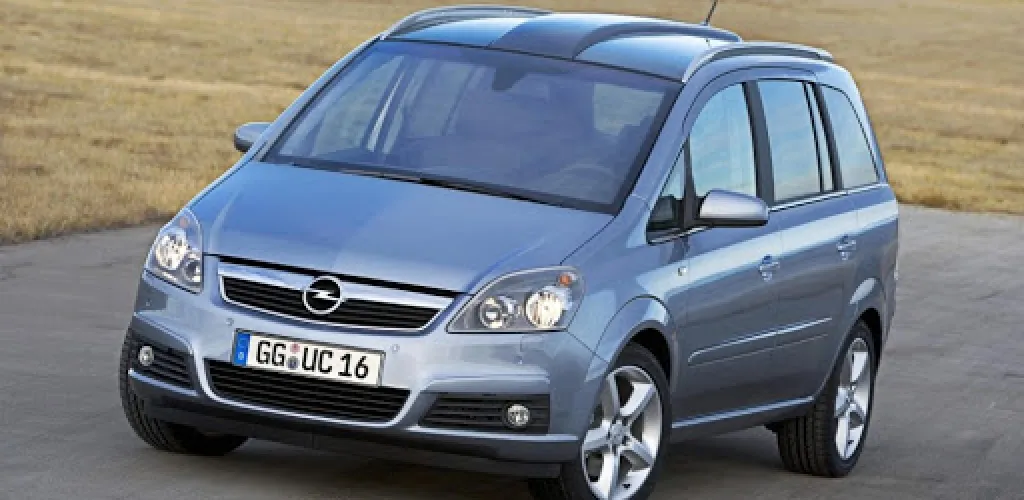
- Shares the T platform with Astra G; finished third in 2000 Car of the Year.
- Major update in 2000 replaced X engines with Z generation to meet Euro 3.
- Facelift in February 2003; OPC turbo introduced around 2001.
- Owners praise spacious seven seats; diesel, brake, and electrical issues common.
Opel Zafira A, the first generation of Opel’s compact MPV, marked the German brand’s entry into the compact minivan segment. Developed with Porsche support and unveiled as a concept at Frankfurt in 1997, this model demonstrated that versatility can come with Opel’s characteristic reliability. Based on the same T platform as the Astra G, the Zafira A managed to secure third place in the 2000 European Car of the Year competition, confirming its quality against European rivals.
We analyzed real experiences from Zafira A owners to provide a complete picture of this MPV—from common issues to real-world fuel consumption and driving impressions on Romanian roads.
What made the Zafira A special on the car market at that time
Zafira A was built on the same T platform as the 1998 Astra G, sharing many components with that car. Initially offered with a range of petrol engines and a single diesel option, the model benefited from a major update in 2000 when the X engines were replaced with the new Z generation. These new powerplants featured variable intake manifolds and could meet Euro 3 emissions standards — a notable technical achievement for the era. A facelift launched in February 2003 completed the model’s evolution.
Reasons why owners chose the Zafira A
To better understand this model, we analyzed responses from Zafira A owners who left reviews on the DailyDriven platform.
Corneliu Ciurea, owner of a 2.0 16V DTI (101 HP) version, explains his choice: “Spacious, 7 seats, fairly reliable, relatively low price, simple construction, a commonly seen model on the market, so a lack of spare parts is unlikely.”
Florin, who drives a 1.8 16V (125 HP) version, shares: “My parents bought it about 8 years ago; they liked it, generally they needed a larger car, spacious and basically a family car to get things done.”
Marian Sebastian sums it up: “Has 7 seats/large boot” — a clear priority for many minivan buyers.

Common problems found on the Opel Zafira A
Based on the analysis of multiple owner experiences, four main problem areas were identified:
Diesel fuel system
- Injection pump: The most commonly reported major issue
- Injectors: They can develop problems over time, affecting engine performance
Braking system
- Brake pads require regular replacement
- System components can wear over time
Electrical issues
- Sensors and actuators can cause minor problems
- Electronic systems may require extra attention on high-mileage cars

Range of engines available
Zafira A offered a diverse range of powertrains, from economical units to a performance variant:
Gasoline engines
- 1.6 16V: Base variant, economical and reliable
- 1.8 16V (125 HP): Ideal balance between performance and consumption
- 2.2 16V (147 HP): For those seeking more power
Performance version
Introduced at Geneva in February 2001, the Zafira OPC turbo went on sale in October 2001. With 192 HP (141 kW), this was the fastest version marketed in Europe. Available only with a five-speed manual transmission, it accelerated from 0–100 km/h in 8.2 seconds and reached a top speed of 220 km/h.
Diesel engines
- 2.0 DTI (101 HP): The initial diesel engine, popular for economy
- 2.2 DTI (125 HP): Introduced in January 2002, offering more power
Driving experience under different conditions
City driving presents both advantages and disadvantages specific to this MPV.

Urban behavior
Ciurea Corneliu describes the urban experience: “It drives easily and fairly comfortably, but the weak point is the blind spot caused by the A-pillar.”
Marian Sebastian confirms: “Quite easy to drive; it doesn’t let you down,” while Florin adds: “Very easy, you can weave through traffic; it’s a decent city car.”
Long-distance performance
On highways and main roads, the Zafira A shows its family MPV strengths. However, Corneliu points out practical aspects: “On long trips, if it doesn’t have cruise control it becomes tiring for the right foot. Also, if it lacks a center armrest it’s tiring for the hands.” The engines run with reasonable noise levels and offer decent comfort at cruising speeds, making the Zafira A a viable option for family travel.
Real-world fuel consumption reported by owners
The consumption analysis based on owner experiences provides a clear picture of the efficiency of these engines:
Engine 1.8 16V (125 HP)
- Mixed consumption: 8.7 L/100 km (Marian Sebastian)
- Urban consumption: 8–9 L/100 km (Florin) / 12 L/100 km (Marian Sebastian)
- Extra-urban consumption: 6–7 L/100 km (Florin)
Variations in consumption are due to driving style, traffic conditions, and the vehicle’s mechanical condition.

Long-term reliability analysis
Experience with the 2.0 DTI diesel engine
Ciurea Corneliu, owner of a diesel version, reports: “The main issue was the injection pump. Minor problems such as brake pads, filters, sensors, and actuators also occurred, which were resolved by cleaning or adjusting mechanisms. These are normal problems for a car with this mileage.”
Experience with the 1.8 gasoline engine
Florin, with a gasoline version, notes: “Regarding issues, in the last 2 years I’ve had a lot of problems with it; it also suffered two accidents caused by my father not paying attention on the road, which meant the front end was replaced and I also had some engine issues.”
Current price ranges on the used market
Based on listings on specialized platforms, a 2005 Opel Zafira A with the 1.8i 125 HP engine and around 250,000 km is listed around €2,350. Prices vary depending on:
- Overall mechanical condition
- Recorded mileage
- Available equipment
- Maintenance history
- Sale region
Essential tips for buyers
Advice from experienced owners
Ciurea Corneliu recommends: “Choose a car with armrests, as they’re important on long trips, and check the injection pump’s condition, have all windows up, and ensure the climate control system works. Preferably the EGR system should be mechanical since it’s more reliable.”
Florin adds: “Be aware that the car can leave you stranded at any moment if you don’t maintain it and don’t replace everything due on time. The interior and exterior should be in good condition, and of course the engine—no oil leaks; everything should be as it should be.”
Essential checks list
- Diesel injection system - check the pump and injectors operation
- Comfort features - armrests, air conditioning, power windows
- Overall mechanical condition - no oil leaks, clean engine
- EGR system - mechanical variant preferred
- Maintenance history - proof of regular servicing
Conclusion
The Opel Zafira A remains a solid choice for families seeking a practical and affordable minivan. While it shows some age-related issues, particularly in the diesel fuel system, its versatility and reasonable maintenance costs keep it relevant on the used-car market. The key to success is selecting a well-maintained example and sticking to the recommended service schedules.