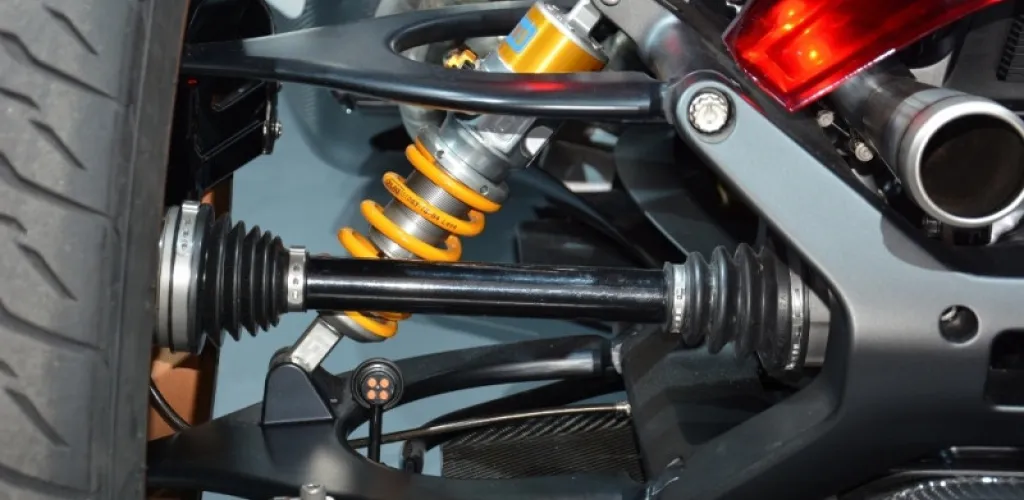
- Sport suspensions improve look and handling, lowering cars for sportier stance.
- Advantages include better high-speed stability, cornering grip, and aerodynamics.
- Trade-offs: stiffer ride, reduced comfort, and lower clearance risks like oil pan strikes.
- Sport springs offer affordable height reduction (15–60 mm; 30–45 mm max) with stock dampers.
Sport suspensions are among the most popular modifications for car owners, a trend that shows no signs of slowing down and that brings both aesthetic benefits and improved performance. In this comprehensive guide, we will explore all types of sport suspensions available on the market, from simple sport spring solutions to the more complex air-ride and hydraulic systems.
On roads in Romania and around the world, more and more cars are sitting lower, evidence that this modification meets both the aesthetic desires and the practical needs of passionate drivers.
Why opt for sport suspensions
Advantages of sport suspensions
Aggressive and sporty look represents the first and most evident improvement. Cars with reduced ground clearance look much more sporty and imposing, with a stronger presence on the road.
Stability at high speeds improves considerably, the car feeling much more “glued” to the road. A lower center of gravity reduces lateral weight transfer in corners, which translates into more predictable and safer handling.
Improved aerodynamics contributes to lower fuel consumption at high speeds (above 120 km/h), as air resistance is reduced by the car’s lower profile.
Stability in corners is far superior, with the car largely eliminating body roll during turns, acceleration, or braking. Vehicle controllability increases significantly, providing a more sporty driving experience.
Disadvantages to consider
Reduced comfort is the main trade-off, sport suspensions are generally stiffer and less comfortable than stock setups. On roads with many bumps, this can become a real issue.

Lower ground clearance requires extra care to avoid hitting the front bar or, more seriously, the oil pan. In models like the VW Passat B5.5 or Golf 4, the oil pan sits very low from the factory, and with sport suspensions the risk of striking it increases considerably.
Sport springs - an affordable solution
Sport springs are the starting point for most enthusiasts who want to modify the car’s ride height. This solution “satisfies both goals” by offering an affordable price and a reasonable compromise between performance and comfort.
Technical characteristics
A set of sport springs can reduce ground clearance by 15-60 mm depending on the model, but specialists recommend not exceeding a reduction of 30-45 mm on factory dampers. The reason is simple: once their travel is reduced, the car becomes less comfortable and the dampers wear prematurely.
A shorter spring is automatically stiffer, because the suspension no longer accepts the same travel it had in the standard configuration. The damper travel reduces on the compression side, while on the extension side it must be preserved to maintain optimal functionality.
Most sport springs fit perfectly with stock dampers, without affecting functionality, and comfort remains similar because the damper travel is not dramatically reduced.

Sport suspensions complete (shock absorbers + springs)
For those with a bigger budget who want the car even lower, a complete sport suspension kit (springs + shocks) is the ideal solution. This option targets those who want both the look and a handling that matches the new stance.
When you need sport dampers
If you install sport springs that lower the car by 45 mm, the damper travel will also be reduced by the same amount. In many cases, this reduction remains within acceptable limits, and the damper can cope with loading and uneven surfaces.
The issue arises when you opt for shorter springs or when stock dampers already have a longer travel. In these situations, the spring can detach from the damper under certain conditions, producing annoying noises and compromising safety.

Advantages of sport dampers
Sport dampers have shorter travel, allowing the use of even shorter springs without technical problems. A shorter spring means less resonance during rapid compression and rebound.
Sport dampers are stiffer and typically have a longer lifespan than stock ones when paired with appropriate sport springs. The drawback is that you start to lose some of the standard suspension comfort.
Adjustable suspensions - for connoisseurs
Height- and stiffness-adjustable suspensions represent the top tier of modifications. They are suitable for both sporty driving and race applications.
Adjustable kits include both springs and dampers strengthened to achieve a higher level of performance. The [spring] is smaller in diameter and does not produce resonance, while the damper rod is thicker, allowing the assembly to better withstand the demands of sporty driving.
Adjustment principles:
- A stiffer spring will shake the chassis more, but will reduce body roll
- A stiffer spring will reduce the damper’s rebound time
- A soft spring will not bounce the car at the slightest bump
- A soft spring will increase body roll and may increase [stopping distance]
- The damper should be stiffer on ascent than on descent
- If the damper is too stiff on descent, the car will have traction issues
Air Ride - comfort meets versatility
For those who want to maintain comfort and practicality, air-ride suspension is the premium solution. This complex system offers the best combination of sporty appearance and daily usability.

Components and how it works
The air-ride system consists of:
- Air bags that replace traditional coil springs
- Air compressor to power the system
- Air reservoir for stored compressed air
- Valves to control pressure in each bag
- Hoses and lines to connect components
- Electronic control system to manage the whole setup
Advantages of the air-ride system
Exceptional comfort is the first major benefit. Even very stiff factory cars are transformed once air bags are installed. Owners report a driving experience where you feel like you’re almost floating.
Versatility in use allows leaving the car “on the ground” for appearance, then raising it quickly for practicality. The lifting operation takes up to 1-2 minutes on standard systems and only a few seconds on high-performance setups.
Dynamic adjustment provides an impressive range – from 0 to maximum pressure, ground clearance can increase by roughly 4x, offering an unparalleled flexibility compared with static suspensions.

Disadvantages and costs
High price is the main drawback. A quality system can cost over 2000 euros without installation, approaching 3000 euros with professional installation.
Component durability varies — bags have a lifespan of 2-5 years depending on usage, though many owners report better performance than these estimates.
Necessary maintenance includes:
- Full annual system and bag inspection
- Draining accumulated condensate
- Checking and replacing air filters
- Inspecting the tightness of all connections
Hydraulic suspensions - a niche solution
Hydraulic systems operate on principles similar to air but use special telescopes and hydraulic fluid instead of compressed air. These systems are used less commonly in Romania, being more typical of the American tuning scene, which is why we will not go into extensive detail here.
The main difference lies in response speed — hydraulic systems can lift or lower the car almost instantly, making them popular for show and demonstration purposes.
How to choose the right suspension
For a limited budget
If you have limited financial resources but want a more stable car, sport springs are the best option. They offer a notable improvement in handling without significantly compromising comfort.
For daily driving
If you want a lower car but still need to drive daily (to clear small curbs, and not worry about canal covers), and the budget allows, air-ride suspension is the ideal choice.
The middle ground
A reg adjustable suspension “boths sides” offers a reasonable compromise between all aspects: cost, performance, looks, and practicality.
Important considerations
Regardless of the option chosen, you should keep in mind that:
- The car will need a wheel alignment recheck
- Handling will change and will require an acclimation period
- Maintenance costs will rise depending on the system’s complexity
- Expert consultation for fine tuning is essential
In conclusion, the choice of suspension type should be made based on budget, needs, and driving style. Each solution has its advantages and disadvantages, and the final decision depends on each owner’s priorities.
Photo sources: hondaprokevin.com, kelownatoyota.com, autoaccessoriesgarage.com, carid.com, x2industries.com