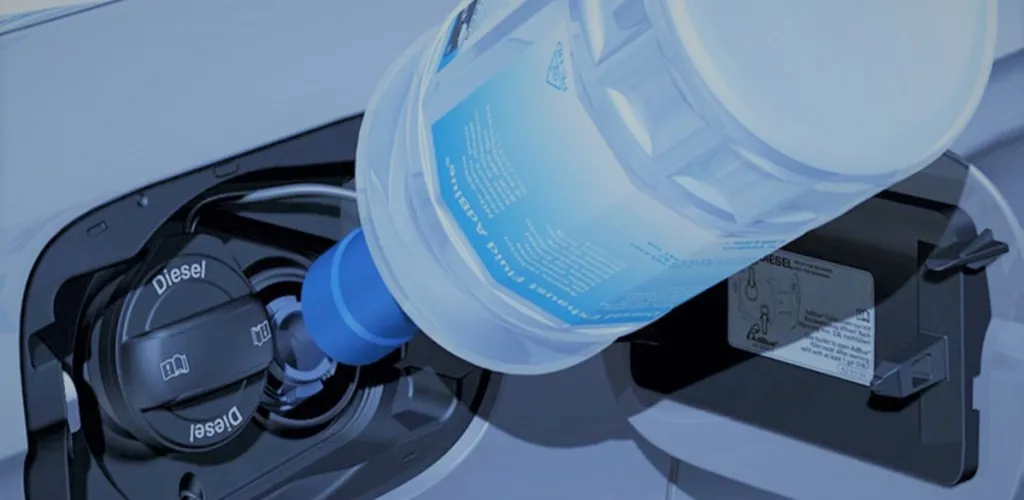
- Adding water to AdBlue can cause €3,000–€8,000 damage.
- AdBlue is 32.5% urea and 67.5% deionized water; tap water damages the system.
- Contamination triggers ECU power reduction, emergency mode, possible stalling or not starting.
- Damaged components include AdBlue injector, SCR catalyst, sensors, DPF, and lines.
When the car runs out of AdBlue and won’t start, many drivers consider topping up the reservoir with water as a temporary fix. This is, however, one of the most expensive mistakes you can make with your diesel vehicle.
This is, however, one of the most costly mistakes you can make with your diesel vehicle. Adding water to the AdBlue system can cause thousands of euros in damage and can completely compromise the exhaust emission control system.
What is AdBlue and why does it contain water
The AdBlue system plays a vital role in the proper operation of modern diesel engines. While AdBlue does indeed contain water, it is deionized water in an exact mix to the manufacturer’s recommended proportions — 32.5% urea and 67.5% deionized water.
The fundamental difference lies in the quality of the water used. Deionized water has undergone a purification process that removes minerals and ions, whereas ordinary tap water contains minerals and ions that are highly detrimental to the exhaust treatment system.
How the SCR system works
Selective Catalytic Reduction (SCR) is the technology behind AdBlue. It injects AdBlue into the exhaust gas flow, where the urea thermally decomposes and forms ammonia. The ammonia then reacts with nitrogen oxides (NOx) in the exhaust gases, converting them into nitrogen and harmless water vapor.
This process requires very precise chemical conditions. Any contamination can disrupt the chemical reactions and can damage catalytic components.
The devastating consequences of adding water
Immediate damage to the system
When tap water enters the AdBlue reservoir, the minerals and ions are rapidly absorbed into the SCR system. These impurities react directly with the catalytic converters and progressively destroy them.

Effects on engine performance
When the SCR system is compromised by improper chemicals, a cascade of events is triggered:
- The AdBlue system sends a signal to the Engine Control Unit (ECU)
- The ECU automatically reduces engine power to limit NOx production
- The vehicle enters a reduced-power emergency operating mode
- Eventually, the engine may stall and refuse to start
Affected components
Water contamination can damage:
- AdBlue injector
- Injection lines and rails
- AdBlue quality sensor
- SCR catalytic converters
- DPF filters (diesel particulate filter)
The dramatic financial costs
Repairing an AdBlue system contaminated with water can cost between €3,000 and €8,000, depending on the make and the extent of the damage. This includes:
- Replacing the AdBlue reservoir
- Replacing the injection system
- Replacing the SCR catalytic converter
- Replacing sensors and electronic components
- Flushing and cleaning all lines
- System recalibration
Repair time can exceed a week, as specialized parts often need to be ordered specifically.
Signs that the system has been contaminated
If you accidentally added water to the AdBlue reservoir, watch for these symptoms:
- Error messages on the dashboard
- Reduced engine power
- Irregular engine operation
- Inability to start after a certain period
- Unusual odor from the exhaust system
What to do if you added water by mistake
If you realize the mistake immediately after adding water:
- Do not start the engine — this is essential to limit damage
- Contact an authorized service center immediately
- Request complete draining and flushing of the system
- Let professionals assess the damage
Correct alternatives in emergency situations
When you run out of AdBlue and cannot find it nearby:
- Contact a mobile service that can bring AdBlue to your location
- Use apps to find the nearest AdBlue stations
- Call roadside assistance
- Do not attempt to drive without AdBlue — the engine will shut down anyway
Conclusion
Adding water to the AdBlue reservoir is never a solution, regardless of the emergency. Repair costs can exceed the value of older vehicles, and downtime can significantly impact your schedule. Investing in an original AdBlue bottle is always cheaper than repairing a contaminated system. Following the manufacturer’s specifications and using only AdBlue-certified products are essential to maintaining optimal operation of the modern diesel vehicle.