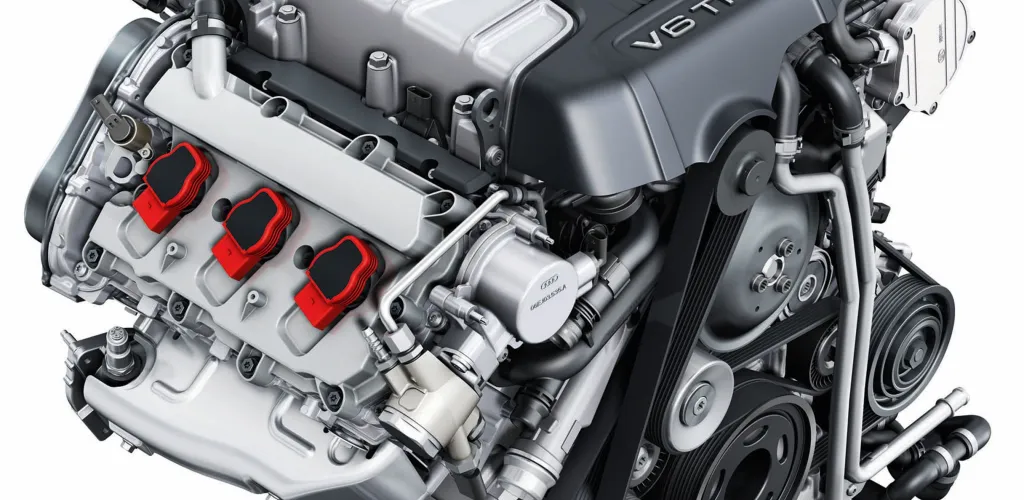
- FSI, TSI, and TFSI are VW Group direct-injection gasoline engines.
- Direct injection yields better efficiency and performance than conventional engines.
- TFSI adds turbocharging to FSI for higher efficiency and power.
- In the USA, sulfur in gasoline harmed catalytic converters, reducing adoption.
The FSI, TSI, and TFSI engines have transformed the automotive industry by introducing direct injection, delivering improved performance and lower fuel consumption. These gasoline powertrains developed by the Volkswagen Group (VAG) have become the standard for most models in the German group’s portfolio.
By understanding the technical differences between these three engine types, you’ll be able to make an informed choice when buying a vehicle equipped with one of these powertrains.
The Meaning of the FSI, TSI, and TFSI Acronyms
FSI stands for the “fuel stratified injection”, TSI means “turbo stratified injection”, and TFSI stands for “turbo fuel stratified injection”.
All three of these engines are gasoline and originate from the VAG group. FSI introduced a new fueling system to the market — whereas previously fuel was sprayed into the intake manifold, the new technology sprays gasoline directly into the combustion chamber.
Advantages of Direct Injection Technology
By making this fundamental technical change, FSI, TSI or TFSI engines are more efficient in fuel consumption, deliver higher performance, and have better dynamics than conventional engines.
For technical numbers: with 1 kilogram of injected gasoline, 14.7 kg of air are burned, or the equivalent of about 12,400 liters.
Disadvantages of FSI Technology
All these benefits come with a drawback, though. In conventional engines, one liter of gasoline adds far less air; FSI improves the mixture and can increase carbon emissions significantly.

For this reason, the VW Group did not have success with these engines in the USA, where gasoline contains a lot of sulfur that damages catalytic converters, and as a result people stopped buying FSI, TSI or TFSI engines.
The TFSI Engine - The Natural Evolution of FSI Technology
TFSI is an FSI engine with an added turbocharger. Thanks to a richer air–leaner fuel mixture, the FSI technology managed to solve a major problem of older turbo engines.
Old turbocharged cars suffered from spontaneous ignition of gasoline inside the cylinder long before ignition was necessary according to engine operating parameters. The turbo would heat the air very hot and create hot spots inside the cylinder that ignited the fuel spontaneously and uncontrollably.
With the advent of TFSI, this phenomenon disappeared. TFSI brought to the market an engine with a high compression ratio, very high thermodynamic efficiency, and reduced fuel consumption.

Characteristics of the FSI Engine
It is a gasoline engine with direct injection, meaning the fuel is sprayed directly into the combustion chambers. This technology is thermodynamically superior and improves engine efficiency. FSI engines improve engine performance and offer better dynamics. Whether they have 4, 5, 6, 8, 10 or 12 cylinders, all current Audi gasoline engines use the FSI system.
Technical Comparison: FSI vs TSI
Similarities Between FSI and TSI
- Displacement: 1984cc
- Maximum power: 200 hp
- Maximum torque: 206 Nm
- Valves per cylinder: 4
- Bore (inner diameter): 82.5 mm
- Stroke (inner): 92.8 mm
- Firing order: 1-3-4-2

Improvements Brought by TSI Over FSI
- Timing chain vs [timing belt]
- Compression ratio: 9.6:1 vs 10.5:1
- Engine management: Bosch MED 17 vs MED9
- 3 oxygen sensors vs 2
- The oil is sprayed as jets at the bottom of the pistons to improve cooling and lubrication
- A better-balanced camshaft
- fuel delivery system improved
- Modified piston crown
- Internal parts modified to reduce parasitic losses
- Improved PCV system
It’s not hard to see that the TSI engine is an enhanced and much more capable version of the FSI.
Known Issues of TFSI Engines
Older versions of TFSI engines fitted to A5, A4 and Q5 models suffer from a factory fault that leads to high oil consumption.
The issue appears to relate to the piston rings that allow small amounts of oil to pass into the cylinders; these amounts burn and thus oil consumption increases. Drivers notice this when the oil level indicator lights up on the dash.
When the warning indicates you should top up the oil, you shouldn’t stop immediately, but you will soon need to add engine oil.
Engines Affected by the Oil Consumption Issue
The 2.0 and 1.8 TFSI engines built before 2012 are affected, with engine codes CAEB, CDNC, and CNDC.
Problems of TSI Engines
TSI engines power the majority of VW vehicles built between 2008 and 2015. TSI engines are also fairly problematic, with issues mainly at the level of spark plugs and ignition coils.
If you own a TSI engine and hear unusual engine noises, you may have PCV valve problems. Many drivers have complained about the intake manifold and the fuel pump.
TSI vs TFSI: Practical Differences
The difference between these engines is simple: both operate on the same principle, but TSI engines power VW models while TFSI engines power Audi models.
FSI vs MPI: Which Technology Is Superior?
Many of you have probably wondered what the difference is between FSI and MPI. MPI uses multi-point injection, whereas FSI uses direct injection. In MPI, gasoline is drawn from the tank by an electric pump and delivered to the injectors via the fuel rail, while FSI uses a different intake manifold.
Real Opinions from Car Owners
Owner Golf 5 1.4 FSI: “I’d drive it nonstop; I really enjoy how well we get along on long trips. What I like is its reliability, and when the engine is well maintained it is very quiet and surprisingly powerful for its capacity.”
Owner Audi A3 1.4 TFSI: “Requires 98 octane gasoline, oil consumption only if you drive constantly; 500–700 km, I added 150 ml for this distance and the suspension is a bit stiff.”
Owner Golf 6 2.0 TSI: “It’s super fast, I’ve driven diesel with 200 hp, but petrol is amazing; at the moment I have a problem with an air sensor and it consumes a bit more.”
Owner Golf 6 1.2 TSI: “I’ve had only minor issues in almost 200,000 km, luckily with it. I’ve replaced bearings, burned-out bulbs, brake pads and other wear items; nothing very expensive or hard to repair.”
Owner Audi A5 2.0 TFSI: “The car was pleasant to drive, fun, stable, you could do many things with it; it was well thought out, but the 2.0 TFSI powertrain was a disappointment. Factory issues with segments, oil consumption medium to high (about 1 liter every 1,500–2,000 km), weak components (ignition coils, PCV valve). In terms of reliability I encountered several problems (alternator pulley, front axle arms, wheel bearings, anti-roll bar links, valve seals) in a relatively short time (about 1 year), which caused constant fear of another trip to the shop.”
Owner Golf 5 1.6 FSI: “I feel at ease every day. It’s like riding a bike. I dislike one part: lambda sensor 2 with NOx sensor; I replaced it. But the problem was that it was expensive in Romania and in Germany I bought it for half the price (new).”
Photo sources: autosessive.com, pinterest.com, blog.moddedeuros.com, jennings-vw.com