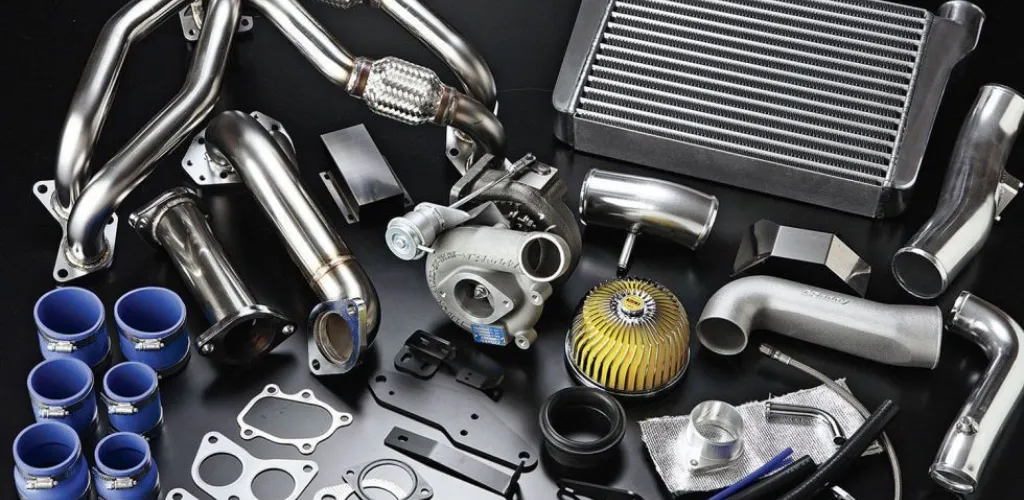
- Turbocharger compresses intake air using exhaust-driven turbine to boost power
- Intercooler cools compressed air to improve engine efficiency and prevent overheating
- Wastegate controls turbine speed to protect both turbo and engine
- DailyDriven offers turbocharger repair, inspection, and reconditioning services
Turbochargers are among the most complex and sensitive components of modern engines. Understanding how they work and their maintenance needs can make the difference between an expensive repair and long-term trouble-free operation.
DailyDriven offers turbocharger repair, inspection, and reconditioning services. If you prefer not to read the entire article, you can contact us directly using one of the two icons at the bottom of the screen, or by phone at 0790449291.
Just as our ancestors knew the role of every bolt on the old Dacia, it is very important for us to understand at least a few things about the major components of the engine.
What is the turbocharger and how does it work?
The turbocharger was invented in 1905 by a Swiss engineer who was the first to use forced induction—air boosted into the intake. Since its inception, turbochargers have been used in all fields involving internal combustion engines, from cars to ships and airplanes.
A modern turbine consists of a shaft that has on both ends two turbine wheels. They are housed in a snail-shaped housing and their role is to guide exhaust gases and to compress the air that will enter the intake.

Working principle of the turbine
The operating principle of a turbine is not overly complicated. A turbine is made of two distinct parts:
- Hot side - located on the exhaust
- Cold side - located on the intake
Exhaust gases produced by the engine enter through the intake of the hot side. Thanks to the very small gap between the turbine housing and the shaft, pressure is created that, in turn, spins the turbine blades. The turbine is thus driven by the energy of the exhaust gas.
Because the wheel on the intake side and the wheel on the exhaust side are connected by a common shaft, they rotate at the same speed, but they have different sizes. The wheel on the intake side draws air from the atmosphere, compresses it, and forces it into the intake.

Essential auxiliary components
To allow the turbo to operate at maximum parameters and not affect the engine, several components must be added to this turbocharging system:
Intercooler - a special radiator that cools the air before it enters the engine. The air heats up when compressed, and this radiator ensures a larger flow of oxygen for the engine, protecting it from overheating.
Wastegate valve - also known as the exhaust outlet, this valve vents excess exhaust gases. It limits and controls the rotation speed of the turbine shaft to protect both the turbo and the engine.
Advantages of the turbocharged engine
Recently, major car manufacturers have shifted to turbo engines, both diesel and petrol. The reason is the much higher efficiency of the turbo engine.

Concrete performance examples
Gasoline engines:
- 1.8 L naturally aspirated (NA): 90-110 hp
- The same engine with a turbo: around 180 hp (almost double)
Diesel engines:
- 1.9 L diesel NA: 68-75 hp
- The same engine with a turbo: 150-180 hp and a much higher torque
Disadvantages and considerations
Disadvantages of a turbo engine are not many; reliability declines slightly, but this mainly happens due to drivers who do not know how to maintain and drive a turbocharged vehicle.
How to take care of your car’s turbo
Turbocharged cars have become more common, and it is very important to know how to use a turbo car correctly.
The importance of an oil change
One extremely important thing is the oil change. Besides lubricating the engine’s internal components, the turbo is also lubricated and cooled by the same oil.
It is crucial to always have fresh oil in the engine, because old oil full of deposits will circulate poorly. This affects the main shaft of the turbo, considering that the turbo blades spin at over 150,000 rpm.

Old oil becomes less viscous and will flow much more slowly through the lubrication channels of the turbine, leading to metal-to-metal wear and significantly compromising the turbine’s reliability over time.
Choosing the right oil
We must respect the viscosity recommended by the manufacturer. Oil does not only lubricate; it also provides:
- Cooling
- Cleaning
- Anti-corrosion protection
- Hydraulic role
If we use too thin an oil in the engine, it may pass the seals and reach the intake. If we use a too viscous oil, it will not cool the turbine efficiently and may put extra pressure on the seals.
Cold-start driving rules
A very important but little-known rule is that you should not rev the engine when it is cold. When the engine is cold, especially in winter, the oil is very viscous and needs time to circulate through the engine to heat up.
General rule to follow: do not rev the car above 2500 rpm until the coolant reaches about 90°C. You will wear both the engine and the turbo prematurely—wear that can be avoided by waiting 5 minutes.
Start&Stop system - usage cautions
The Start&Stop system can be harmful to a turbocharged engine. If you drive aggressively in the city and reach a red light, this system does not know that the turbo is hot and may stop the engine automatically, leaving the turbo without cooling.
If you drive sportily, it is best to disable the Start-Stop system to protect the turbo.

Rules for turning off the engine
After a smooth drive: it is enough to wait 30 seconds before turning off the engine.
After spirited driving: it is best to wait a few minutes for the turbo to cool down.
After a long highway trip: when stopping for fuel, wait at least 2-3 minutes to cool the turbine, or leave the engine running if you are making only a short stop.
What can go wrong with a turbo?
A turbo has various elements and parts that make it efficient. It has many moving parts, but it also has a lubrication and cooling system with oil or water cooling (water cooling is common on higher-performance turbos).
Common faults
The main shaft - the first part to fail, bending over time due to rapid heating and cooling or due to reduced lubrication. Once deformed, it starts to have play and can push the bearings.
Wastegate valve - can fail if it does not have proper cooling.
Blades of the turbine wheels - can fail if the air filter is not replaced on time.
Symptoms of faults
The turbo will warn you when it has problems:
- A police siren-like noise that grows louder
- Reduced power on acceleration - if the turbo leaks pressure, the power will be noticeably lower
- Excess smoke from the exhaust
- Increased oil consumption
Before blaming the turbo, it’s best to ensure the vehicle’s overall condition is sound, as other faults can cause the symptoms above.
Turbocharger reconditioning - is it worth the investment?
One thing to highlight from the outset: there is no equivalence between reconditioning and cleaning. Cleaning is not a reconditioning, nor does it repair or help a turbo that is broken.
What professional reconditioning entails
Reconditioning is a professional service performed in a specialized auto service and consists of replacing all defective turbine components with new ones, and, at the end, dynamic balancing, which is vital and can be done only with special equipment.
Stages of a complete reconditioning
- Disassembly and cleaning - done carefully to identify turbine problems
- Replacing defective parts - gaskets, seals, shaft, or any other faulty component
- Preliminary verification - after which the turbine is centered and balanced
- Final testing - reassembled and tested on the car
Such a reconditioning can take from 3 to 8 hours (including the mounting/dismounting process on the car). The most popular turbine brands are: Garrett, Holset, IHI, Mitsubishi, etc.
Costs of reconditioning
This reconditioning operation costs on average about 4-5 times less than purchasing a new turbine.
The price of a reconditioning depends greatly on the chosen service, but also on the turbine’s condition. If not many parts are affected, the job costs much less. In general, prices start from around 700 lei and go up to 1500-1800 lei depending on the make and model of the car.
Tips to extend the turbine’s life
To maximize the turbine’s durability, follow these recommendations:
Basic maintenance
- Change the engine oil on time, regularly and ensure it is the one recommended by the manufacturer
- Use a quality air filter and replace it when it starts to get dirty
- Keep the intercooler clean at all times
Driving style
- Avoid overheating the engine and turning it off immediately afterward
- Do not accelerate abruptly up to high speeds - take it progressively and warm up the engine and the turbo gradually
- Respect the warm-up period before loading the engine to the maximum
If you follow these tips, you shouldn’t have issues with the turbo too soon. With a little care in daily use, a turbocharged engine can last many kilometers without interventions.
Photo sources: dellsservicecenter.com, cars.com, garrettmotion.com, mechlectures.com