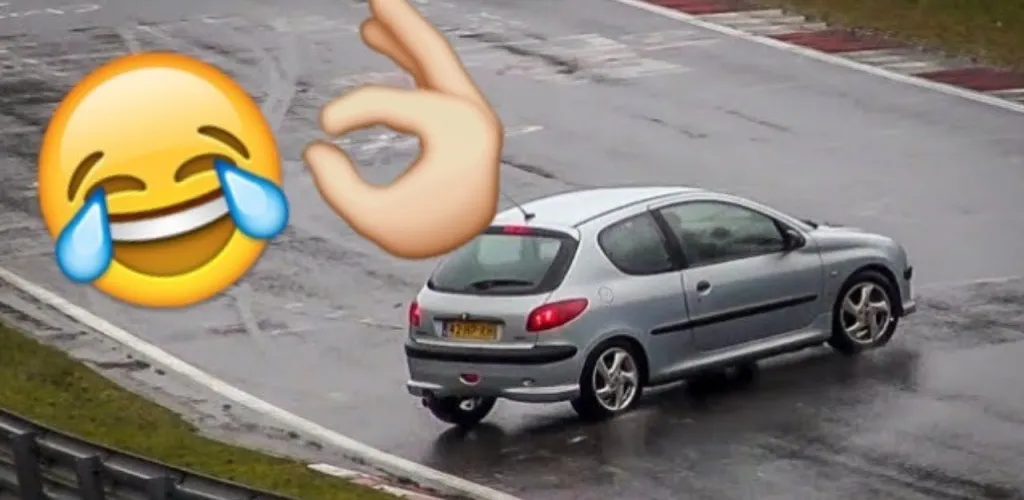
- Avoid hard braking or rapid acceleration to prevent wheel lock
- Reduce speed progressively to regain grip
- Keep steering straight or steer controllably to avoid secondary skid
If you drive thousands of kilometers each year, you’ve probably faced at least once a situation where you temporarily lost control of the car. Whether it’s a wet road, ice, or a sudden maneuver to avoid an obstacle, losing control can quickly escalate into a serious crash — it can all happen in just a few seconds.
Understanding how vehicle dynamics work in such situations and knowing the correct reaction techniques can make the difference between a minor incident and a devastating accident. In this article, we’ll analyze effective methods to regain control of a car that has spun out of control, and you’ll learn how to prevent such dangerous moments.
How a car loses control
Modern passenger cars are designed to be relatively easy to control under normal use and when weather conditions permit. However, once the tires lose grip on the road surface — whether they lock under braking or spin on acceleration — the ability to maintain direction is lost almost instantly.
The most common causes of loss of control are:
- Sudden braking on a wet or icy road
- Aquaplaning on wet roads
- Excessive acceleration on slippery surfaces
- Taking corners at too high a speed
- Abrupt transitions between surfaces with different grip
Regardless of cause, the moment the car starts to skid or rotate requires quick and correct reactions. The natural instinct — to brake hard or countersteer excessively — can aggravate the situation. Therefore, knowing the correct techniques before facing such a situation is essential.
Five effective methods to control a skid
1. Avoid hard braking or rapid acceleration
This is the most important rule when the car is skidding. Sudden braking will lock the wheels completely, eliminating any chance of regaining grip. Locked wheels will spin on the slick surface, and you will lose full steering control.
Equally dangerous is the impulse to accelerate abruptly. When the car loses grip, the rapid rotation of the drive wheels will only prolong the loss of control, often spinning the vehicle in an unpredictable direction.

The key is to maintain a constant level of pedal pressure — neither braking hard nor accelerating suddenly. Let the vehicle stabilize as much as possible.
2. Reduce speed progressively
During a skid, the car often moves chaotic, without a clear or predictable direction. Before attempting any corrective maneuver, allow the wheels to regain solid contact with the road.
The correct method is to ease off the accelerator gradually. This gradual reduction in speed lets the tires gradually regain grip, without jolting the driveline. It’s a delicate balance — you want to slow down, but without creating a sudden deceleration that could lock the wheels.
3. Keep the steering straight or steer controllably
The natural instinct is to countersteer aggressively — if the car is skidding to the right, steer strongly to the left. That reaction can lead to a secondary skid and an even more dangerous direction.

The correct technique is to keep the steering relatively straight or steer very lightly in the direction you want to travel — not in the direction you are currently moving uncontrollably. If you approach an intersection or a turn and need to steer, do so simultaneously with gradual deceleration. Movements should be slow, smooth, and predictable — nothing abrupt.
4. Use the braking system correctly
If your car is equipped with ABS (Anti-lock Braking System), which is common on most modern vehicles, you can apply steady and firm pressure to the brake pedal. The ABS will modulate the pressure to prevent wheel lock, maintaining a minimum degree of directional control.
You will feel pulses in the brake pedal — this is normal ABS operation. Do not lift off the pedal; maintain steady pressure and let the system do its job.
If the car does not have ABS, you should brake by pumping — apply and release brake pressure repeatedly and quickly. This prevents wheel lock and preserves some control over the direction.
5. Stop safely and recover
Once you have managed to straighten the car and regain full control, identify the first safe place to stop on the roadside. Do not continue driving immediately — adrenaline and stress can affect your concentration for several minutes.
Stop, pull the handbrake, take a deep breath, and allow yourself 5–10 minutes to calm down. This pause is not a sign of weakness — it is a safety measure that can protect you from a second incident caused by reduced concentration.
Special techniques for snow and ice skids
Driving on snow or ice presents additional challenges compared with a simple wet road. Grip is dramatically reduced, and the car responds much more slowly to inputs. Here’s what you need to know:
Don’t panic and stay fully focused. Panic leads to abrupt and uncontrolled movements that will worsen the skid. Breathe steadily and focus on small, precise movements.
Lift off the accelerator very slowly. On ice, even a quick lift of your foot off the accelerator can cause a deceleration strong enough to trigger a skid.
Brake very gently and progressively. Even with ABS, ice dramatically reduces braking effectiveness. Start braking much earlier than you would on dry pavement and apply pressure gradually.
Work with physics, not against it. Once the car begins to slide on ice, it follows the laws of physics — inertia and lack of friction. Try to regain control gradually, not with a drastic maneuver.
Essential preventive measures
Drive defensively in adverse weather conditions
The best way to manage a skid is to prevent it. When weather conditions are severe — heavy rain, heavy snowfall, ice — critically evaluate whether the trip is truly necessary. If you can delay or cancel the journey, that is often the wisest course of action.
If you must drive:
- Reduce your speed by 30-50% compared with your normal speed
- Increase the following distance to at least 4-5 seconds
- Avoid abrupt maneuvers — rapid acceleration, braking or sharp turns
- Use appropriate seasonal equipment — winter tires are essential
- Check wiper condition and the operation of the defogging system
Know your braking system
Each vehicle brakes differently, depending on several factors:
- Vehicle weight — a heavy SUV requires a longer stopping distance than a compact car
- Condition of components — worn discs and pads reduce braking efficiency
- Type of braking system — front/rear disc brakes vs. rear drum brakes
- Presence of assistive technologies — ABS, EBD (Electronic Brakeforce Distribution), brake assist
For beginner drivers, it is vital to practice in varied conditions, preferably under the supervision of an experienced person or in a defensive driving course. Controlled simulations of emergency scenarios will help you react correctly when the real situation occurs.
Periodic checks of the braking system are also essential. Inspect:
- Brake pad thickness (minimum 3 mm)
- Disc condition (no deep grooves or uneven wear)
- Brake fluid level and condition
- ABS operation (warning light off)
Maintain a safe following distance
The 3-second rule is a minimum in ideal conditions. On a wet road, increase it to 4-5 seconds. On snow or ice, 8-10 seconds is not excessive.
How do you calculate? When the car in front passes a fixed landmark (pole, sign), count the seconds until you reach that point. If it’s fewer than 3 seconds on dry roads or 5 on wet roads, you are following too closely.
An appropriate distance gives you:
- Sufficient reaction time for braking
- The possibility to avoid abrupt braking
- Better visibility of the road ahead
- Room to maneuver in an emergency
Defensive driving does not mean driving slowly everywhere — it means adjusting speed and behavior to conditions, anticipating potential hazards, and always keeping a safety margin. This approach dramatically reduces the risk of losing control of the vehicle.
Learning and applying these techniques can save lives — yours, your passengers’, and other road users’. Whether you are a novice or an experienced driver, understanding vehicle dynamics and the correct way to react in critical situations should be a constant priority.