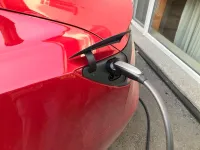
- New energy caps impose market tariffs for EV charging above 255 kWh/month.
- Home charging without corporate tariffs hits households hardest.
- Dacia Spring full charge costs range from 19 to 304 lei by provider.
- A 12k km/year Dacia Spring uses ~1,680 kWh, below the cap.
Two things have recently shifted for electric vehicle owners in Romania: rising operational costs and new energy compensation caps that began on September 1. This analysis examines the real costs faced by EV owners, from affordable models like the Dacia Spring to premium SUVs such as the BMW iX xDrive50, by comparing tariffs offered by different energy providers.
Impact of the new energy caps on drivers
The decision to adjust the energy compensation cap significantly affects households that charge their vehicles at home. Under the new rules, households consuming more than 255 kWh per month face higher tariffs for energy used beyond this threshold.
Owners who drive roughly 1,000 km per month may use between 150-200 kWh solely for charging the car, a substantial portion of the compensated cap. The situation is even more complex for plug-in hybrid owners who rely mainly on electric mode.
Note that this issue disproportionately affects those who live in houses and charge their vehicles independently, without access to corporate tariffs or employer-subsidized charging facilities.
Updated tariff structure for electricity
Minister of Energy, Virgil Popescu, explained that the new compensation structure works as follows: “Households that consume more than 255 kWh/month, but up to 300 kWh/month, will pay at market price the difference of kWh between the two caps. Households consuming over 300 kWh/month are not covered by the emergency ordinance.”
Tariffs for residential customers:
- Up to 100 kWh/month: 0.68 lei/kWh (VAT included)
- Between 100-255 kWh/month: 0.80 lei/kWh (VAT included)
- Above 255 kWh/month: market tariff (varies by provider)
This structure means that an EV owner who exceeds the 255 kWh threshold will pay market tariffs for all additional consumption, which can substantially raise the monthly bill.
Cost analysis for the Dacia Spring
The Dacia Spring, the most affordable electric vehicle on the Romanian market, features a 27.4 kWh battery. The cost of a full charge varies dramatically depending on the energy provider chosen:

- Hydroelectrica: 19 lei (0.69 lei/kWh) - the most advantageous option
- EON Energie (E.ON Cool Electric): minimum 80 lei (2.93 lei/kWh)
- RCS & RDS (Residential customer offer): 92 lei (3.37 lei/kWh)
- CEZ (CEZ Residential): 125 lei (4.56 lei/kWh)
- Engie (Universal Service): 127 lei
- Engie (Ampero Verde eFresh): 163 lei
- Enel (Enel Fix Relaxat): 145 lei (5.30 lei/kWh)
- We Power Team: 304 lei
For a user who travels about 12,000 km per year with a Dacia Spring (average consumption around 14 kWh/100 km), the annual energy requirement is about 1,680 kWh, i.e., roughly 140 kWh per month — still below the compensated cap.
Costs for the BMW iX xDrive50
The premium BMW SUV, with a 105.2 kWh battery, presents a very different charging cost picture:
- Hydroelectrica: 72 lei - base tariff
- EON Energie (E.ON Cool Electric): 308 lei (2.93 lei/kWh)
- CEZ (CEZ Residential): 480 lei (4.56 lei/kWh)
- Enel (Enel Fix Relaxat): 557 lei (5.30 lei/kWh)
- We Power Team: 1,169 lei (11.11 lei/kWh)
For a heavily used BMW iX, with ~1,500 km/month and an average consumption of 22 kWh/100 km, the monthly energy need for the car reaches about 330 kWh, clearly exceeding the compensated cap and attracting substantial costs at market tariffs.
Calculating the charging cost for any electric vehicle
To determine the cost of a full charge for any other EV, use this simple formula:
Full charge cost = Battery capacity (kWh) × Energy tariff (lei/kWh)
For example, for a Volkswagen ID.4 with a 77 kWh battery at a tariff of 3 lei/kWh:
77 kWh × 3 lei/kWh = 231 lei for a full charge
It’s important to note that you rarely charge from 0% to 100%; most charging occurs between 20% and 80% to extend battery life.
Charging times – An essential factor to consider
Unlike petrol or diesel cars, which can be fueled in minutes, EVs require significantly longer charging times:
Home charging (standard 220V outlet, 2.3 kW):
- Dacia Spring (27.4 kWh): about 12 hours for a full charge
- BMW iX xDrive50 (105.2 kWh): about 46 hours for a full charge
Home wallbox charging (7.4 kW):
- Dacia Spring: about 4 hours
- BMW iX xDrive50: about 14 hours
Public fast charging (50-120 kW):
- Most vehicles: 20-80% capacity in 30-45 minutes
- Some premium models can reach 80% in only 18-25 minutes at ultra-fast stations (150+ kW)
These times make charging planning essential, especially for long trips where fast charging stations may be busy during peak periods.
Comparison with fossil fuel costs
For a complete picture, let’s compare operating costs with traditional vehicles:
A petrol car with a consumption of 7 L/100 km and petrol price at 7 lei/liter:
- Cost per 100 km: 49 lei
- Cost per 1000 km: 490 lei
A Dacia Spring with a consumption of 14 kWh/100 km at the Hydroelectrica tariff (0.69 lei/kWh):
- Cost per 100 km: 9.66 lei
- Cost per 1000 km: 96.6 lei
However, at premium tariffs (e.g., 5.30 lei/kWh):
- Cost per 100 km: 74.2 lei
- Cost per 1000 km: 742 lei
This analysis highlights the crucial importance of choosing an energy supplier for the profitability of an electric vehicle.
Outlook and future trends
Energy sector experts warn that current pressures on energy prices are just the beginning, with anticipated further increases in the near term. This will affect charging tariffs both at home and at public stations, which vary with demand and wholesale market costs.
A noteworthy point: in 2021, Romanian drivers bought more electric vehicles than diesel cars, marking a milestone for the local market. This trend shows growing appetite for electric mobility despite cost and infrastructure challenges.
Strategies to optimize charging costs
To minimize charging expenses, owners can adopt the following strategies:
- Careful comparison of providers: The difference can be up to 16x between the cheapest and most expensive provider.
- Off-peak charging: Some providers offer reduced rates for nighttime consumption.
- Using free public charging stations: Many shopping centers and parking facilities offer free charging for customers.
- Installing photovoltaic panels: The initial investment can be recouped in 5-7 years through self-generated energy.
- Charging planning: Charge the battery only up to 80% and avoid discharging below 20% to extend battery life.
In conclusion, while EVs offer clear advantages in terms of emissions and reduced mechanical maintenance costs, the new realities of Romania’s energy market require careful analysis of operating costs. The choice of energy supplier and understanding the tariff structure are as important as the vehicle selection itself.