- Apartment EV charging challenges due to lack of private parking and limited public stations
- Residents improvise with extension cords, using hood routing and internal locking to deter theft
- Tech options include Sonoff POW and surveillance to safely manage charging
- Commercial stations with metering, RFID access, and HOA management are being piloted
The transition to electric mobility in Romania faces practical challenges specific to apartment residents who do not have access to private parking with charging stations. With the 2035 deadline for phasing out internal combustion vehicles approaching, Romanian drivers are showing creativity in finding solutions for charging electric vehicles at apartment buildings.
In line with the Paris Agreement on climate, emissions must be significantly reduced to meet environmental protection and air quality improvement objectives. Under these conditions, an increasing number of motorists in Romania are considering purchasing electric cars, motivated also by the high costs of fuels.
Charging challenges in apartment buildings
For most electric vehicle owners who live in apartments, charging is the main challenge in adopting electric mobility. Unlike those who have private housing and can install private charging stations, apartment residents must find alternative solutions.
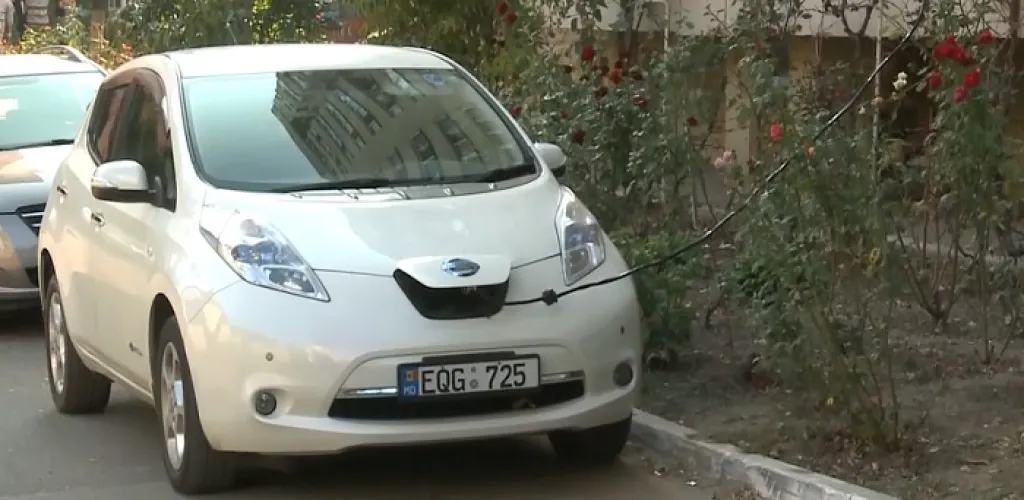
The limited number of public charging stations amplifies this problem, making it difficult to use electric cars for trips outside the area. In this context, many electric vehicle owners turn to improvised methods, using extension cords to connect the car to the apartment socket.
Integrated locking systems
- Automatic locking system: After connecting the cable to the car and pressing the lock button twice on the remote, the charging plug automatically locks into the car’s port via the vehicle’s security system.
- Hood protection: The cable can be routed through the engine bay, leaving the plug under the hood, which makes access difficult for potential thieves.
- Charging from inside: The cable can be threaded through the car, leaving the window slightly ajar, then the vehicle is locked.
Advanced technological solutions
- Sonoff POW: A programmable smart relay that powers the extension cord only during charging, eliminating voltage when not needed.
- Surveillance cameras: Installing visible monitoring systems to deter theft attempts.
Installing charging stations in apartment buildings
Another community member asked: Are there group members who live in older apartment buildings and have installed a charging outlet? I am interested in metered models (so multiple users can charge, but costs can be shared).
Solutions for apartment blocks
The responses highlighted several viable options:
- Commercial stations with individual metering:
- Stations in the ‘public’ or ‘office’ category with RFID cards
- Integrated software for monitoring individual consumption
- Separate billing for each user
- Management by the homeowners association
- Implementation in Cluj-Napoca:
- Pilot projects with stations mounted at the base of the building
- Separate metering for each charging
- Partial investment supported by the owner of the electric vehicle
- Need for approval from the homeowners association
Individual meters
An easier solution involves using meters available on the market to measure electricity consumption, enabling precise calculation of costs for each charging session.

Safety considerations and recommendations
Electrical safety
- Using extension cords with adequate cross-section (minimum 2.5 mm²)
- Avoid overloading the building’s electrical network
- Protection against water ingress
Legal and neighborly considerations
- Obtaining consent from the homeowners association
- Compliance with internal regulations
- Avoid blocking access routes
Future outlook
As the 2035 deadline for the phased elimination of internal combustion vehicles approaches, charging infrastructure for collective housing becomes a priority. Current solutions, though creative, are temporary and cannot substitute for proper infrastructure.
Local administrations and homeowners associations must collaborate to implement sustainable charging solutions at building level. Government programs promoting electric mobility should also include measures specific to collective housing.
The ingenuity of Romanian drivers in finding solutions for charging electric cars at apartment buildings demonstrates the willingness to adopt green technologies, despite the infrastructural challenges today. Nevertheless, developing adequate infrastructure remains essential for the success of the transition to electric mobility in Romania’s urban environment.