- Romania’s EV charging network is expanding rapidly with small 2–5-point stations.
- Most charging occurs at home; public charging supplements long trips.
- Public stations are clustered at malls, hotels, and fueling sites.
- Charging time depends on station power, battery acceptance, current level, and temperature.
The Romanian electric car market has started to grow rapidly, and with it the charging infrastructure is developing. More and more Romanians are choosing electric vehicles or plug-in hybrids, drawn by lower maintenance costs and environmental benefits. However, being a developing market, many questions arise about charging these vehicles.
In this comprehensive guide, we will clarify all important aspects of charging stations, from the types available to practical tips for optimal use.
What EV and PHEV mean and how they differ?
To understand the topic better, it’s important to clarify two terms frequently used in the electric car industry:
EV (Electric Vehicle) - refers to a 100% electric passenger car that runs solely on energy stored in batteries and must be charged from an external source.
PHEV (Plug-in Hybrid Electric Vehicle) - represents a hybrid vehicle that combines an electric motor with an internal combustion engine (usually petrol). The electric motor can be charged both from an external source and via energy recovery during braking or through the generator driven by the internal combustion engine.
What is a charging station and what does it look like?
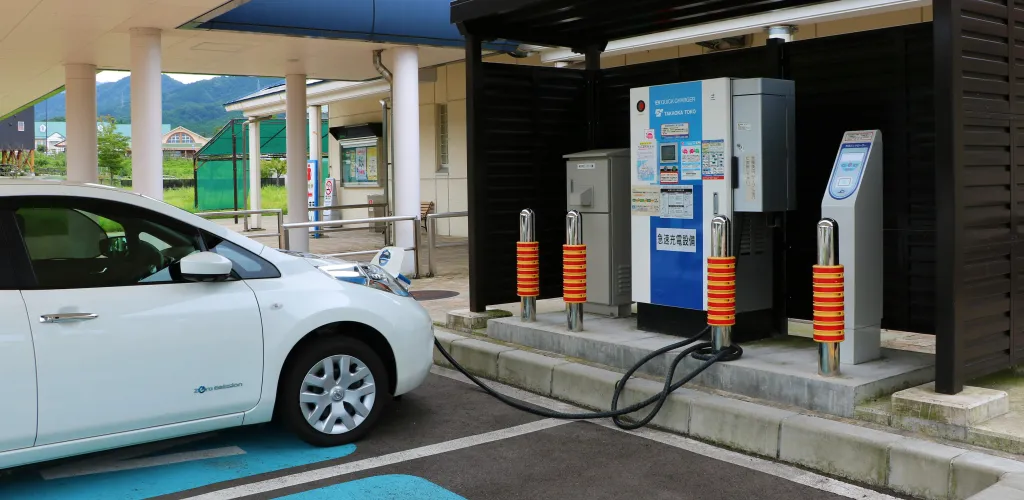
A charging station is a system that contains two or more individual charging points that together form the station. Do not expect installations as large as a traditional gas station.
In Romania, the most common stations have only a few charging points (2–5 points) and are located in:

- Shopping center parking lots (Dedeman, IKEA, malls)
- Supermarkets (Lidl, Kaufland, Carrefour)
- Hotels and restaurants
- Public parking lots in major cities
- Fuel stations
European trend in infrastructure development
In many European cities, innovation has led to charging points installed right on streetlight poles, equipped with solar panels to ensure green energy. This approach optimizes urban space and provides convenient access to charging.
Current status of charging stations in Romania
According to recent statistics, Romania is in an accelerated development phase for charging infrastructure. If in 2019 there were only 390 charging stations for 1,100 electric cars, the situation has improved considerably today.
It is important to note that in Romania, as in the rest of Europe, the majority of electric cars (approximately 80%) are still charged at home. The European average for daily distances driven with electric cars is only about 30 km, which makes home charging sufficient for daily needs.
Owners use public stations mainly when traveling long distances (over 300 km) or when they do not have access to home charging.

Charging time: key determining factors
Charging time depends on several essential technical factors:
- Charging station power (measured in kW)
- Battery acceptance capacity (limited by the battery management system)
- Current battery level (charging is faster when the battery is depleted)
- Ambient temperature (cold weather reduces charging efficiency)

Types of stations by charging speed
Slow charging stations (3 kW) These stations are suitable for home charging overnight. A full charge takes about 8–12 hours, depending on battery capacity. They are the most economical to install and use.
Fast charging stations (7–22 kW) Represent the standard for urban public charging and advanced home installations. A full charge takes between 3–6 hours. Most city stations operate at this power.
Rapid charging stations (43–50 kW) Allow charging from 0 to 80% in approximately 30–45 minutes. Not all electric cars are compatible with this technology. In Romania, these stations are rare but their number is rising.
Ultra-rapid charging stations (100–350 kW) Represent the future of fast charging, capable of charging a battery from 10% to 80% in 15–30 minutes. Tesla Supercharger and the IONITY network are examples of such technologies.
Home EV charging station installation
Home EV charging station installation
Important note: Not all models support fast charging. Entry-level models are limited to 3–7 kW. Check your car’s technical specifications before investing in a higher-powered charging station.

Types of connectors for electric cars
Although the variety is not very large, not all cars use the same connector. There are two main categories:
AC charging connectors
- Type 1 (J1772) - used mainly on Japanese and American cars
- Type 2 (Mennekes) - European standard, adopted in Romania
DC charging connectors
- CHAdeMO - developed by Japanese manufacturers
- CCS Combo - European standard for fast charging
- Tesla Supercharger - Tesla’s proprietary connector (opening up to other brands)
Installing a home charging station
Installing a home charging station is the most convenient solution for the majority of users. About 80% of electric car charges occur at home, underscoring the importance of this option.
Advantages of home charging:
- Maximum convenience - the car charges overnight
- Lower costs - household electricity tariffs
- Constant availability - you are not dependent on public stations
- Full control - you can schedule charging during off-peak hours
Technical requirements for installation:
- Adequate electrical supply (single- or three-phase)
- Protective differential device (mandatory for safety)
- Necessary permits (depending on installed power)
- Dedicated parking space
Public charging etiquette and unofficial rules
To ensure harmonious coexistence among electric vehicle users, follow these principles:
Basic rules
Monitor the charging status Periodically check progress and free the spot when the battery reaches a sufficient level (80–90%). Do not occupy the station longer than necessary.
Priority to 100% electric vehicles If you own a PHEV, yield to a pure electric vehicle when the station is occupied. Your hybrid can run on the internal combustion engine.
Do not unplug someone else’s car If you find a car plugged in, do not unplug it without the owner’s consent. Locate the owner in the area or leave a polite note.
Tips for responsible use
Report technical problems Notify the station operator or the competent authorities about any observed malfunction.
Offer help If you see someone struggling with the station, offer assistance. The electric vehicle community relies on solidarity.
Handle cables with care Keep the cable tidy after charging and avoid leaving it hanging or in the way of other users.

Is it worth buying an electric car in Romania?
Switching to an electric vehicle involves a change of mindset and habits, especially regarding “refueling.” Unlike fossil fuels, where you can fill up in a few minutes and have hundreds of kilometers of autonomy, electric charging requires more time and planning.
Clear advantages
Lower operating costs The cost of an electric “full” is a fraction of conventional fuels. For 100 km, the cost of electricity is 3–5 times cheaper than gasoline.
Positive environmental impact Even if electricity in Romania comes partly from fossil sources, the higher efficiency of electric motors means overall emissions are significantly reduced.
Superior driving experience Electric motors deliver maximum torque from the first rotation, offering smooth, quiet, and more comfortable driving.
Our recommendation
Installing a home charging station is essential for an optimized experience with an electric vehicle. Thus, each morning the car will be ready to go with a charged battery. Typically, you will need to charge the car 2–3 times per week, depending on the distances driven.
With ongoing infrastructure development and falling technology costs, the current moment is favorable for the transition to electric mobility in Romania.
Photo sources: auto-bild.ro, presasm.ro, profit.ro, blog.e-acumulatori.ro