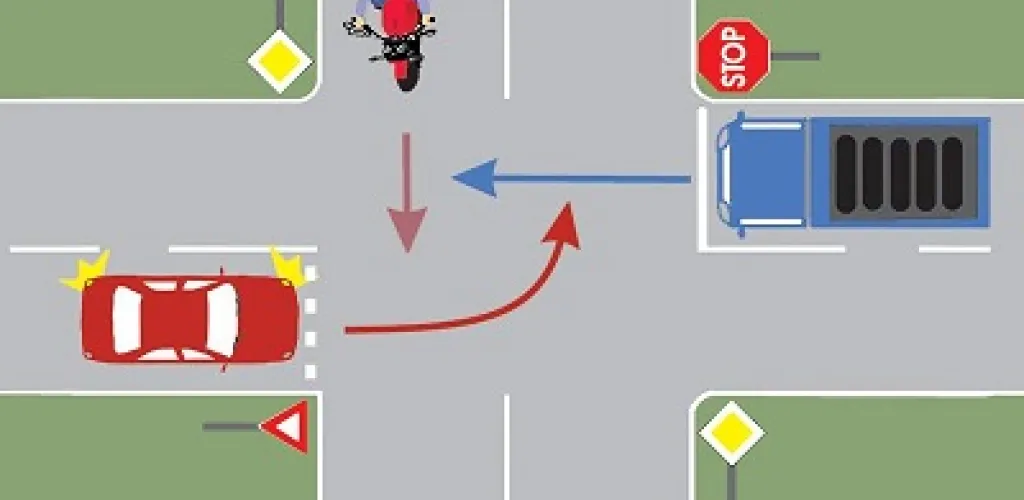
- Uncontrolled intersections: yield to vehicles from the right; trams have priority, except when turning left.
- Controlled intersections: obey officers, signals, or priority signs; signage has absolute priority.
- Left turns at signalized intersections yield to opposing traffic, even if both lights green.
- Right-hand priority applies at priority-indicator intersections when two vehicles arrive.
Navigating intersections correctly is one of the most important skills for a responsible driver. Understanding right-of-way not only helps prevent accidents but also keeps urban traffic flowing smoothly. Right-of-way refers to the priority when crossing an intersection that is not controlled, for a vehicle relative to others arriving at the same time from different directions.
Although the concept may seem simple, the practical application of right-of-way rules varies significantly depending on the type of intersection and the signaling methods present. To avoid confusion and dangerous situations, it is essential to know in detail all categories of intersections and the specific rules for each.
General principles of behavior at intersections
As you approach an intersection, the driver has a duty to travel at a speed that allows stopping to yield right-of-way to traffic participants who have it. This fundamental rule applies regardless of the type of intersection and forms the basis of road safety.
An important technical aspect to remember is that turning left, for vehicles entering an intersection on the same road in line but from opposite directions, is carried out to the left of the intersection’s circle, without crossing their trajectories.
Uncontrolled intersections
Uncontrolled intersections are the most common in residential areas and on secondary roads, where there are no traffic signals or traffic controllers directing the flow.
Right-hand priority
At uncontrolled intersections, the vehicle driver must yield to all vehicles coming from the right. This simple rule, known as the “priority to the right,” is fundamental to navigating intersections and must be applied with maximum vigilance.
Priority of trams
At uncontrolled intersections, the driver must yield to all vehicles traveling on tram tracks. Trams lose priority only when turning left, at which point standard priority rules apply.
Intersections with controlled traffic
These intersections are divided into three distinct categories, each with its own specific rules:
- Intersections controlled by traffic officers – where the officer’s directions take precedence over any other signals
- Intersections controlled by traffic signals – where the traffic lights regulate vehicle flow
- Intersections controlled by priority signs – including roundabouts
Respecting signage
At intersections controlled by priority indicators, traffic signals, or by traffic officers, the driver must comply with the meaning of their indications. This rule has absolute priority over all other traffic rules.
Left turns at signalized intersections
At signalized intersections, vehicles turning left give priority to vehicles traveling from the opposite direction. This rule applies even when both traffic streams have a green light.
Applying the right-hand priority rule
At intersections controlled by priority indicators, the right-hand priority rule is observed only when two vehicles are about to meet, each entering the intersection from a road marked with a priority indicator that conveys the same meaning of priority or loss of priority.

Roundabout intersections
Roundabouts have become increasingly popular in Romania due to their efficiency in smoothing traffic and reducing accidents. Understanding the specific rules is crucial for safety.

Fundamental principle
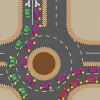
In roundabouts, vehicles circulating inside have priority over those about to enter the intersection. This rule applies only if all approaches to the roundabout are equipped with signs meaning “Yield” and “Roundabout.”
Specific driving rules
In roundabouts, the following detailed rules apply:
Principle of circumnavigation:
- You should go around the central island to the right, following the arrows shown on the roundabout sign.
Respecting interior signaling:
- The driver must follow the meaning of signaling devices installed inside the intersection (the rules applicable to controlled intersections apply), if they exist.
Lane positioning for specific directions:
-
For the first street on the right: the driver stays in the curbside lane (the first lane) and activates the right-turn indicator when entering the intersection.
-
For the direction straight ahead: the driver may stay in the curbside lane (the first lane) or in the lane next to the axis of the road (the second lane).
-
For turning left: the driver stays in the lane next to the axis of the road (the second lane) and activates the left-turn indicator when entering the intersection.
Special rules for turning left
In an intersection with an imaginary center, turning left is performed by circling the imaginary center of the intersection to the right. This general rule, however, has several important exceptions.
Exceptions to the general rule
An exception to the rule of circling the imaginary center to the right occurs when:
- There are special lanes for performing the maneuver – in large intersections with multiple dedicated lanes
- There is a police officer’s signal directing traffic in the intersection
- The direction change to the left by vehicles entering the intersection on the same road in line but from opposite directions (their paths do not cross)
- In an intersection with two-way traffic located at the end of a one-way street
Important restrictions and safety measures
Prohibition of blocking the intersection
Entering an intersection is prohibited even if the traffic light or a priority sign allows it, if, due to traffic congestion, the driver risks becoming immobilized, hindering, or obstructing traffic flow.
This rule is particularly important during peak hours in big cities, where blocking an intersection can create a cascading effect on traffic in the area.
Practical recommendations for drivers
For safe navigation through intersections, experts recommend:
- Reducing speed well in advance of the intersection
- Careful observation of all traffic participants
- Proper use of signaling devices
- Maintaining a safe following distance
- Avoiding abrupt or unexpected maneuvers
Understanding and correctly applying right-of-way rules at intersections is a fundamental responsibility for every driver. Following these principles not only ensures your safety and that of other road users but also contributes to smoother urban traffic flow in increasingly dense city environments.