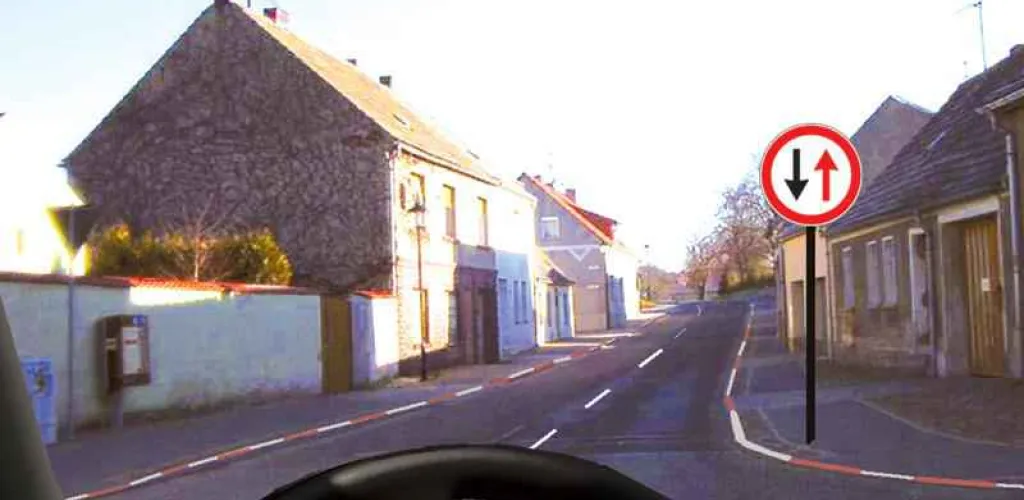
- The sign grants you priority over oncoming traffic on narrow road sections.
- It is a circular sign with red border, white background, two opposite arrows.
- Used where two-way passage isn’t possible, like narrow bridges or tunnels.
- In Romania, it’s regulated by Emergency Ordinance 195/2002 and Standard 1848/2011.
Driving on public roads in Romania requires a deep understanding of traffic signs, which play a crucial role in maintaining road safety. Among them, the oncoming traffic priority sign is one of the signs that can confuse some drivers, even though the rules it imposes are clear and mandatory.
Understanding this sign correctly can make the difference between safe driving and a potentially dangerous situation, especially on narrow road sections where maneuvering space is limited.
Legal framework of road signs in Romania
According to current regulations, road signs in Romania are regulated by Emergency Ordinance 195/2002 and Romanian Standard 1848/2011. Romania, being a signatory to the Vienna Convention on Road Traffic (1968) and the European Agreement (1971), aligns road signs with European standards.
These regulations ensure uniformity and clarity of meanings for drivers from all European countries, facilitating international travel and maintaining high road safety standards.
Classification of road signs
Main types of signs
- Warning signs – signals hazards or special situations
- Priority signs – establish the right of way at intersections
- Prohibition/restriction signs – limit certain types of traffic
- Mandatory signs – impose specific traffic behaviors
- Directional signs – provide information about directions and destinations
- Informational signs – supply useful data about the area or road
- Supplementary panels – complete and refine the message of the main signs
Distinctive shapes of signs
- Triangular shape – for warning and hazard signs
- Circular shape – for all signs that prohibit or restrict something
- Distinctive shapes – for priority signs, which have more distinctive configurations
Placement and visibility of signs
By current regulations, road signs are usually mounted on the right side of the road so that drivers can observe them easily and understand that they apply directly to them. However, there are situations when signs can be placed on the opposite side of the road or even above the lanes, depending on visibility needs and the specifics of the area.
When signs are placed above the lanes, they refer exclusively to traffic on those lanes, thus providing a more precise direction of traffic.
The oncoming traffic priority sign
Physical description
This sign appears as a circle with a red border on a white background, in which two arrows oriented in opposite directions are depicted. The simple but clear design of this sign ensures quick identification by drivers, even in reduced visibility conditions.

Usage contexts
The sign is predominantly encountered on narrow road sections where the width of the carriageway does not allow comfortable passage of two vehicles simultaneously. These situations may occur in the following contexts:
- Narrow bridges
- One-lane-per-direction tunnels
- Road repair works with temporary restrictions
- Road sections through towns with narrow streets
- Mountain areas with winding roads
Relationship with other signs
This traffic sign is typically preceded by the narrow road signs, which warn drivers about approaching a restricted traffic zone. This sequencing allows drivers to prepare in advance for the necessary maneuvers.
Obligations of drivers
Main rule
When encountering this sign, drivers have the strict obligation to yield to all vehicles coming from the opposite direction. This means they must stop or slow down until the road is fully clear.
Assessing the situation
Compliance with this sign includes:
- Careful observation of traffic from the opposite direction
- Accurate estimation of the time needed to traverse the area
- Complete stop if vehicles from the opposite direction approach
- Resume traffic only when it is safe
Penalties for non-compliance
Non-compliance with this sign constitutes a traffic offense and may incur penalties under the Road Code, ranging from fines to license suspension, depending on the severity and consequences.
Supplementary panels
The sign may be accompanied by supplementary panels that specify:
- Vehicle category targeted (passenger cars, trucks, vehicles over a certain tonnage)
- Time intervals when the restriction applies
- Distance over which the inverse-priority zone extends
- Exceptions (emergency vehicles, public transport)
These panels eliminate any ambiguity and ensure correct application of traffic regulations.
Practical tips for drivers
Anticipating situations
- Reduce speed before the restricted zone
- Check rear-view mirrors to assess traffic behind
- Maintain a safe following distance to allow stopping if necessary
Communicating with other road users
- Use signaling to indicate intentions
- Eye contact with other drivers when possible
- Cooperative gestures to facilitate traffic flow
Understanding and strict compliance with the oncoming traffic priority sign significantly contribute to road safety and to the smooth flow of traffic on the problematic sections of Romania’s public roads.