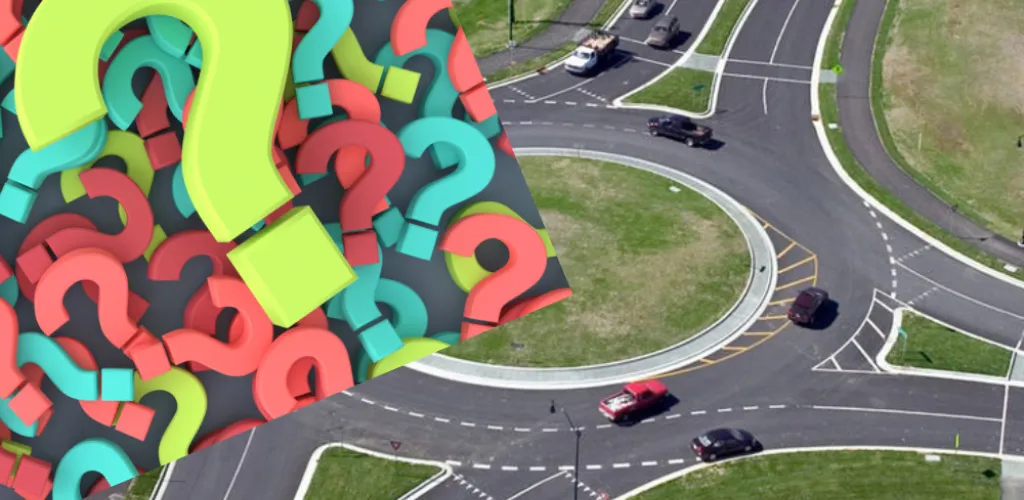
- Romania is adopting more roundabouts, replacing traffic signals and STOP signs.
- Roundabouts force a circular, unidirectional flow to reduce conflict points and crashes.
- Roundabouts originated in 18th-century Europe, notably Paris’s Arc de Triomphe roundabout.
- Roundabouts lower crash severity by slowing vehicles and improving reaction time.
Intersections are among the most dangerous elements of road infrastructure, locations prone to serious accidents. In recent years, Romania has witnessed a real revolution in intersection design, with roundabouts appearing more and more frequently, replacing the old systems with traffic signals or STOP signs. This transformation is not accidental — it is based on decades of research and the demonstrable benefits of these traffic solutions.
Roundabouts are not a modern invention, but a solution with deep roots in European urban history, whose effectiveness has stood the test of centuries.
What is a roundabout and how it works
Essentially, a roundabout is a circular road surrounding a raised central island, designed to control the flow of vehicles from multiple access roads. The operating principle is straightforward: all vehicles entering the roundabout must travel in the same direction around the central island, creating a continuous and controlled flow.
This configuration eliminates major conflict points typical of classic intersections, where vehicles can come from opposite or perpendicular directions. Instead of direct crossing points, a roundabout turns all potentially dangerous maneuvers into simple entrances and exits from a circular flow.
Historical origins of the roundabout
The history of roundabouts is surprisingly long, predating the automobile era by over a century. The earliest documented examples appeared in 18th-century Europe, when architects and urban planners sought solutions to manage horse-drawn traffic and pedestrians in crowded urban centers.
One of the most famous historical examples is the Arc de Triomphe roundabout in Paris. Construction of this circular intersection began in 1777, under the supervision of Marquis de Marigny, and was completed in 1780. Today, this intersection — known as Place Charles de Gaulle — remains one of the most iconic roundabouts in the world, handling heavy traffic on the famous Avenue des Champs-Élysées and the eleven boulevards that converge here.
Expansion in North America
The American continent adopted the concept nearly a century later than Europe. The first American roundabout was built in 1857, marking the beginning of a new era in managing urban traffic in the United States. However, the popularity of these solutions in America has experienced significant fluctuations over the decades.

Why roundabouts are safer than traditional intersections
Speed reduction — the key factor
The main feature that makes roundabouts safer is the mandatory slowdown at entry. The circular geometry does not allow maintaining high speeds, forcing drivers to slow down naturally. This speed reduction directly impacts the severity of potential accidents:
- At lower speeds (under 30 km/h), the impact of an accident is significantly reduced
- Driver reaction time is improved
- The possibility of avoiding collisions increases considerably
Unidirectional flow eliminates major conflicts
In roundabouts, all vehicles move in the same direction around the central island. This feature nearly eliminates the possibility of head-on collisions—the most dangerous type of road accidents. Instead of crossing maneuvers or turns that require threading through traffic, all movements become simple entrances and exits from a circular flow.
Analysis of conflict points
Traffic engineering uses the concept of “conflict points” to assess the danger level of an intersection. These points are where vehicle trajectories intersect, creating potential accident situations.
A comparison between intersection types is enlightening:

- The classic T-intersection: approximately 32 conflict points
- The four-arm intersection: over 50 conflict points
- The roundabout: only 8 conflict points
This dramatic reduction in conflict points translates into improved road safety statistics.
Additional benefits of roundabouts
Improved traffic flow
Beyond safety aspects, roundabouts contribute to better traffic flow by eliminating dead times typical of traffic lights. Vehicles no longer need to wait at red lights when there is no traffic from other directions, resulting in shorter travel times and optimized fuel consumption.
Environmental impact
Reducing stops and abrupt acceleration translates into:
- Reduced pollutant emissions
- Lower fuel consumption
- Lower noise levels in residential areas
Maintenance costs
Compared to signalized systems, roundabouts do not require:
- Maintenance of complex electronic equipment
- Electric power consumption for operation
- Periodic replacement of electronic components
Challenges and considerations for implementation
Although the advantages are evident, implementing roundabouts requires attention to several factors:
- Available space: roundabouts occupy more space than classic intersections
- Educating drivers: many minor accidents occur due to non-adherence to priority rules
- Adapting to local traffic: sizing must be appropriate for traffic volume
Roundabouts represent a natural evolution in urban traffic management, combining centuries-old urban planning principles with modern safety and efficiency requirements. Their accelerated implementation in Romania reflects a growing understanding of the benefits they bring for road safety, as well as the quality of life in urban environments.