- Fuel consumption is fuel per distance; economy comes from driving style and maintenance.
- Manufacturers specify urban, extra-urban, and combined consumption; real use is 10-20% higher.
- L/100 km and mpg are inverse; lower L/100 km or higher mpg indicates efficiency.
- Manual method uses (Liters ÷ Kilometers) × 100 formula.
Fuel prices have reached historic highs recently, and experts do not foresee a drop anytime soon. This economic context is pushing more drivers to seek effective ways to save fuel and monitor consumption precisely. A proper understanding of fuel consumption and the right saving techniques can lead to significant long-term savings.
What fuel consumption means
Practically, fuel consumption describes the amount of fuel a car uses relative to the distance traveled. Fuel economy involves reducing this amount as much as possible through optimizing driving style and proper vehicle maintenance.
Types of fuel consumption
Each type of passenger car comes with a standard fuel consumption provided by the manufacturer, represented by three values:
- Urban consumption - recorded under city traffic conditions with frequent stops, accelerations and decelerations
- Extra-urban consumption - measured on open roads, at steady speeds and with fewer stops
- Combined consumption - the weighted average of urban and extra-urban consumption
Note: These figures are generally lower than what drivers achieve in real life, because tests are conducted under perfect road conditions and with a highly defensive driving style. The difference can be 10-20% compared to real consumption.
Differences between measurement systems
In Romania and Europe, consumption is measured in liters per 100 km (L/100 km), while in the USA the system used is miles per gallon (mpg), which indicates distance traveled per unit of fuel. It’s important to understand that these systems are inverse—lower L/100 km means higher efficiency, just as a higher mpg means higher efficiency.
How to calculate fuel consumption correctly
Method 1: Using the onboard computer
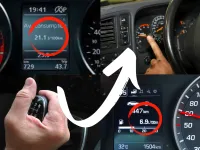
Most cars built in the last 10-15 years are equipped with sensors that indicate:
- Instantaneous consumption
- Average consumption for a trip
- Consumption over the last 100/500/1000 km
- Remaining range based on fuel level
Advantages: Simplicity and real-time monitoring Disadvantages: Accuracy can vary with sensor calibration, and the error can be up to 5-10%

Method 2: Precise manual calculation
For a realistic and verifiable calculation, follow these steps:
- Reset the on-board computer counter to zero or note the current odometer reading
- Cover at least 100 km under similar conditions (or more for variability
- Record the exact distance traveled
- Calculate fuel consumed from the on-board computer or by the difference in fuel level
Calculation formula:
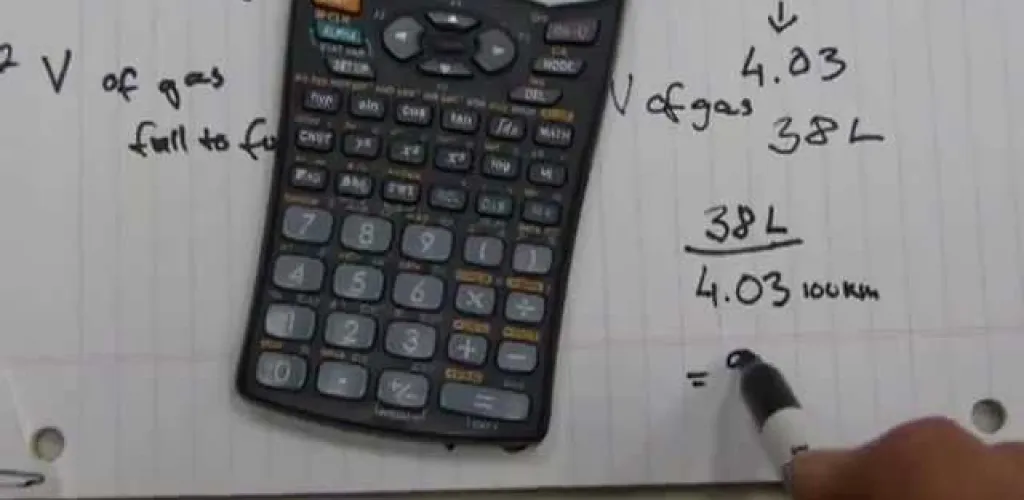
Consumption (l/100km) = (Liters consumed ÷ Kilometers traveled) × 100
Practical example: If you have traveled 635 km and consumed 57 liters:
- 57 ÷ 635 × 100 = 8.98 l/100 km
Method 3: Calculation by full-tank fills
Steps to follow:

- Fill up completely until the pump stops automatically
- Reset the odometer to zero
- Drive under normal conditions
- At the next fill-up, record:
- Kilometers traveled
- Liters refueled (from the receipt)
- Apply the formula above
Note: This method can have errors due to differences in fueling and pressure variations in the tank, but it remains the most accurate way to verify the on-board computer.
Calculating fuel costs
To find the cost per kilometer:
- Cost per 100 km = Consumption (l/100km) × Price per liter
- Cost per kilometer = Cost per 100 km ÷ 100
Example:
- Consumption: 8.98 l/100km
- Fuel price: 6.50 RON/liter
- Cost per 100 km: 8.98 × 6.50 = 58.37 RON
- Cost per kilometer: 0.58 RON
These calculations are essential for budgeting transport expenses and comparing costs between different vehicles.
Calculating fuel efficiency
To find how many kilometers you can drive per liter:
Km/liter = Kilometers traveled ÷ Liters consumed
From the previous example: 635 ÷ 57 = 11.14 km/liter
This indicator is useful for comparing efficiency between different vehicles and for tracking improvements in driving style.
Factors that influence consumption
Driving style
- Aggressive driving: abrupt accelerations, frequent braking, high revolutions → consumption can rise by up to 30%
- Defensive driving: slow accelerations, steady speeds, traffic anticipation → consumption can drop by 10-20%
- Using cruise control on long highways to maintain a constant speed
- Driving speed: above 90 km/h, consumption increases exponentially due to aerodynamic drag
Road conditions
- Urban traffic: frequent stops, constant accelerations → higher consumption by 30-50% compared to open roads
- Open road: steady speed, no stops → optimized consumption
- Weather conditions: strong wind, rain, snow → consumption increases by 5-15%
- Altitude and grade: climbing on hilly roads significantly increases consumption
Vehicle mechanical condition
- Tire pressure: underinflated tires → consumption increases by 3-5%, plus uneven wear
- Air filter: clogged filter → consumption increases up to 10% due to a richer mixture
- Engine oil: wrong viscosity or old oil → increased friction in the engine
- Wheel alignment: misalignment → additional resistance and rapid tire wear
- Injection system: dirty or faulty injectors → incorrect spray and incomplete combustion
- Spark plugs: worn plugs → incomplete ignition and power loss
Additional factors
- Vehicle weight: every extra 50 kg increases consumption by about 1-2%
- Aerodynamics: open windows at high speeds increase consumption by 10%, roof racks by 5%
- Air conditioning usage: additional consumption of 0.5-1.5 l/100km, especially at low speeds
- Electrical loads: headlights, defogging, heated seats → additional consumption
Tips for saving fuel
Efficient driving techniques
- Anticipate traffic to avoid sudden braking and maintain momentum
- Keep a steady speed as much as possible, using cruise control on highways
- Use engine braking on descents to avoid constant braking
- Avoid prolonged idling – switch off the engine for longer stops
- Plan routes to avoid heavy traffic and peak hours
- Accelerate smoothly and progressively to keep the engine operating efficiently
- Shift at optimal revs — generally 2000-2500 rpm for diesels, 2500-3000 rpm for petrol
- Limit highway speeds — consumption rises exponentially beyond 100 km/h
Preventive maintenance
- Check tire pressure monthly and adjust per the manufacturer’s specifications
- Replace filters per service schedule – air filter, fuel filter, pollen filter
- Use the recommended oil with the correct viscosity for the season
- Perform alignment and balancing annually or after tire changes
- Inspect and replace spark plugs at recommended intervals
- Clean or replace injectors if you notice performance drops
- Inspect the exhaust system for leaks that can affect engine efficiency
Additional optimizations
- Remove unnecessary weight from the trunk and cabin
- Remove roof racks when not in use
- Close windows at high speeds and use moderate climate control
- Use quality fuel from reputable stations
- Avoid congested routes by planning alternative paths
Choosing an efficient car
When purchasing a new or used vehicle, consider:
- Engine displacement: smaller turbocharged engines offer a good balance between power and economy
- Type of transmission: modern automatics (DSG, CVT) can be as efficient as manuals
- Modern technologies: start-stop, hybrid, regenerative braking, mild-hybrid systems
- Vehicle weight: lighter cars with optimized construction
- Aerodynamic coefficient: more aerodynamic shapes reduce air resistance
- Fuel type: diesel for long distances, petrol for city driving, hybrid or electric for flexibility
Long-term monitoring
For precise results and trend identification:
- Perform calculations regularly (weekly or at every fill)
- Keep a fuel log to identify trends and anomalies
- Compare consumption under different conditions (season, road type, driving style)
- Monitor the impact of changes in driving style or after service
- Use specialized apps for automatic tracking of consumption and costs
- Compare with other owners of the same model for result validation
Conclusion
Accurately calculating fuel consumption is essential for efficiently managing transport costs. Regardless of the method chosen, consistency over longer distances yields more precise results. The combination of careful monitoring and adopting an efficient driving style can lead to substantial long-term savings.
Remember that the best fuel economy comes from combining defensive driving with regular vehicle maintenance and smart route planning. Even small improvements in driving style and maintenance can lead to substantial savings over the course of a year.