- Real fuel consumption often differs from official ratings due to driving style and conditions.
- Efficient driving can cut consumption by up to 20-25%, saving money and reducing emissions.
- Fuel economy uses L/100 km; longer distances yield more precise results.
- To measure real consumption: fill tank, reset trip, drive, refill, and compute.
Fuel prices have risen significantly in recent times, prompting an increasing number of drivers to pay attention to their vehicle’s fuel consumption. In this context, understanding how you can verify your car’s real consumption becomes essential for your monthly budget and for future automotive purchase decisions.
Why Knowing Your Car’s Real Fuel Consumption Matters
A car with low fuel consumption can generate substantial long-term savings, especially as fuel price trends continue upward. Each automaker states a standard consumption for its models, but these values are usually optimistic and hard to achieve under real-world driving conditions.
Real fuel consumption is directly influenced by several factors:
- Driving style - sudden accelerations, frequent braking, and high speeds increase consumption
- Road conditions - heavy traffic, mountain roads or rough pavement
- Tire type - tire pressure and rolling resistance
- Fuel quality - differences among gas stations and fuel grades
- Vehicle condition - clogged filters, worn spark plugs or problems in the injection system
- Weather conditions - outside temperature and the use of air conditioning
Adopting a preventive and efficient driving style can reduce consumption by up to 20-25% compared to aggressive driving.
What Fuel Economy Means
Fuel economy represents the ratio between distance traveled and the amount of fuel consumed. In Romania and in most European countries, consumption is expressed in liters per 100 kilometers (L/100 km). The lower this value, the more efficient the car.
The calculation formula is simple:
Fuel consumption (L/100 km) = (Amount of fuel / Distance traveled) × 100

For example, if you consumed 40 liters over 500 km, the average consumption would be: (40 / 500) × 100 = 8 L/100 km.
As the measurement distance increases, the result becomes more precise, since it smooths out consumption fluctuations on short routes.
Economic and Environmental Impact
Reducing fuel consumption brings multiple benefits:
- Direct financial benefits: significant monthly fuel savings; lower maintenance costs (an efficiently running engine wears less); better resale value for vehicles with low consumption
- Environmental benefits: reductions in CO2 and greenhouse gas emissions; reduced air pollution in urban areas; conservation of natural petroleum resources
Although planetary oil reserves are steadily declining and demand is rising with the growing number of vehicles, every driver can contribute to balancing this equation through responsible consumption. In the long term, if global fuel consumption declines, price pressure will ease, benefiting the entire community.
How to Calculate Real Consumption: Step-by-Step Guide
To determine your car’s real consumption, follow these steps:
1. Preparation for measurement
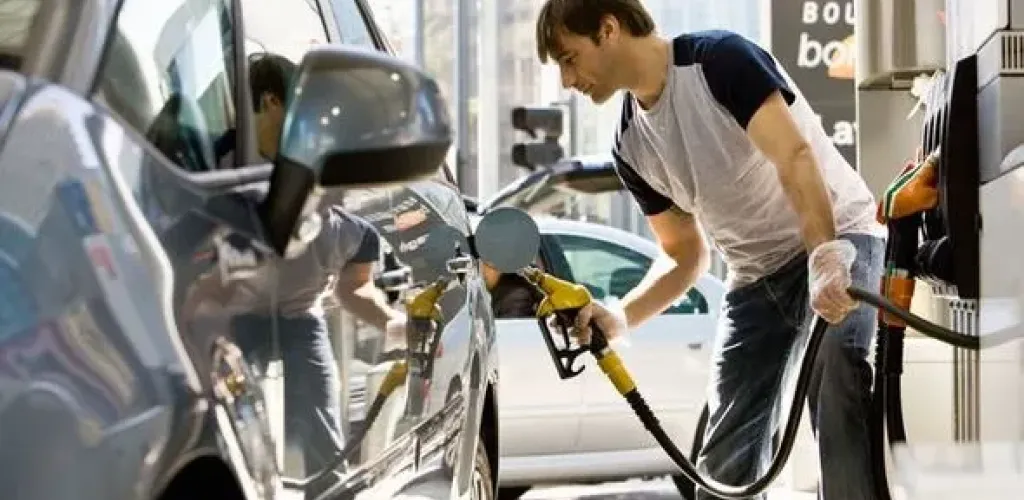
- Fill the tank completely until the first automatic stop
- Reset the trip meter to zero
- Note the exact odometer reading on the dashboard
2. Measurement period
- Drive in your usual style on typical routes (city, highway, motorway)
- For relevant results, cover at least 300-500 km
- Avoid significantly changing your driving style from normal
3. Final filling
- When the needle returns to the same position as the first fill (preferably near empty), refill completely
- Save the receipt showing the exact liters filled
- Check the kilometers traveled on the trip meter
4. Calculating consumption
- Apply the formula: Liters filled / Kilometers traveled × 100
Practical example:
- You filled 45 liters
- You covered 550 km
- Consumption = (45 / 550) × 100 = 8.18 L/100 km
5. Additional checks
For a complete picture of consumption:
- Urban consumption: measure separately under heavy city traffic
- Extra-urban consumption: test on open roads at a steady speed
- Mixed consumption: a combination of city and highway, most relevant for daily use
- Cold consumption: in winter months, when the engine requires more fuel for heating
Modern monitoring tools
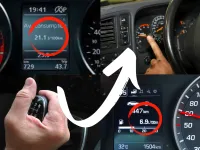
Most cars built after 2010 are equipped with onboard computers that display:
- Instant consumption (L/100 km or L/h at idle)
- The average consumption for the current trip
- The overall average consumption
- The estimated range based on the remaining fuel
These systems use advanced sensors and offer good accuracy (±5-10%), but they can deviate from real consumption calculated manually. For those seeking exact data, manual calculation remains the most precise method.
There are also smartphone apps such as Fuelio, Drivvo or Simply Auto that help you log fillings and track consumption over time, providing detailed statistics and graphs.
Factors influencing daily consumption
Driving style:
- Sudden accelerations and braking can increase consumption by up to 40%
- Maintaining a constant speed significantly reduces consumption
- Proper use of the gearbox (shifts at optimal RPM)
Road conditions:
- Heavy urban traffic increases consumption by 50-100% compared to highway
- Mountain roads with many climbs increase consumption
- Uneven road surfaces or pavements increase rolling resistance
Mechanical condition:
- Clogged air and fuel filters
- Worn spark plugs or dirty injectors
- Incorrect tire pressure (underinflated by 0.5 bar increases consumption by 5%)
- Old engine oil or oil of inadequate quality
Vehicle load:
- Every 50 kg extra increases consumption by about 1-2%
- Roof boxes increase aerodynamic drag
- Open windows at high speeds (over 80 km/h) increase consumption
Tips to Reduce Consumption
To achieve the best possible fuel economy:
- Regular maintenance: follow service intervals and use quality parts and consumables
- Correct tire pressure: check monthly and keep at the values recommended by the manufacturer
- Anticipative driving: anticipate traffic and avoid unnecessary braking
- Constant speed: use cruise control on highways
- Avoid prolonged idling: switch off the engine during stops longer than 30 seconds
- Efficient air conditioning: at low speeds open the windows, at high speeds use the AC
- Weight reduction: remove unnecessary items from the trunk
- Fuel quality: refuel at trusted gas stations
By applying these principles and constantly monitoring consumption, you will be able to achieve significant savings and contribute to protecting the environment.