- Angled parking suits tight spaces; approach slowly, 45-degree angle, use mirrors, exit easier.
- Parallel parking requires practice; 30–50 cm initial gap, reverse to 45-degree angle, straighten, center.
- Perpendicular parking is the simplest; align and reverse into the space.
Correct parking of a car is one of the most important skills a driver must master, especially in busy urban environments. The more crowded a city is, the harder it is to find a free parking space, and when you do find one you will quickly notice that it is very small and you will need to improve your parking abilities to manage. If you are among those who never liked parking, this guide will provide the techniques and tricks needed to park the car without issues and without scratching it.
Main Types of Parking
Before learning how to park correctly, it’s essential to understand that there are several types of parking, each with its own characteristics and specific techniques. The most common situations are when we need to park perpendicular, angled, or parallel to other cars. Each type of parking is different and has its own tricks that can help us make the operation much easier.
Angled Parking
Angled parking could be the best method to choose when space is tight and the parking space is small, but it all depends on how much room you have to execute the maneuvers. This technique is commonly found in multi-story parking lots and in commercial areas.
How to execute:
- Approach the row of parking spaces at a slow speed
- Point the front of your car toward the left side (or right, depending on the parking direction)
- Maintain an angle of about 45 degrees between your car and the car parked next to you
- Check the distance to the other vehicles using the mirrors
- Enter the parking space gently while keeping the angle constant
The advantage of this parking type is that it provides more maneuvering space than side parking and makes exiting the space easier.
Parallel Parking (along the curb)
It’s a technique that some people find more challenging because you must know exactly from which position to start the maneuvers and when to turn the wheel. However, once mastered, this method can help you park the car even in the narrowest spaces, with just two maneuvers.
Steps for correct parallel parking:
- Initial positioning: Position your car parallel to the other parked cars, beside the one in front, about 30–50 cm away
- Reference point: When your mirror aligns with the rear of the car in front, start turning the steering wheel fully
- First maneuver: Reverse with the wheel turned fully until the car forms an angle of about 45 degrees
- Direction adjustment: Straighten the wheel in the opposite direction to align the car parallel with the curb
- Finalizing: Adjust the final position to sit centered between the two cars
This technique requires practice, but once learned it becomes natural and extremely useful in busy urban areas.
Perpendicular Parking
The simplest type of parking and perhaps the one you should start with when you want to learn to park. When cars are parked perpendicular to the curb, position the car in the desired direction and simply reverse.
Execution technique:
- Identify the parking space and approach it from the correct side
- Drive past the space by about 1–1.5 m
- Check the available space using the mirrors and onboard cameras
- Put the car in reverse and begin turning toward the open space
- Adjust the angle to enter straight into the parking space
- Constantly monitor the distance to the adjacent cars
This type of parking is most common in public parking lots and shopping centers, where space is more generous.
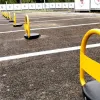
Essential Rules for a Perfect Parking
To ensure you can park without any problems and avoid scratching or hitting other cars, keep a few simple points in mind when it comes to parking.
Find the Right Parking Spot
Try to identify the space where your car can be parked most easily. When you have a choice between multiple positions, you should choose the one where your car is safest, even if you have to walk a little farther.
Selection criteria:
- Prefer spots that are 1–2 m longer than your car
- Avoid very tight spots between two large vehicles
- Consider the type of parking you can execute best
- Check that there is enough space to open the doors
- Ensure that the cars in front and behind won’t block you
Analyze the Position Correctly
In addition to maintaining a safe distance from the other vehicles so you don’t end up blocked in the parking, if you find only one free spot that is tight, you should try to gauge whether the car will fit before starting the parking maneuvers.
Preliminary assessment:
- Estimate the length and width of the available space
- Compare the dimensions with your car
- Check for obstacles (posts, high curbs, potholes)
- Consider the space needed for maneuvering
- Depending on the type of parking, you will need more or less space around the car
Always Use Turn Signals
We offer this tip so the parking operation goes as quickly and smoothly as possible. Signal your intention to park well in advance so the other drivers know you will slow down and to avoid potential collisions.
Why it is important:
- Prevent rear-end collisions with cars behind you
- Inform other drivers who might want the same spot
- Avoid forming a queue behind you
- Show respect to other road users
- Reduce the risk of misjudging space in a hurry
Park Properly and Follow the Rules
Even if you didn’t align correctly on the first try, we recommend making two additional adjustments and placing the car in the correct position. Never leave the car in an illegal position.
Mistakes to avoid:
- A wheel on the sidewalk – risks a fine and disturbs pedestrians
- The rear sticking out of the parking space – obstructs traffic
- Wheels on the line – you occupy two spaces and risk being hit by other cars
- Too close to other vehicles – risk scratches when opening doors
- Blocking access to other cars – you may be towed or fined
Additional Tips for Beginners
Use Modern Parking Aids
If your car is equipped with modern assistance systems, take advantage of them:
- Parking sensors: Help estimate the distance to obstacles
- Rear-view camera: Provides full visibility around the car
- Parking assist: On some cars it can automatically perform parallel parking
- Power-folding mirrors: Reduces the risk of collisions in tight spaces
Practice in Safe Conditions
Before venturing into busy traffic:
- Practice in empty parking lots
- Use cones or bottles to mark boundaries
- Try all types of parking
- Familiarize yourself with your car’s dimensions
- Learn to estimate distances using mirrors
Stay Calm and Take Your Time
Do not rush when you park:
- Even if there are cars behind you, focus on safety
- It’s better to back out and retry parking than to hit something
- Don’t be intimidated by impatient honking
- Precision is more important than speed
Conclusion
Proper parking of a car is a skill that improves with consistent practice. Whether you choose angled, side, or perpendicular parking, the key is to understand the specific technique for each type and apply it with patience and attention. Following the basics – choosing the right spot, correctly assessing the position, using turn signals, and parking correctly – will ensure not only the safety of your car but also that of other vehicles around. With time and experience, parking will become a natural and easy operation, even in the most challenging urban situations.