- Tires over 5 years pose major safety risk, regardless of tread
- Check the DOT code; last four digits show manufacture week and year
- Tread below 3–4 mm increases aquaplaning risk; inspect with coin, bars, or gauge
- Sidewall cracks or bulges signal structural damage and possible tire failure
Tires are the only point of contact between your car and the road, responsible for transmitting all braking, acceleration, and steering forces. Regardless of weather conditions or the type of driving surface, tires must perform optimally to ensure vehicle safety.
Keeping tires in good condition is not just about performance; it is a safety-critical matter. Damaged or worn tires significantly compromise braking distance, vehicle stability, and steering control, potentially leading to serious accidents.
Tire age - the critical 5-year barrier
The rubber from which tires are made is an organic material that degrades over time, regardless of mileage. After 5 years from the date of manufacture, the elastic properties of the rubber degrade irreversibly through:
- Oxidation - the rubber hardens and becomes stiffer
- Microscopic cracking - fine cracks that compromise structural integrity
- Loss of grip - compounds responsible for road grip degrade
Even if the tread appears to be in good condition, tires older than 5 years pose a major safety risk, especially at high speeds or in difficult weather conditions.
Tech tip: Check the DOT code on the tire sidewall — the last 4 digits indicate the week and year of manufacture (for example, 2319 means week 23 of 2019).
Tread wear - the critical 3 mm test
The tread depth is the most important indicator of tire condition. When it falls below 3–4 mm, water evacuation is dramatically reduced, increasing the risk of aquaplaning.
Methods for wear verification:
-
50-cent coin test: Insert the coin into the main grooves of the tread. If the coin shows more than halfway, the tires are critically worn.
-
Integrated wear indicators: These 1.6 mm high rubber wear bars run transversely across the tread and become visible when the tire is worn. When indicators appear in 2–3 consecutive locations, replacement is urgent.
-
Depth measurement with a tread depth gauge: Specialized tools provide exact measurements — below 3 mm for summer tires and below 4 mm for winter tires indicates the need for replacement.

Structural damage to the tire
Cracks and splits in the sidewalls
The sidewalls of tires are subjected to intense stresses and can exhibit a range of damage types:
- Radial cracks - from the rim edge toward the tread, caused by chronic underinflation
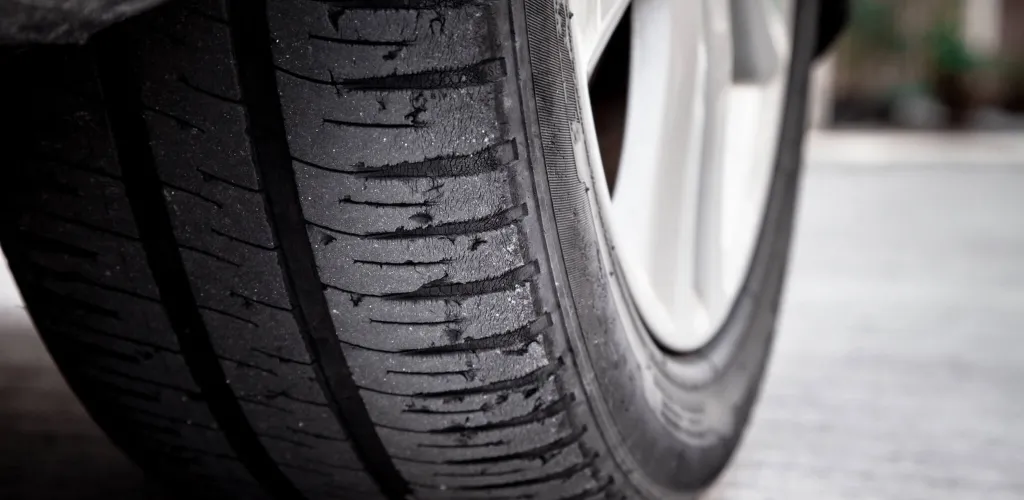
- Circumferential cracks - parallel to the tread, indicating aging rubber
- Crazing - fine surface cracks caused by UV and ozone exposure
These damages compromise the tire’s structural integrity and can lead to tire failure at high speeds.
Bulges and deformities - signs of impact
Bulges are visible blisters on the tire surface, caused by:
- Strong impacts in potholes or curbs
- Overinflation combined with impact
- Carcass manufacturing defects

A bulge indicates damage to the inner layers of the tire’s textile or steel cords, creating a weak spot that can burst without warning. Immediate replacement is mandatory.
Uneven wear - diagnostic for technical problems
Uneven wear is often the first sign of more serious mechanical problems:
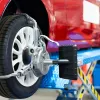
Types of wear and their causes:
-
Outer-edge wear:
- Underinflation
- Incorrect alignment (excessive negative camber)
- Frequent aggressive cornering
-
Inner-edge wear:
- Excessive positive camber
- Incorrect toe-in
- Worn suspension components
-
Cup wear (cupping):
- Faulty shocks
- Wheel imbalance
- Worn suspension components
-
Zig-zag wear:
- Incorrect pressure
- Excessive toe-in/toe-out
- Insufficient tire rotation
Loss of pressure - alarm signal
A tire that loses pressure steadily requires immediate investigation:
Common causes of air loss:
- Punctures by foreign objects - nails, screws, sharp stones
- Cracks in the sidewall - caused by aging or impact
- Valve issues - damaged or dirty valve
- Bead seal failure at the rim - caused by corrosion or deformation
- Rubber porosity - in very old tires
Inspection and maintenance schedule
Mandatory monthly inspection
- Check the pressure when the tires are cold (before starting the drive)
- Visual inspection of the tread and sidewalls
- Wear check with simple tests or specialized tools
- Balance check by observing vibrations at steady speeds
Preventive maintenance
- Tire rotation every 10,000–15,000 km for even wear
- Wheel alignment annually or after impacts with large potholes
- Balancing at mounting new tires or when vibrations appear
- Proper storage in cool, dry places away from direct sunlight
The safety risks of worn tires
Impact on braking performance
Worn tires dramatically increase braking distance:
- By 25–30% on dry roads
- By 50–70% on wet roads
- Increased risk of aquaplaning starting at 60 km/h in rain
Compromised vehicle stability
- Reduced handling in corners and during sudden direction changes
- Excessive vibrations transmitted through the steering wheel and chassis
- Increased road noise and passenger discomfort
- Higher fuel consumption due to increased rolling resistance
Effects on other components
Worn tires accelerate wear on:
- Suspension components - shocks/struts, springs, torsion bar
- Steering system - tie rods, steering linkage, rack
- Wheel bearings under uneven loading
- Braking system due to uneven heating
When to consult a specialist
Call a professional mechanic in the following situations:
- Unexplained rapid wear - under 20,000 km for summer tires
- Persistent vibrations at steady speeds (80–120 km/h)
- Abnormal road noise while driving - squeaks, thumps, rubbing
- Repeated uneven wear after tire replacement
- ** steering problems** - car pulls to one side
Professional diagnostics can identify issues in the suspension or steering system before they cause costly damage.
Investing in road safety
Timely replacement of worn tires is a crucial investment in road safety. New tires offer:
- Optimal grip on all surface types
- Minimum braking distances in critical conditions
- Ride comfort and reduced noise
- Long-term savings by avoiding costly repairs
Remember that tires are the safety element you cannot compromise - they are the only barrier between you and serious accidents.