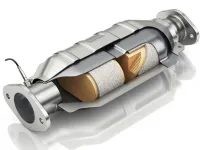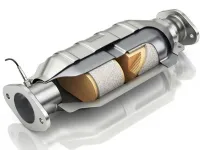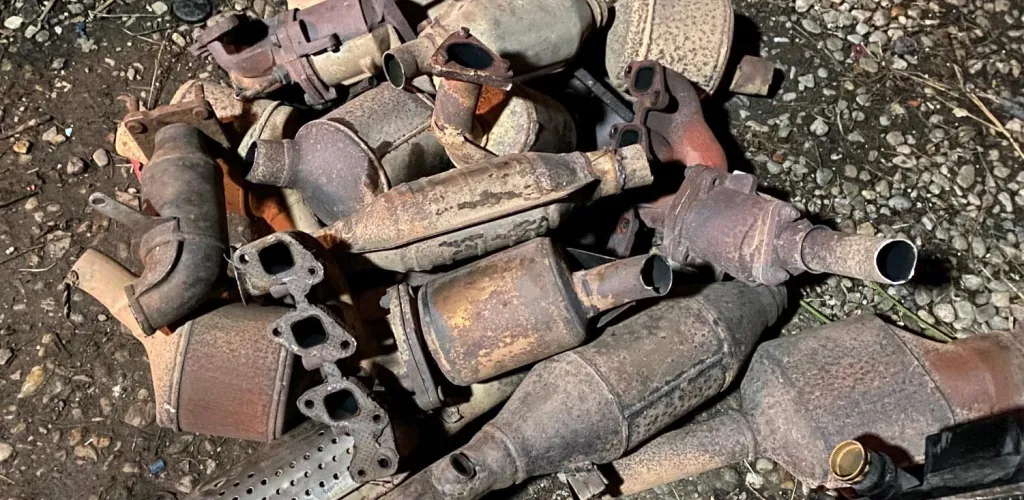
- Catalytic converters reduce engine emissions with precious-metal catalysts.
- They use a ceramic honeycomb with large surface area for reactions.
- Located under the car between the manifold and main exhaust pipe; operates at 400–800°C.
- Ferrari F430: two converters about $4k each; total ~ $10k.
The catalytic converter is one of the most expensive components in a passenger car. While many drivers know these parts carry high price tags and were frequently stolen in the past, few understand the essential role they play in the vehicle’s operation and in protecting the environment.
In this comprehensive guide, we explore in detail what a catalytic converter is, how it works, and the current prices on the auto market.
What is the catalytic converter and how it works?
The catalytic converter is an essential component of the exhaust system, with the fundamental role of reducing the engine’s harmful emissions. Located in the immediate vicinity of the exhaust valves, the converter transforms toxic substances in the exhaust gases into compounds that are less harmful to the environment.
Internal structure of the catalytic converter
Although externally the converter looks like a simple muffler, the technology inside is sophisticated. The main component is a ceramic honeycomb structure, coated with thin layers of precious metals. This structure has a massive surface area for contact – a typical converter can have over 45,000 cells through which exhaust gases pass.
When hot exhaust gases pass through this honeycomb structure, the precious metals act as a chemical catalyst, facilitating reactions that transform:
- Carbon monoxide (CO) into carbon dioxide (CO2)
- Unburned hydrocarbons (HC) into water (H2O) and carbon dioxide
- Nitrogen oxides (NOx) into nitrogen (N2) and oxygen (O2)
Location of the catalytic converter in the exhaust system
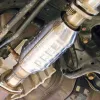
Exact location varies by vehicle model, but in general the converter is found under the car within the exhaust system, strategically positioned between the exhaust manifold and the main exhaust pipe. This placement is not accidental – the converter must be close enough to the engine to quickly reach the optimal operating temperature (roughly 400-800°C), but not so close as to be damaged by excessive heat.
The original part is usually welded at the factory for maximum seal, while during replacement the new catalytic converter is mounted with clamps and special gaskets, making future interventions easier if needed.
What are the average prices for a catalytic converter?
The price of a catalytic converter varies dramatically depending on the vehicle type, engine size, and the emission standards it must meet.
Luxury cars and supercars
In the premium segment, costs are considerably higher. According to industry analyses, the most expensive catalytic converter belongs to the Ferrari F430, which uses two converters, each valued at approximately $4,000. For this vehicle, replacing the entire catalytic system would cost around $10,000, just for the parts.
Most premium automakers such as Lamborghini, Ferrari, Porsche, or Aston Martin equip their vehicles with dual catalytic systems to meet stringent emissions standards while maintaining optimal engine performance. For these brands, the cost of replacing converters ranges from $6,000-$10,000, to which labor can add $1,500-$2,000.
SUVs and utility vehicles
For large-size and mainstream SUVs, prices remain substantial but more affordable than for luxury cars. In the case of a Ford F-250 pickup, a Mercedes X-Class, or a Jeep Grand Cherokee, the price of a catalytic converter ranges from $2,500-$3,000 for parts. Labor adds another $500-$1,000, depending on the complexity of the replacement and access to the component.
Reasons these vehicles require pricier converters include:
- Larger engines with greater cylinder displacement (3.0-6.0 L)
- Higher volume of exhaust gases to process
- Tighter durability requirements for heavy use
- More complex exhaust systems, often with a dual configuration
Compact cars and mid-size sedans
For everyday cars that dominate daily traffic — compact sedans, hatchbacks, mid-size sedans — the price of a catalytic converter is more affordable, between $1,000-$1,500 for OEM parts. Aftermarket parts can be found for $500-$800, but quality and durability vary significantly.
Labor costs for these vehicles are typically lower, between $200-$400, because access to the exhaust system is easier.
Additional replacement costs
It’s important to note that when replacing the catalytic converter, you will most likely need to replace other components of the exhaust circuit:
- Lambda sensors (oxygen sensors) – $100-$300 each
- New gaskets and clamps – $50-$150
- High-temperature bolts and nuts – $30-$80
- Possible exhaust pipe repairs – $150-$400
Why are catalytic converters so expensive?
The main explanation for the high cost of catalytic converters lies in the materials from which they are made. To better understand, let’s look at the components and processes involved.
Precious metals in the composition
Catalysts contain a combination of platinum-group metals, essential for the chemical processes that reduce emissions:
Platinum (Pt) – The most important catalytic metal, facilitates the oxidation of carbon monoxide and hydrocarbons. The current price of platinum is around $900-$1,100 per troy ounce (about $30,000 per kilogram). A standard converter contains between 3-7 grams of platinum.
Palladium (Pd) – Used mainly to reduce nitrogen oxides; palladium has become extremely expensive in recent years, reaching above $2,000 per troy ounce (about $70,000 per kilogram). The palladium content in a converter varies from 2-7 grams.
Rhodium (Rh) – The most expensive of all, rhodium can exceed $10,000 per troy ounce (about $350,000 per kilogram). The amount used is smaller, between 1-2 grams per converter, but its contribution to the price is significant.
The complex manufacturing process
Beyond raw material costs, producing a catalytic converter involves sophisticated manufacturing processes:
- Creating the ceramic substrate – The honeycomb structure must be perfectly uniform and resistant to extreme thermal shocks
- Applying the washcoat layer – A special ceramic compound that increases the active surface area
- Depositing the precious metals – A precise process requiring specialized equipment
- Encapsulation and thermal insulation – To protect components and prevent heat loss
- Testing and certification – Each converter must meet strict performance standards
Stricter emission standards
Emission standards are becoming increasingly stringent. Euro 6d standards and the forthcoming Euro 7 impose very tight limits for NOx, particulates, and other emissions. This means manufacturers must use more precious metals and more advanced technologies to meet requirements, further increasing costs.
Maintenance and inspection of the catalytic converter
To avoid the high costs of full replacement, proactive maintenance of the catalytic converter is essential.
Warning signs of catalytic converter problems
- Check Engine light – Often the first indicator of a problem
- Decreased engine performance – Power loss, poor acceleration
- Increased fuel consumption – A clogged converter forces the engine to work harder
- Unusual noises – Rattling or whining from under the car
- Rotten egg smell – Indication of incomplete processing of sulfur compounds
- Overheating in the engine bay – A blocked converter can cause heat buildup
Cleaning and regeneration methods
Before deciding on replacement, there are cleaning options that can extend the converter’s life:
Chemical cleaning – Special products added to the fuel tank to clean deposits. Cost: $50-$150.
Professional cleaning – Removal of the converter and cleaning with specialized equipment. Cost: $200-$400.
Thermal regeneration – Industrial process of controlled heating to remove deposits. Cost: $300-$600.
Importance for periodic technical inspection
During the periodic technical inspection (PTI), the proper operation of the catalytic converter is mandatory. The emissions test checks:
- CO (carbon monoxide) levels
- HC (hydrocarbons) levels
- Lambda (air-fuel ratio)
- Smoke opacity (diesel)
A faulty catalytic converter will automatically fail the PTI, and fines for driving without a valid PTI are significant. Additionally, driving a vehicle with excessive pollution emissions can incur additional penalties.
Conclusion
The car catalytic converter represents a significant but essential investment for the legal and environmental operation of a vehicle. Prices range from about $1,000 for compact cars to over $10,000 for supercars, justified by the precious metals in the composition and the sophisticated technology involved.
Preventive maintenance and periodic checks of the catalytic converter can extend its life and avoid hefty replacement costs. At the same time, the proper functioning of this component is crucial not only for passing the PTI but also for protecting the environment and reducing pollution in our cities.