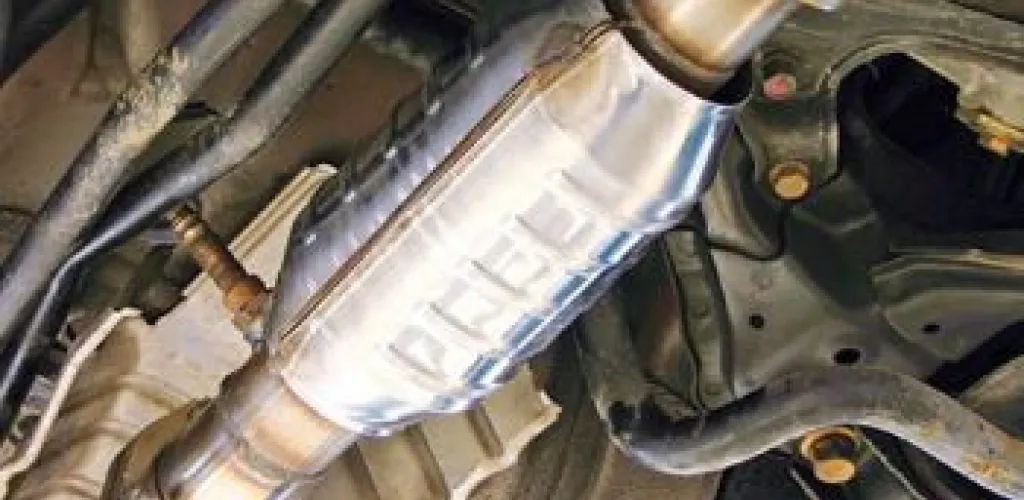
- Catalytic converters reduce emissions and last about 10-15 years or 150k-250k km
- Check engine light signals catalyst efficiency issues; codes include P0420, P0430, P0421/P0431
- A clogged converter creates backpressure, causing power loss and sluggish acceleration
- A faulty converter can increase fuel consumption by about 10-25%
The catalytic converter is one of the most important components of the exhaust system, responsible for reducing the engine’s pollutant emissions. This seemingly simple part plays a crucial role in the vehicle’s optimal operation and in protecting the environment.
Although designed to last for many years, the catalytic converter can develop various problems that significantly affect engine performance. Early identification of these problems can prevent costly engine damage and help keep the car within legal emissions limits.
What is the catalytic converter and how does it work?
The catalytic converter is a complex component placed in the exhaust system, usually between the exhaust manifold and the exhaust pipe. This part contains a ceramic or metallic honeycomb substrate coated with precious metals such as platinum, palladium, and rhodium.
These precious metals act as catalysts, facilitating chemical reactions that transform pollutant gases into less harmful compounds. Carbon monoxide is converted into carbon dioxide, unburned hydrocarbons are oxidized, and nitrogen oxides are reduced to nitrogen and oxygen.
The optimal operating temperature of the converter is between 400-800°C, at which its conversion efficiency can exceed 95%. This component has an average lifespan of 10-15 years or 150,000-250,000 kilometers, depending on operating conditions and engine maintenance.
Common symptoms of a faulty catalytic converter
Early recognition of fault signs can prevent costly damage and keep the vehicle operating normally.
1. Check engine light on the dashboard
The most common symptom is the activation of the check engine light on the dashboard. The engine management system constantly monitors the converter’s efficiency using oxygen sensors placed before and after it.

Error codes typically include:
- P0420 – Catalyst efficiency below normal threshold (Bank 1)
- P0430 – Catalyst efficiency below normal threshold (Bank 2)
- P0421/P0431 – Catalyst efficiency below threshold during heating
For manual diagnosis, a vacuum gauge connected to the intake manifold can be used. At idle, a normal reading is between 16-21 inHg (400-533 mmHg). When accelerating up to 3000 rpm, the vacuum should drop and then quickly return to the initial value. A slow return indicates exhaust restriction.
2. Loss of power and lag when accelerating
A clogged catalytic converter creates a backpressure in the exhaust system, restricting the flow of exhaust gases. This manifests as:
- Weak acceleration, especially on inclines
- Power loss at high revs
- Engine that seems to “suffocate” during acceleration
- Difficulties in overtaking
For manual testing, with the engine at 2000 rpm, the surface of the exhaust pipe will emit pulsating heat if the converter is clogged.
3. Increased fuel consumption
A faulty catalyst disrupts the air–fuel mixture balance, causing the control unit to compensate by injecting more fuel. Consumption may increase by 10-25%, depending on the degree of blockage.
This occurs because the lambda sensors cannot measure the oxygen content in the exhaust gases correctly, sending erroneous data to the ECU.
4. Distinct sulfur smell (rotten eggs)
Backpressure forces the engine to run with a rich fuel mixture. Unburned fuel reaches the catalyst, overheats it, and produces sulfurous compounds with a characteristic rotten-egg smell.
This odor is more pronounced:
- When starting a cold engine
- During accelerations
- When operating for extended periods at idle
5. Decoloration of the converter housing
Overheating causes discoloration of the housing metal, which takes blue or purple hues. This discoloration indicates temperatures above 900°C, which damages the interior ceramic substrate.
Overheating can be caused by:
- Engine misfires
- Too-rich fuel mixture
- Faulty or worn spark plugs
- Problems in the injection system
6. Difficulties starting the engine
A clogged catalyst creates backpressure that prevents complete exhaust of burned gases. At startup, gases remaining in the cylinders interfere with the next combustion cycle, causing:
- Difficult starting, especially when cold
- The engine stalls shortly after starting
- The need to blip the throttle to keep it running
7. Increased pollutant emissions
A faulty catalytic converter can no longer transform pollutant gases efficiently, resulting in:
- CO emissions rising by 300-500%
- Increased unburned hydrocarbons
- Emissions norms exceeding limits at inspections
- Failures in emissions tests
8. Engine misfires
Backpressure from the exhaust affects cylinder charging with fresh mixture, causing:
- Irregular combustion
- Engine vibrations
- Power losses
- Erosion of spark plugs and ignition coils
Main causes of catalytic converter failure
Understanding the causes helps prevent future problems and extend the life of this costly component.
Ignition system problems
Worn spark plugs, faulty coils, or damaged wires cause misfires that allow unburned fuel to reach the catalyst. It can ignite at high temperatures, damaging the ceramic substrate.
Injection system faults
- Dirty or stuck injectors
- Loose fuel pump
- Defective fuel pressure regulator
- Clogged fuel filter
These issues alter the fuel dose, creating overly rich mixtures that overburden the converter.
Engine wear
- Worn piston rings allowing oil to pass into the combustion chamber
- Intake or exhaust valves with faulty seals
- Intake manifold cracked
- Damaged head gasket
Burnt oil deposits coat the catalyst, reducing its efficiency.
Poor-quality fuel
Using fuel high in sulfur or with inappropriate additives can poison the catalyst, permanently reducing its conversion capacity.
Operation under extreme conditions
- Frequent short trips that don’t allow full heating
- Aggressive driving with abrupt accelerations and braking
- Improper engine maintenance
Professional diagnostics
For accurate diagnostics, specialized service shops use:
Gas analyzers - measure pollutant concentrations before and after the converter Oscilloscopes - analyze lambda sensor signals Infrared thermometers - check the temperature difference between converter inlet and outlet Endoscopes - visually inspect the interior condition of the catalyst
Replacement costs and available options
Costs vary considerably depending on several factors:
OEM converters
- Higher quality, maximum durability
- Extended warranty
- Cost: 1,500-4,000 lei for small/medium class cars
- Cost: 3,000-8,000 lei for premium or diesel vehicles
Aftermarket converters
- Variable quality, competitive prices
- Limited warranty (1-2 years)
- Cost: 800-2,500 lei
- Pay attention to compatibility with the engine management system
Universal converters
- Require mounting adaptations
- The most affordable option
- Risk of incompatibility with modern systems
- Cost: 400-1,200 lei + adaptation costs
Replacement labor
- 200-600 lei, depending on mounting complexity
- 2-4 hours of work for most vehicles
- Vehicles with restricted access may require more time
Preventive measures to extend the life of the catalytic converter
To avoid premature catalytic converter failure:
Regular maintenance:
- Spark plugs replacement per the manufacturer’s schedule
- Annual injection system check
- Use only high-quality fuels
- Replace the air filter per specifications
Driving style:
- Avoid very short trips where the engine doesn’t fully heat up
- Smooth driving, avoiding abrupt accelerations and braking
- Stop the engine immediately if misfires occur
Monitoring:
- Watch for the check engine light
- Periodic emissions checks
- Investigate any unusual odors
Conclusion
The catalytic converter represents a significant investment in the proper operation of the vehicle and in environmental protection. Early recognition of symptoms and addressing underlying causes can prevent major costs and keep the vehicle within legal emission limits.
Replacing this component should not be delayed, as a faulty catalyst can cause secondary engine damage, leading to much more expensive repairs. Investing in a quality catalytic converter, combined with proper engine maintenance, ensures reliable long-term performance.