- Converts CO, hydrocarbons, and NOx into H2O, CO2, and N2 at high exhaust temps.
- Uses ceramic honeycomb and precious metals (Pt, Rh, Pd) to catalyze reactions.
- New efficiency ~99%, dropping to about 95% with mileage.
- Placed close to engine to maximize high-temperature operation.
Catalytic converters are a crucial component for reducing harmful emissions and meeting environmental standards. This technical part transforms toxic gases from the exhaust into substances that are less harmful to the atmosphere, and it is mandatory on most modern vehicles.
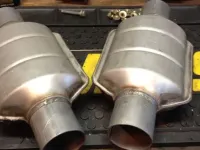
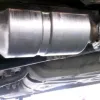
Technically, a catalytic converter is a device that facilitates chemical reactions to convert harmful gases in the exhaust into less dangerous substances before they are released into the atmosphere.
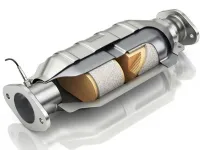
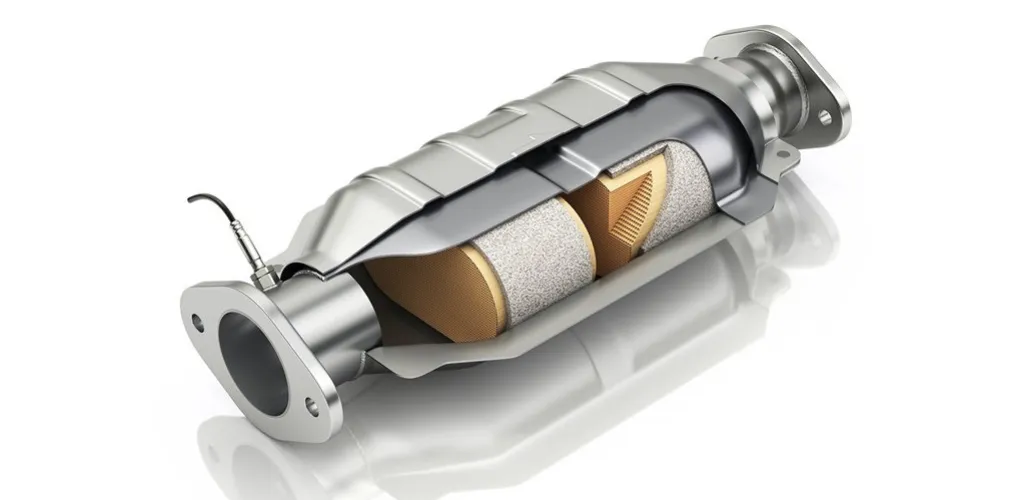
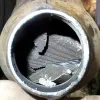
Modern catalytic converters have a ceramic honeycomb structure, where catalytic materials, mainly precious metals such as:
- Platinum - accelerates the oxidation process
- Rhodium - acts as a reducing agent for nitrogen oxides
- Palladium - facilitates the complete combustion of hydrocarbons
Although these are precious metals, the amounts used are relatively small — only a few grams per converter, enough to ensure the efficiency of the process.
What is the car catalytic converter?
From a technical standpoint, the catalytic converter or “catalytic converter” is a device that facilitates chemical reactions to convert toxic gases from the exhaust into substances that are less dangerous before their release into the atmosphere.
Catalytic converters in modern cars feature a ceramic honeycomb structure, where catalytic materials (primarily precious metals) are deposited, including:
- Platinum - accelerates the oxidation process
- Rhodium - acts as a reducing agent for nitrogen oxides
- Palladium - facilitates the complete combustion of hydrocarbons
While these are precious metals, the quantities used are relatively small — only a few grams per converter, enough to ensure process efficiency.
How does a car catalytic converter work?
The internal combustion engine produces several types of harmful emissions:
- Carbon monoxide (CO) - toxic colorless and odorless gas
- Unburnt hydrocarbons - volatile organic compounds
- Nitrogen oxides (NOx) - contribute to smog formation
The catalytic converter uses the high temperature in the exhaust (above 400°C) to facilitate chemical reactions that transform these substances into:
- Water (H₂O)
- Carbon dioxide (CO₂)
- Nitrogen gas (N₂)
This explains why you sometimes observe water droplets at the exhaust — a sign that the converter is functioning correctly.

Catalytic converter efficiency
A new catalytic converter has an efficiency of about 99%, which gradually drops to around 95% after tens of thousands of kilometers. For optimal operation, the converter is placed as close to the engine as possible to take advantage of the high temperatures required for the chemical reactions.
Symptoms of a faulty catalytic converter
Recognizing problems with the catalytic converter is crucial for maintaining engine performance and preventing further damage:
Main signs of failure:
- Engine stalls after starting — indication of severe blockage
- Delay in acceleration followed by sluggish gear changes
- Increased fuel consumption — up to 20-30% more
- Reduced power — engine no longer responds to demands
- Unstable idle — engine vibrates excessively
- Pungent odor when starting cold — sign of incomplete combustion
- Metallic noises from the catalytic converter area — possible damage to the ceramic honeycombs
If the catalytic converter’s efficiency drops significantly, the check engine light will illuminate on the dashboard.

Methods to clean the catalytic converter
Method 1: Cleaning by spirited driving
The simplest and most economical method involves:
- Fill with premium gasoline (higher octane)
- Warm up the engine to operating temperature
- Controlled spirited driving:
- Shift gears at the redline
- Downshift more frequently
- Keep the engine under load
- Maintain a minimum speed of 90 km/h for proper cooling
Warning: Do not attempt this method in the city! The risk of overheating and melting the ceramic honeycombs is real if you do not ensure adequate cooling through speed.
Method 2: Cleaning with chemical solutions
For manual cleaning:
- Carefully remove the catalytic converter
- Pre-cleaning with compressed air or water
- Apply the solution:
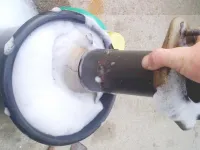
- Pour 500 ml of cleaner solution
- Cover both ends
- Agitate the solution inside
- Let it act according to instructions
- Final rinse with soap and water under pressure
Important: This method works only if the catalytic converter has not melted or cracked inside.

Replacement costs and maintenance
Prices for new catalytic converters:
- Entry-level range: 500-1,000 lei
- Mid-range: 1,000-2,500 lei
- Premium / high-performance vehicles: 2,500-5,000+ lei
Second-hand parts:
- At wrecking yards: about 500 lei (varies by model)
- Reconditioning: 300-800 lei plus the old part
Catalytic converter removal option
Advantages:
- Lower short-term cost
- Slight performance gains
- Eliminates risk of clogging
Disadvantages:
- Illegal — it will not pass the technical inspection
- Negative impact on the environment
- Increased exhaust noise
- Possible fines during inspections
Maintenance tips for the catalytic converter
Preventing problems:
- Use high-quality fuels — at least once a month fill with premium
- Avoid city-only driving — the catalytic converter needs high temperatures for self-cleaning
- Regular engine maintenance:
- Change air filters on time
- Use quality oil
- Check the fuel injection system
- Occasional spirited runs — for catalytic converter cleaning
Early warning signs:
- Gradual drop in performance
- Slightly higher fuel consumption
- Less stable idle
- Color of exhaust smoke
Recognizing and addressing these signs early can significantly extend the catalytic converter’s lifespan and avoid costly replacement.
The catalytic converter is a long-term investment in the health of the vehicle and the environment. Preventive maintenance and conscious driving can ensure optimal operation for hundreds of thousands of kilometers.