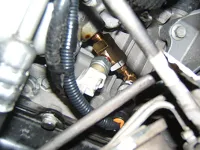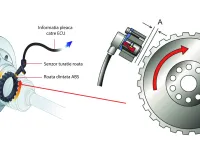
Parking sensors are features you can add to your car to make parking easier. Since they have proven their usefulness over time and are no longer considered just an accessory to have because others do, most new cars now come equipped with parking sensors from the factory.
Parking sensors are ideal in situations where you need confirmation that you’re properly oriented during parking, that you’ve correctly estimated the distance between the back of your car and nearby obstacles or other vehicles. If your car isn’t equipped with parking sensors, it’s good to know that you can purchase these components—either original or aftermarket—at any time and have them installed at an authorized service center.
What Is the Operating Mechanism and How Do Parking Sensors Help You?
Parking sensors form an electronic system that generally operates based on ultrasound or electromagnetic fields. Using these technologies, the sensors quite accurately measure the distance between the car and obstacles in front of and behind it.
Parking (proximity) sensors are usually mounted on the front and rear bumpers of the car. They detect obstacles that the car might hit when you’re parking and making multiple forward-reverse maneuvers. To warn you when you’re too close to obstacles around the car (fences, barriers, boundaries of underground/above-ground parking lots, other cars), the parking sensor system emits special sounds whose intensity increases and decreases depending on the distance between the car and the obstacle.
Currently, parking sensor systems have evolved, and now cars can display parking maneuvers, turning maneuvers, and even the exact distance between the car and the obstacle using the navigation system. Although assistance systems for orientation and easier parking—like parking sensors—have evolved greatly, it doesn’t mean you should abandon your driving instincts and rely 100% on the car’s electronic guidance.
There can be obstacles (e.g., lower curbs) that parking sensors cannot detect.
How Do You Know if the Parking Sensors on Your Toyota Yaris Are Not Functioning Correctly?
Like any car part or component, parking sensors have a longer or shorter lifespan depending on various factors (quality, maintenance). Parking sensors can malfunction and give errors, which is why we’ll show you how to recognize problems with the parking sensors on your Toyota Yaris.

The most common unpleasant situation with parking sensors is design defects. Many sensors are faulty from the factory and may not work at all. This happens with new cars and with sensor systems made in China that you purchase separately and then install on the car.
If even a single sensor out of the 4 or 5 you mount on the bumper is defective, your effort is in vain because the system won’t work.
In General, If the Parking Sensors on Your Toyota Yaris Have Problems, You Can Notice the Following Operational Errors:
- The sensors don’t transmit continuous messages; they work intermittently.
- Unusual sounds when the car is in reverse.
- Lack of sounds when an obstacle is detected.
- Errors in emitting sounds; the distances between the car and obstacles are no longer correctly signaled acoustically.
- Errors in estimating the distances between the car and obstacles.
If the parking sensors no longer function correctly, there’s always a risk of causing minor damage to the car. Considering there’s no dashboard warning light to alert you of a problem with the sensor system, it’s your responsibility to always ensure the sensors are in good working order. You should constantly check the accuracy of the parking sensors, especially if you tend to rely heavily on them when making parking or reversing maneuvers.
What Kind of Parking Sensors Fit the Toyota Yaris?
In the automotive market, several types of parking sensors are available, each with its advantages and disadvantages. The most well-known and widely used are ultrasonic sensors and electromagnetic sensors.
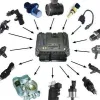
Ultrasonic Parking Sensors
Ultrasonic sensors are the most popular and use a well-known technology based on a control unit, a transmitter, and a receiver. The transmitter sends ultrasound to the receiver; the control unit measures and calculates the path of the ultrasound, and the sensors thus receive accurate data about the distance of various obstacles relative to the car.
The disadvantages of ultrasonic parking sensors include limited precision—they cannot recognize small obstacles or materials that do not stop ultrasound, such as plastic—and malfunctioning if they accumulate deposits or dirt.
Electromagnetic Parking Sensors
Electromagnetic sensors use electromagnetic field technology to measure the distance between the car and obstacles. The system contains a metal emission-reception strip that creates an electromagnetic field. When approaching an obstacle, the system, equipped with a processor, interprets the distance and emits warning signals.
Technologically, electromagnetic sensors are considered more advanced than ultrasonic ones. Additionally, they are more practical and aesthetically pleasing, as they can be mounted externally or internally without being visible.
What Budget Do You Need to Repair the Parking Sensors on Your Toyota Yaris?
As mentioned, parking sensors are useful features, but any driver should be able to manage very well without them. If your car is equipped with parking sensors and they have malfunctioned, you should consider repairing them. We recommend investing in repairing the parking sensors because they help you avoid obstacles more easily during parking, and it would be a shame not to benefit from this guidance if you already have them installed on your car.
The repair budget depends on several factors, primarily the type of sensors and how many sensors are defective. Replacing a single sensor can cost a few hundred lei, but the complete system can cost several thousand lei, including labor.