- Wheel speed sensors monitor wheel rotation and feed ABS, TCS, ESP, and more.
- They work via magnetic field changes from toothed reluctor rings to generate signals.
- Proper operation improves safety, braking efficiency, comfort, energy use, and emissions.
- Symptoms include ABS warning light, inconsistent braking, or traction/stability control issues.
Wheel speed sensors are essential components of modern vehicle safety systems. Present on every wheel of vehicles equipped with ABS, these sensors continuously monitor rotation speed and feed critical information to the ABS system and other electronic controls of the car. Their correct operation is vital for safe driving, directly influencing braking efficiency and vehicle stability.
This article explains how they work, their role across automotive systems, common symptoms of failure, and practical maintenance and replacement tips.
Principle of operation of wheel speed sensors
Wheel speed sensors, also known as ABS sensors, were originally implemented for the anti-lock braking system. Each wheel has its own sensor mounted near the brake disc or hub, depending on vehicle design.
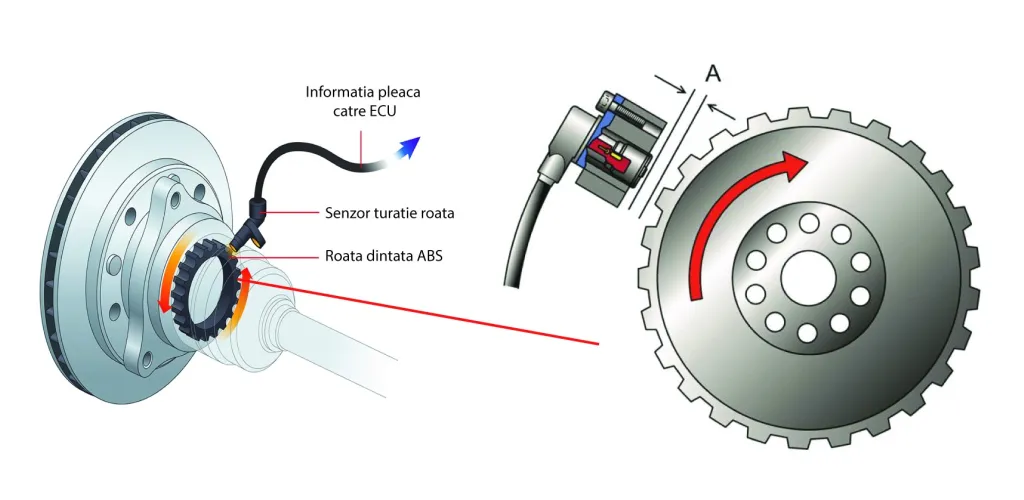
These sensors operate on the principle of detecting the magnetic field generated by a toothed wheel (reluctor ring) that turns with the wheel. When the wheel spins, the sensor detects changes in the magnetic field and generates an electrical signal that is sent to the control unit.
The signal frequency is directly proportional to the wheel’s rotation speed, allowing the system to determine precisely how many revolutions per second each wheel makes.
Role of wheel speed sensors in automotive systems
Wheel speed sensors provide data to multiple electronic systems in the vehicle:
- ABS (Anti-lock Braking System): Uses data to detect when a wheel is about to lock during braking. When the sensor detects that a wheel slows down sharply relative to others, the ABS reduces braking pressure on that wheel, preventing full lock and maintaining steering control.
- TCS (Traction Control System): Monitors wheel slip during acceleration, reducing power when slip is detected.
- ESP (Electronic Stability Program): Uses sensor information to detect and correct understeer or oversteer, applying selective braking to individual wheels.
- ACC (Adaptive Cruise Control): Uses data to compute the vehicle speed and maintain the set distance from the vehicle in front.
- Other systems: The engine control unit, automatic transmission, navigation system, and various driver-assistance systems also receive information from these sensors via the CAN bus.

Benefits of proper sensor operation
- Increased safety: Allows ABS to prevent wheel lock during emergency braking, reducing stopping distance and maintaining steering control.
- Improved comfort: Systems using this data can provide a smoother driving experience with softer transitions between acceleration and braking.
- Energy efficiency: By optimizing wheel slip and braking strategies, fuel consumption can be reduced.
- Lower emissions: More efficient power and braking management contribute to lower NOx emissions.
Symptoms of wheel speed sensor failure
Early recognition of ABS sensor problems can prevent dangerous situations and more costly secondary failures. Here are the main warning signs:

- ABS warning light: The most obvious symptom is the permanent ABS warning lamp on the dashboard. This indicates the system has detected a problem and has disabled ABS.
- Stored error codes: The control module will store diagnostic trouble codes (DTCs) that can be read with a scan tool. Common codes include C0035-C0050 for individual wheel sensors.
- Wheel locking during braking: Without correct sensor information, the ABS cannot function, causing wheels to lock under heavy braking.
- Unusual ESP behavior: The car may become unstable in corners or ESP may activate without apparent reason.
- Failures of other systems: Traction control, adaptive cruise control, and even the speed limiter may stop working.
- Abnormal fuel consumption: Some vehicles may show increased consumption due to the disabling of optimization features.
Common causes of sensor failure
Understanding the causes helps prevent problems:
- Normal wear: After many kilometers, sensors can deteriorate due to constant vibration and harsh operating conditions.
- Contamination: Dirt, oil, brake fluid, or rust on the reluctor ring or sensor tip can interfere with the signal.
- Wiring damage: Wires can be cut, broken, or corroded, especially in areas exposed to moisture and road salt.
- Mechanical issues: Excessive play in wheel bearings can alter the gap between the sensor and the reluctor ring, affecting signal quality.
- Reluctor ring damage: The toothed ring can crack, deform, or corrode, producing erroneous signals.
Diagnostics and replacement
Correct diagnosis requires a professional scan tool capable of reading error codes and verifying real-time signals from each sensor. The mechanic will inspect the physical condition of the sensors, wiring, and reluctor rings.
Replacing a faulty sensor is relatively straightforward, but attention to detail is essential:
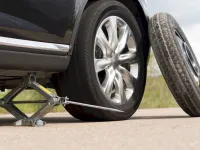
- Lift the car and remove the wheel
- Locate and disconnect the sensor
- Remove the mounting bolt (often corroded)
- Extract the sensor and clean the mounting area
- Install the new sensor with the correct torque
- Check the gap to the reluctor ring
- Reconnect and test the system
The cost of a sensor ranges between 100 and 300 lei, depending on the make and model of the vehicle, while labor is around 50-100 lei per sensor.
Preventive maintenance
To extend the life of wheel speed sensors:
- Periodically inspect the physical condition of the sensors and wiring during tire changes
- Clean the area around the sensors to prevent dirt buildup
- Periodically check wheel bearings
- Do not ignore the ABS warning light – diagnose the problem as soon as possible
- Use OEM or equivalent quality parts for replacements
Wheel speed sensors are small but vital components for the safety and performance of modern vehicles. Proper operation ensures that all electronic safety systems can function at optimal parameters, protecting you and other road users.
Photo source: instructables.com