- Missing mandatory car items incur separate fines per item.
- First aid kit fines: 590-725 lei.
- Two reflective triangles required; fines 580-725 lei each.
- All equipment missing can total up to 3,000 lei.
In Romania, driving on public roads comes with clear requirements for vehicle equipment. According to Government Emergency Ordinance No. 195/2002, every vehicle must be equipped with a first aid kit, two reflective triangles, and a fire extinguisher, all homologated. The absence of these items constitutes a contravention and can lead to substantial fines.
In this guide you will find all the necessary information about the fines, the legal requirements for each piece of equipment, and practical recommendations to stay compliant with road traffic legislation.
Fine amounts for missing equipment
Missing mandatory equipment in the vehicle is penalized as follows:
- For the first aid kit: fine between 590-725 lei
- For the reflective triangles: fine between 580-725 lei
- For the fire extinguisher: fine between 580-725 lei
- For the absence of all equipment: fines can be cumulated, reaching up to 3,000 lei
The exact amount of the fine depends on the decision of the authorized police authority and the specific circumstances of the control. It is important to note that each missing item constitutes a separate contravention, and fines may add up.
First aid kit
Regulations and legal requirements
The first aid kit is regulated by Minister of Health Order no. 987/2007 for approving the minimum content of the auto first aid kit. Not every first aid kit is acceptable — it must meet certain specific standards.
Mandatory technical characteristics
Before purchasing, ensure the first aid kit meets the following conditions:
Physical characteristics:
- Secure and airtight closing system
- Protection against dust, humidity, fuels, and oils
- Adequate dimensions to protect the contents
- Durable material suitable for vehicle conditions
Mandatory labeling:
- Product name
- Name and address of the manufacturer
- Name and address of the person responsible for placing the product on the market
- CE mark and homologation number
- Visible expiration date
Minimum mandatory contents
According to Order 987/2007, the kit must contain:
- Sterile bandages (various sizes: 6x8 cm, 8x10 cm, 10x12 cm)
- Sterile compresses (minimum 10 pieces)
- Leucoplast (minimum 5 m)
- Elastic bandage (6-8 cm wide)
- Textile triangular bandage for immobilization
- Disposable medical gloves (minimum 2 pairs)
- Medical scissors
- Instant cold packs (2 pieces)
- Hand sanitizer (minimum 100 ml)
- Instruction sheet in Romanian
Maintaining validity
Upon expiration, components must be replaced with others with the same characteristics, in accordance with HG No. 911/2005 on medical devices. Regular checks:
- Expiration date of sterile products
- Condition of packaging (no damage)
- Integrity of medications and sanitary materials
- Functionality of the closing systems
Reflective triangles
Specifications and mandatory standards
Drivers must hold two homologated reflective triangles according to:
- Geneva Agreement of 1958
- European standards ECE-R27
- Directive 2009/144/EC on vehicle reflective elements
Recognizing correct homologation
Legal triangles must have:
- Homologation mark with the letter “E” and country code (enclosed in a circle)
- Series number of the homologation
- Red reflectivity on all three sides
- Wind resistance and weather durability
- Solid mounting system
- Non-slip base
Necessary technical characteristics
Dimensions:
- The height of the sides must be at least 40 cm
- Reflective area must cover at least 70% of the total surface
Resistance:
- Wind resistance of at least 50 km/h
- Stability on uneven surfaces
- Resistance to temperatures between -40°C and +70°C
Proper use in traffic
In case of a breakdown or accident:
- Place the first triangle 30-50 meters before the vehicle (in towns)
- The second triangle at 100-150 meters (on national roads and highways)
- Position on the same lane as the immobilized vehicle
- Must be visible from at least 100 meters distance
- At night or in low visibility, increase the placement distance
Safety tips for mounting:
- Put on the reflective vest before exiting the vehicle
- Check traffic before stepping onto the roadway
- Place the triangle from the road edge toward the vehicle
- Ensure the triangle is stable and visible
Fire extinguisher
Legal framework and regulations
Extinguishers are regulated by Law No. 307/2006 on fire protection and the orders of the Minister of Internal Affairs. A functional extinguisher in the vehicle can prevent the spread of fire and save lives.
Compliance requirements and technical specifications
Mandatory technical specifications:
- Minimum capacity: 1-2 kg (for passenger cars)
- Recommended type: ABC powder (effective for A, B, and C fires)
- IGSU conformity certificate (General Inspectorate for Emergency Situations)
- CE mark and instructions in Romanian
- Functional pressure gauge to check pressure
- Activation lever in good condition
Maintenance and periodic checks:
- Check pressure monthly (green indicator = correct pressure)
- Replace at expiration date (shown on the label)
- Store at temperatures between -20°C and +60°C
- Position within easy reach in the vehicle (not buried in luggage in the trunk)
- Check physical condition (no rust, dents, or damage)
- Annual inspection by authorized personnel (for commercial vehicles)
Types of extinguishers recommended for vehicles
1. ABC powder extinguisher (most used):
- Universal, effective for all fire types
- Fires of type A (solids: upholstery, plastics)
- Fires of type B (flammable liquids: petrol, diesel)
- Fires of type C (gases: LPG, natural gas)
- Affordable price: 60-120 lei
- Lifespan: 5-10 years
2. AFFF foam extinguisher:
- Ideal for fuel fires
- Leaves no harmful residues
- Effective for enclosed spaces
- Price: 80-150 lei
3. CO₂ extinguisher:
- For electrical fires (car systems, batteries)
- Does not damage electronic components
- Leaves no residues
- Price: 100-180 lei
Correct usage mode
In case of a vehicle fire:
- Stop the engine and ignition immediately
- Evacuate all occupants
- Call 112 for assistance
- Retrieve the extinguisher and disengage the safety pin
- Stand at 2-3 meters from the fire
- Keep the extinguisher vertical and press the lever
- Direct the jet to the base of the flames
- Move the extinguisher in a zig-zag to cover evenly
Important: Do not fully open the hood if you see smoke — oxygen can intensify the fire. Open partially and spray through the gap created.
Practical tips for compliance
Mandatory periodic checks
Monthly:
- Verify the physical presence of all equipment in the vehicle
- Check the first aid kit’s condition (intact packaging, no damage)
- Check the reflectors for clear reflectivity and intact parts
- Check extinguisher pressure (green indicator)
- Ensure all equipment is accessible quickly
Semi-annually:
- Check expiration dates for each piece of equipment
- Replace expired components in the first aid kit
- Test closing and mounting systems
- Check labeling and homologation marks
- Clean and inspect extinguisher bottles
Annually:
- Full ITP inspection
- Replace damaged or expired equipment
- Update according to legislative changes
Estimated costs for 2024
Initial investment:
- Complete and homologated first aid kit: 80-150 lei
- Set of 2 homologated ECE-R27 reflectors: 40-80 lei
- Authorized vehicle extinguisher (1-2 kg): 60-120 lei
- Reflective vest (recommended): 15-30 lei
- Total cost: approximately 200-350 lei
Annual maintenance costs:
- Replacing first aid kit components: 30-50 lei
- Extinguisher check/refurbishment: 20-40 lei
- Total annual: 50-90 lei
Correct placement of equipment in the vehicle
First aid kit:
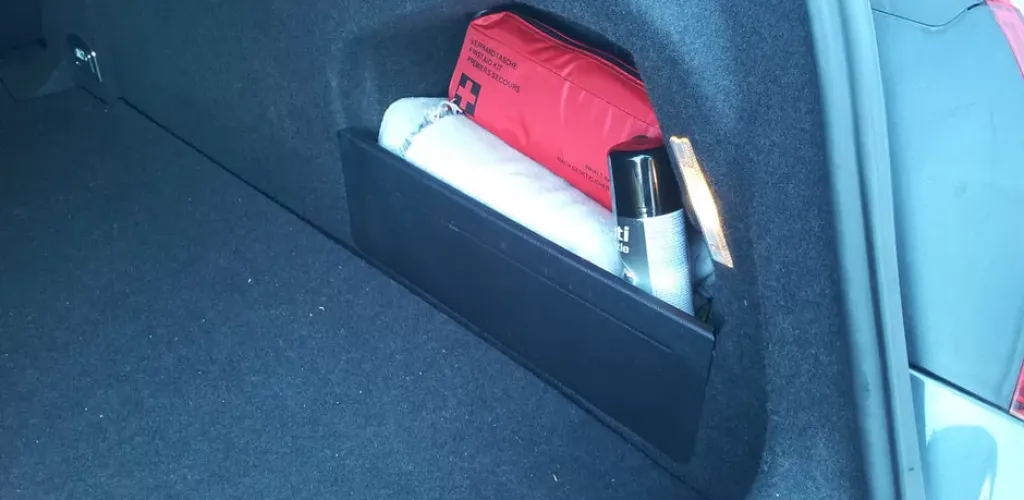
- Place in the trunk, in a fixed and accessible location
- Do not place under heavy luggage
- Protect from extreme temperatures (not near the hot engine)
- Mark the location for rapid access in emergencies
Reflective triangles:
- In the trunk or under seats, in a protective case
- Fixed to prevent movement during sudden braking
- Accessible without unloading the entire trunk
- Near the reflective vest
Fire extinguisher:
- Fixed rigidly in the trunk with special brackets OR
- Under the driver’s or front passenger’s seat (with approved mounting system)
- Accessible within a maximum of 5 seconds
- Positioned vertically with the valve up
- Do not block access with other objects
Legal consequences and risks
Legal and financial risks
Immediate penalties:
- Fines between 580-725 lei for each missing piece
- Possibility of cumulation up to 3,000 lei
- Obligation to present proof of equipment purchase within 48 hours
Issues at periodic technical inspection (ITP):
- Rejected at the ITP for missing mandatory equipment
- Additional costs for re-presentation
- Inability to circulate legally until obtaining the ITP
Insurance complications:
- Possible issues with compensation in case of an accident
- The insurer may invoke non-compliance with legal obligations
- Reduction of compensation amounts
Liability escalation in case of an accident:
- Missing medical kit can be considered an aggravating circumstance
- Increased liability if lack of equipment contributed to injuries
- Possible civil actions by victims
Safety risks and practical consequences
Medical emergencies:
- Inability to provide first aid until EMS arrives
- Worsening victims’ conditions in accidents
- Risk of infection when treating wounds without sterile materials
- Loss of precious time in lifesaving efforts
Breakdown or accident risks:
- Inability to correctly signal a immobilized vehicle
- Risk of another accident due to lack of warning
- Endangerment of vehicle occupants
- Potential chain accidents at night or in fog
Fire risks:
- Inability to extinguish a fire in its early stages
- Risk of rapid flame spread
- Total loss of the vehicle
- Risk of fuel tank explosion
- Serious injuries or fatalities among occupants
Benefits of compliance and safety
Legal benefits:
- Avoidance of substantial fines
- Full compliance during road checks
- Smooth ITP clearance
- Respect for road traffic laws
Safety benefits:
- Protection of occupants’ lives and health
- Ability to intervene quickly in emergencies
- Reduced risk of additional accidents
- Potential life-saving for yourself or others
Long-term financial benefits:
- Avoidance of fines
- Prevention of major losses in case of fire
- Avoidance of high medical costs
- Protection of vehicle investment
Social responsibility:
- Contribution to the safety of other road users
- Ability to assist in accidents
- Positive example for other drivers
- Respect for social conduct norms
Final recommendations
Following the obligation to possess a first aid kit, reflective triangles, and a fire extinguisher is not only a formal legal requirement but an essential safety measure that can make the difference between life and death in critical situations.
The approximate investment of 200-350 lei for initial acquisition of these items is negligible compared with:
- Fines up to 3,000 lei for not having them
- Medical costs in case of an accident
- Material losses in case of a fire
- The priceless value of human life
Periodic checks:
- Monitor changes or updates to legislation
- Check the condition and validity of equipment
- Ensure their functionality and accessibility in the vehicle
- Be sure you know how to use them correctly
Every driver has a responsibility not only to their own safety and that of their passengers but also to other road users. The mandatory equipment is an investment in safety that can save lives and prevent tragedies.
Keep these equipment items permanently in the vehicle, check them regularly, and ensure you know how to use them correctly in emergencies.