- Thunderstorms greatly reduce visibility, tire grip, and braking efficiency for drivers.
- Postpone travel until conditions improve if possible.
- Avoid flooded roads; hydro-lock and being swept away are real dangers.
- If you must drive, double or triple distance; braking worsens on wet roads.
Driving in a powerful thunderstorm is one of the most challenging tasks for any driver, regardless of experience behind the wheel. Extreme weather drastically reduces visibility, alters tire grip on the road, and significantly increases braking distances. Understanding the hazards and adapting driving behavior to these conditions can make the difference between a safe trip and a serious accident.
This guide explains the main risks and provides practical safety tips to help you stay in control when storms hit.
Risks of driving in a thunderstorm
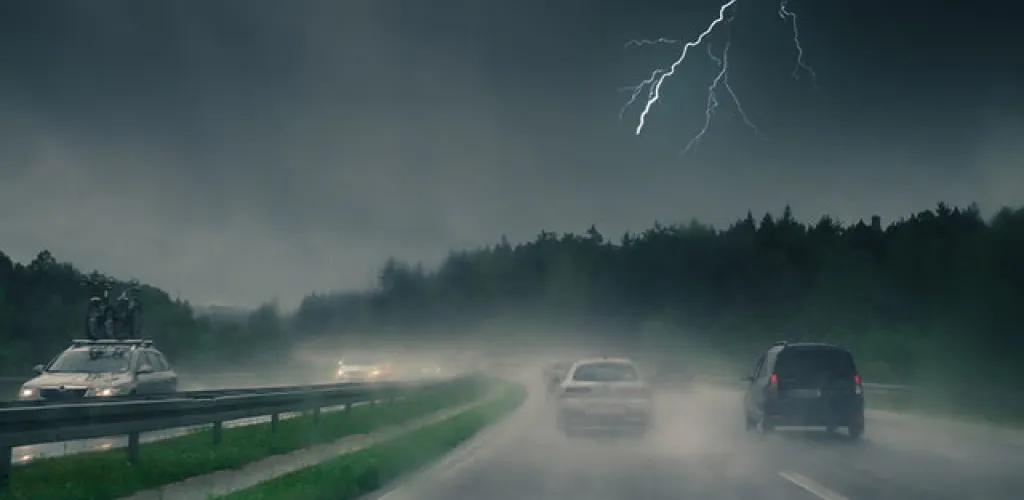
Thunderstorms are always accompanied by a combination of dangerous weather phenomena: torrential rain, strong gusts of wind that can destabilize the vehicle, drastically reduced visibility and deteriorated road conditions. Water accumulates on the road surface, creating a thin film between tires and asphalt, a phenomenon known as aquaplaning, which can cause a total loss of control.
In addition to these, storms bring other hazards: objects carried by the wind that can strike the vehicle, fallen trees blocking the road, localized floods turning roads into rivers, and lightning that can strike directly the car or surrounding infrastructure.
Is it safe to drive in a thunderstorm?
The short answer is: no, if you can avoid it. Weather safety experts’ guidance is clear — drive during a thunderstorm with thunder and lightning only if strictly necessary. If you are at home or at a safe location when the storm starts, postponing travel until conditions improve is advisable.
Statistics show that the accident risk rises by up to 70% in heavy rain, and during strong thunderstorms this risk is even higher. Reduced visibility, slippery roads and the unpredictability of other road users make driving a very dangerous activity.
Essential safety tips for driving in a thunderstorm
If the situation compels you to drive during a thunderstorm, following these rules can save your life:
Avoid flooded roads
This is the golden rule of driving in a storm. Never attempt to cross a flooded section of road, no matter how shallow the water appears. It can be extremely difficult to gauge the real depth, and what looks like a calm surface may hide a deep pothole or a drainage canal.
If your vehicle enters deep water, the motor can ingest water (a phenomenon called hydro-lock), leading to serious and costly engine damage. In extreme cases, the car can be swept away by the current. Even 30 centimeters of moving water can shift a vehicle.
Keep a greater safety distance
In a thunderstorm, the standard safety distance should be doubled or even tripled. The wet surface dramatically reduces braking efficiency — on a wet road, stopping distance can increase by up to 50% compared with normal conditions. At higher speeds, the difference is even more dramatic.
Avoid getting too close to the vehicle in front and never practice tailgating. You need extra time and space to react to any sudden maneuver by other road users.

Keep the vehicle watertight
Make sure all doors, windows and the panoramic sunroof (if present) are fully closed and locked. This prevents water from entering the cabin, which can damage the vehicle’s electrical system and create dangerous short circuits.
Beyond that, water inside the vehicle promotes corrosion and mold, and in severe indoor flooding, insurers may declare the vehicle a total loss.
Use the lights correctly
Proper illumination is essential during a thunderstorm. Turn on low beam headlights even during the day to stay visible to other drivers. If visibility is very poor (under about 100 meters), activate front and rear fog lights if your vehicle has them.
Do not use high beams in heavy rain — light reflects off water droplets and creates a white curtain effect that further reduces visibility. Ensure all lights are functioning correctly before setting off.
Significantly reduce speed
This is perhaps the most important safety measure. Reduce speed by at least 30-40% below the legal limit or the speed you would normally drive under normal conditions. On the highway, where the limit is 130 km/h, do not exceed 80-90 km/h in a strong thunderstorm.
Lower speed gives you more reaction time, reduces the risk of aquaplaning, and helps the vehicle maintain grip on the road. Remember: ABS and ESP are valuable aids, but they don’t work miracles on a water-covered surface.
Special dangers of lightning
Lightning poses an additional risk during a thunderstorm. While a car acts as a Faraday cage and offers relative protection in the event of a direct lightning strike, the risks remain considerable.
What to do if you’re caught in a thunderstorm with lightning at the wheel
If you notice frequent lightning while driving, the best course of action is to pull into a safe area and wait for the storm to pass. Choose an open place, away from tall trees, power poles or metal structures that could attract lightning.
Once stopped, stay in the car with the doors and windows closed. Do not touch metal parts of the vehicle — the steering wheel, metal levers, door handles. If the car is struck by lightning, the electrical current will travel through the metal body and discharge into the ground through the tires.
Turn off the engine and disconnect electronic devices plugged into outlets. Lightning can cause surges that damage the vehicle’s electronic systems.
Damage caused by lightning
A direct lightning strike on a vehicle can cause extensive damage:
- Electrical system: engine control unit (ECU), alternator, battery and fuses can be completely ruined
- Windshield and glass: the power of the strike can shatter glass
- Tires: the electrical current can discharge through the tires, which can explode or be severely damaged
- Bodywork: burn marks, holes or deformities may appear at impact points
- Electronic components: infotainment, navigation, sensors and cameras may stop functioning
In the most severe cases, a lightning-struck vehicle may be deemed a total loss, too costly to repair.
Additional tips for maximum safety
Check the vehicle condition before you set off
Before any trip in bad weather, ensure that:
- Tire tread depth is within the proper range (minimum legal 1.6 mm, recommended over 3 mm for wet weather)
- Wipers work correctly and blades are in good condition
- All lights are functional
- Windshield washer fluid level is topped up
- Defogging/defroster system works efficiently
Avoid sudden maneuvers
On wet roads, any sudden maneuver — acceleration, braking or steering — can lead to loss of grip. Drive smoothly and progressively, anticipate traffic situations and avoid abrupt changes in direction.
Be mindful of aquaplaning
Aquaplaning occurs when a film of water forms between the tires and the road, effectively allowing the vehicle to “float” on water. Signs of aquaplaning include:
- The steering becomes lighter and less precise
- The engine sounds louder (rpm rises as wheels skid)
- The vehicle tends to slide sideways
If you enter aquaplaning, do not brake abruptly and do not steer violently. Lift slightly off the accelerator and keep the steering wheel straight until the tires regain grip.
Conclusions
Driving in a heavy thunderstorm should be avoided whenever possible. If you are forced to drive, strict adherence to safety rules, reducing speed and heightened vigilance can make the difference between a safe trip and a serious crash. Remember that no meeting or appointment is worth risking your life or that of other road users. In case of severe thunderstorms, the safest course is to pull over and wait for the weather to improve.