- Romania’s signs follow European standards with seven categories and shape meanings.
- Warning triangles indicate hazards; circular signs ban/prohibit; shapes reflect priority.
- High-accident zones require 10 serious crashes in five years, drivers slow and stay vigilant.
- Internet connectivity center: blue rectangle with @; newer license holders know it.
Traffic on Romania’s public roads requires heightened attention to traffic signs, many of which are rarely encountered or not sufficiently known by drivers. While not all signs are new, some still cause confusion and can lead to undesirable situations. In this guide we detail four such signs and the obligations they impose on drivers.
Romanian road signs comply with European standards, Romania being a signatory to the Vienna Convention on Road Traffic (1968) and the European Agreement (1971). They are classified into seven main categories:
- Warning signs
- Priority signs
- Prohibition/restriction signs
- Mandatory signs
- Guiding signs
- Informational signs
- Auxiliary panels
The geometric shape of road signs carries a precise meaning: triangular for warnings, circular for prohibitions, and distinctive shapes for priority. Traffic signs undergo periodic updates, in line with traffic regulations established in different jurisdictions.
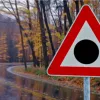
Area with high accident risk
Sursa foto: stirileprotv.ro
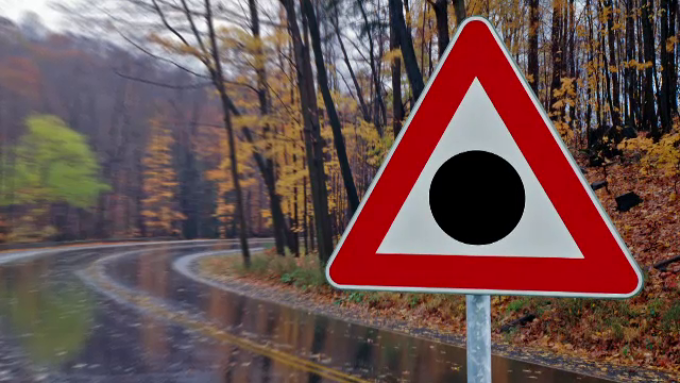
This warning sign, represented by a red triangle with a black dot in the center, is one of the least understood road signs introduced on Romania’s public roads. Its meaning is clear and alarming: it marks a stretch of road with a high risk of road accidents.
Installation criteria
For this sign to be installed, the stretch must meet strict conditions: at least 10 serious road accidents over five consecutive years, resulting in at least 10 victims, whether injured or killed.
Obligations for drivers
- Exercise heightened caution in traffic
- Reduce your speed
- Increase attention to the road and to other road users
- Anticipate potential dangerous situations
Geographical distribution
Only in Bucharest are there 33 zones where this indicator is installed, but it is also found in many other cities. In Cluj, for example, such a sign marks Dealul Feleacului. Nationally, DN1 has 37 such signs, DN2 has 21, and DN7 has 16, these being the national roads with the most marked hazardous zones.
Internet connectivity center

Sursa foto: capital.ro
This informational sign, represented by a blue rectangle with the “@” symbol on a white background, is familiar mainly to those who obtained their driving license in recent years. For other drivers, the meaning may seem enigmatic.
Purpose of the sign
The sign indicates the immediate proximity of an internet access center. On the main panel or on an additional panel the exact distance to the respective center may also be written. This type of sign belongs to the information signs category and serves to facilitate access to digital services for travelers.
The Bucharest Main Ring
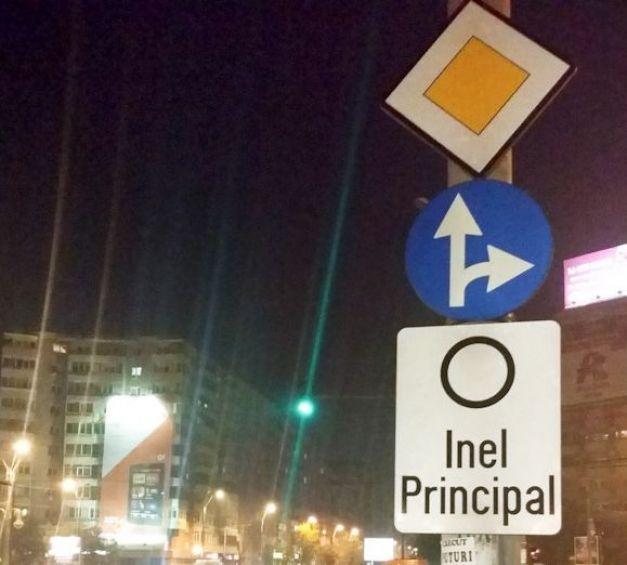
Sursa foto: wordpress.com
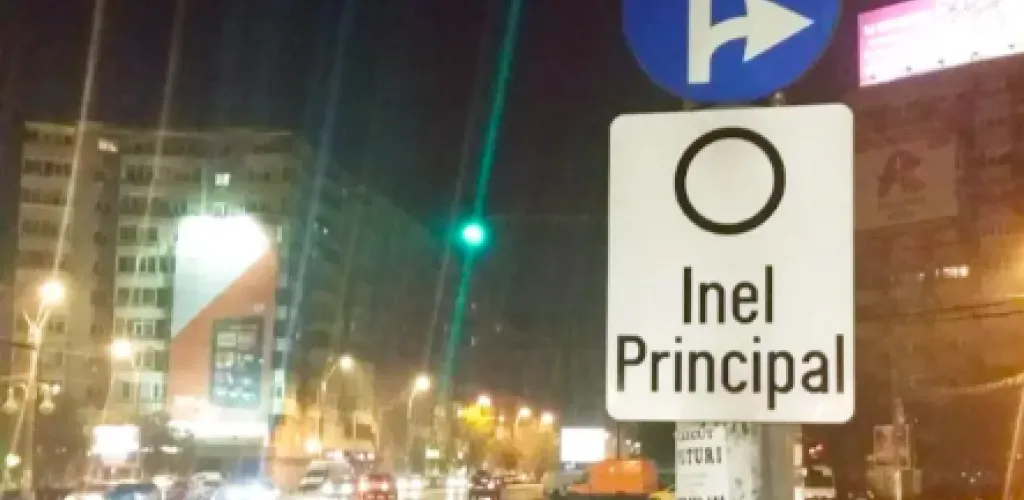
This orientation indicator, represented by a black circle on a white background, was introduced in Bucharest in 2015 and causes confusion especially for drivers from outside the capital or those who do not regularly travel on main routes.
Route of the Main Ring
The Main Ring defines the following route: Uranus Boulevard – 13 Septembrie Avenue – Libertății Boulevard – Mitropolit Nifon Street – 11 Iunie Street – streets in the Șerban Vodă area (multiple one-way streets) – Mărășești Boulevard – Nerva Traian Boulevard and adjacent streets – Dacia Boulevard – Mihai Eminescu Street – Mircea Vulcănescu Street – returning to the Uranus area.
The complete ring system
Bucharest will benefit in the future from an integrated system of three rings:
- The Central Ring will have the route: Uranus Blvd – 13 Septembrie Avenue – Libertății Blvd – Mitropolit Nifon Street – 11 Iunie Street – streets in the Șerban Vodă area (multiple one-way streets) – Mărășești Blvd – Nerva Traian Blvd and adjacent streets – Dacia Blvd – Mihai Eminescu Street – Mircea Vulcănescu Street – returning to the Uranus area.
- The Middle Ring will be positioned between the Main Ring and the Beltway, thereby complementing the city’s traffic flow management system.
Attention to phone or smartphone use
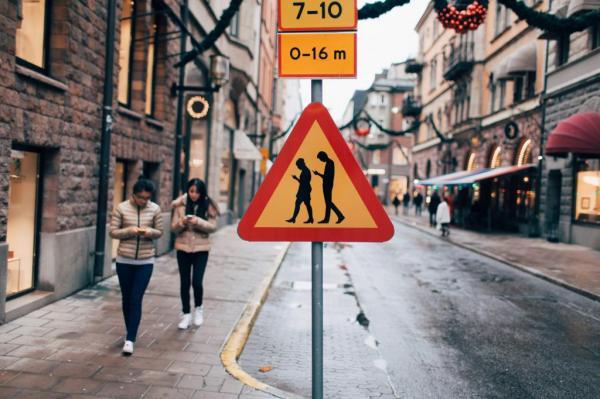
Sursa foto: greatnews.ro
Although this indicator has not yet been implemented in Romania’s road legislation, it is likely to be introduced in the near future. Originating in Stockholm in 2016, the sign has since been adopted by many other cities in Sweden and other European countries.
Context and necessity
In the context of technological progress and increasing dependence on mobile devices, pedestrians pay less and less attention to road traffic. This sign aims to warn both drivers and pedestrians about the danger of smartphone distraction in high-traffic areas or at pedestrian crossings.
Relevance for Romania
Given the global trend toward digitalization and the rising number of accidents caused by pedestrian inattention, implementing this sign in Romania could contribute to road safety, especially in busy urban areas and at pedestrian crossings near educational institutions or shopping centers.