- On ramps, climber has priority over the descender when space is tight.
- Overtaking near ramp top with visibility under 50m is prohibited; stopping on ramps is forbidden.
- Heavier vehicles have priority; descending car yields to ascending truck; coordination via radio possible.
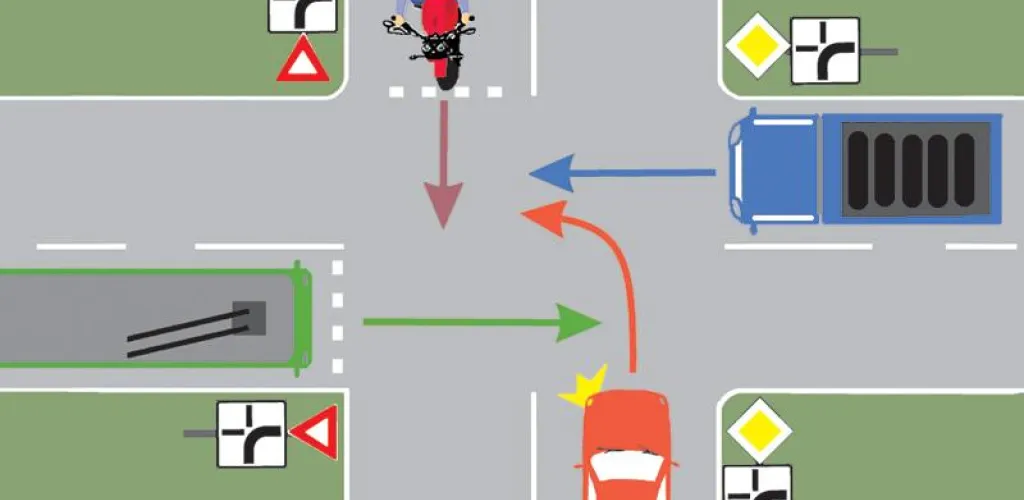
- At unsignaled intersections, yield to vehicles from the right; left-turning yields to right.
Traffic on the road often involves complex situations where drivers must make quick decisions about who has the right of passage. Two of the most common dilemmas faced are giving priority on ramps and applying the right-hand rule correctly. These situations can cause confusion and even accidents if not understood.
Knowing traffic rules precisely and applying them across different road contexts is essential for the safety of all road users. Also, in certain situations, road courtesy and common sense can complement the legal framework to ensure smooth and safe traffic.
Right-of-way on ramps: rules and practical considerations
The difference between ramp and slope
Before discussing priority, it’s important to clarify the terminology. A ramp refers to the stretch of road we ascend, while a slope refers to the portion we descend. This distinction is crucial for understanding priority rules.
General priority rule
According to the Romanian Traffic Code, when two vehicles meet on a ramp or slope and there is an obstacle on the carriageway beside which both vehicles do not fit, the vehicle that climbs the ramp has priority over the one that descends the slope.
This rule rests on solid technical principles: the vehicle that climbs requires more motor effort and is harder to restart from a standstill on an ascent.
Restrictions and limitations in ramp areas
Near the top of the ramp, if visibility is less than 50 meters, any overtaking maneuver is prohibited. Also, along the entire length of the ramp or slope, stopping of vehicles is strictly prohibited to avoid creating additional obstacles.
Practical considerations and road courtesy
While the legal rule is clear, practical application is affected by road courtesy, which may modify how priority is applied:
Differences in vehicle mass:
- When vehicles of different mass meet, the heavier vehicle has priority
- A car descending a slope yields to a truck ascending a ramp
- Conversely, it is wiser to yield to a descending truck to avoid overloading its braking system
Communication between professional drivers: Truck drivers often communicate via radio to coordinate safe crossings when visibility allows.
Tips for managing ramp situations
- Avoid accelerating to ‘win’ priority
- Assess the situation calmly and apply common sense
- Consider the technical characteristics of the vehicle in front
- Maintain safer following distances, especially on inclines
Right-of-way: when and how it applies
Fundamental rule
At unsignaled intersections (no traffic signs or signals), the driver must yield to vehicles coming from the right. This rule forms one of the foundations of road traffic.
Specific application situations
Unsignaled intersections:

- Any vehicle coming from your right has priority
- The rule applies regardless of the width of the street or size of the vehicle
Left turns: In unsignaled intersections, when turning left, you must yield to vehicles approaching from the opposite direction.
Important exceptions
Roundabouts: At roundabouts, vehicles already inside the roundabout have priority. Once inside, you have priority over those waiting to enter.
Priority roads: On roads marked with priority signs, the right-hand rule does not apply.
Tips for correct application
- In case of uncertainty, apply the right-of-way rule
- Slow down approaching intersections
- Visually check for traffic signs
- Signal your intentions
Evolution of road traffic in Romania
Early steps in motoring
At the beginning of 1904, Romania had only 51 motor vehicles registered, compared with nearly 9 million in 2021. The first car was already on the road since 1889, but widespread adoption was slow.
Development of road education
In 1906 the first driving school was established in Bucharest by the Automobil Club of Romania. The measure was necessary due to the high number of accidents reported for the 100 registered cars.
Historic driving exams and practical tests
License exams were held on Șoseaua Kiseleff in the north of the capital and included:
- Reaction time test: A police officer threw a pillow in front of the car, simulating an obstacle
- Avoidance test: The applicant had to avoid the obstacle by braking or evasive maneuvers
- Safety evaluation: Success depended on the safe execution of the maneuver
Simplicity of the old rules
Traffic rules were much simpler and fewer. Penalties were noted directly on the pages of the driving license, which resembled a small notebook. The likelihood that several vehicles would meet at the same place was extremely small.
Challenges of modern traffic
Problems of current infrastructure
Romania faces:
- Significant deficit of highways
- Poor roads with many potholes
- Abandoned or poorly executed roadworks
- Projects implemented only on paper
Aging vehicle fleet
Vehicles in Romania are aging, with multiple technical issues affecting road safety.
Deficient road education
Many drivers exhibit:
- Lack of respect for traffic rules
- A sense of ownership on the road
- Misunderstanding of priority rules
- Aggressiveness in traffic
Impact on safety
The combination of deficient infrastructure, aging fleet, and poor road education contributes to more accidents on Romania’s roads.
Conclusion
A correct understanding of ramp priority and the right-of-way rules is essential for road safety. While legal rules provide a clear framework, practical application often requires common sense, especially in complex situations involving vehicles of different mass.
Road education continues and adherence to traffic rules remain key to improving safety on Romanian roads. In the context of insufficient infrastructure and an aging fleet, individual responsibility among drivers becomes even more important.