- Dumitru Vasescu built Romania’s first car (1880) with steam power, metal rims, dual brakes.
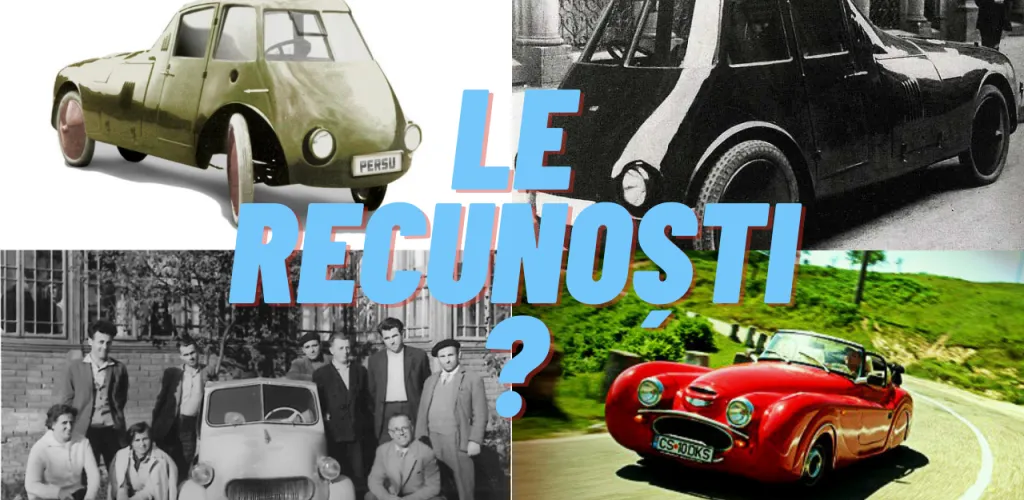
- Aurel Persu’s 1921 aerodynamic vehicle had wheels integrated into the body, coefficient 0.22.
- Radu Manicatide’s MR Roadster: two units, rear two-stroke engine, 11.5 HP, 70 km/h.
When we talk about Romania’s automotive industry, most of us immediately think of Dacia, ARO, or Oltcit. However, the history of Romanian automobiles does not begin with these famous brands; its origins lie much earlier, in the 19th century, when Romanian ingenuity gave birth to remarkable inventions that foreshadowed mass production by decades.
The first attempts to build Romanian cars date back to 1880, and over the following decades Romanian inventors created vehicles with technical features surprisingly advanced for their time, some of them comparable to modern standards.
Dumitru Vasescu - the Pioneer of Romanian Automobiles (1880)
The first Romanian car was built in 1880 by engineer Dumitru Vasescu, originally from Iași. After going to Paris to study engineering, Vasescu established a mechanical workshop in the capital of France, where he designed and built the first Romanian car capable of moving on both roads and rails.
The car of Vasescu was powered by a steam engine and featured a few technical characteristics revolutionary for its era:
- Metal rims with rubber tires (unlike the wooden wheels of carriages)
- A braking system made of two independent mechanical components
- Capable of traveling on public roads
When the automobile appeared on the streets of Paris, it attracted the attention of the entire press, being regarded as something truly revolutionary. Vasescu brought the vehicle to Romania in 1906 to be displayed in Bucharest. Unfortunately, both the car and its inventor faded into the mists of time — Vasescu died in 1909, and his model was never found.
Aurel Persu and the World’s First Aerodynamic Vehicle (1921)
Thirteen years after Vasescu’s death, another Romanian engineer would revolutionize the auto industry again. Aurel Persu invented in 1921 the world’s first aerodynamic vehicle, with wheels integrated into the bodywork—a concept that the auto industry would adopt only decades later.
Remarkable technical performance
The Persu car boasted impressive technical specifications:

- Aerodynamic coefficient: 0.22 (comparable to a modern Ferrari)
- Proven reliability: 120,000 kilometers covered without major issues
- Revolutionary design: wheels fully integrated into the body
Persu built his car in Germany, where he also obtained a patent for the invention. Upon returning to Romania, he donated it to the Dimitrie Leonida Technical Museum in Bucharest, where it remains today. Unfortunately, the vehicle is not in good technical condition—the wooden chassis has deteriorated significantly and requires urgent restoration to prevent the loss of this technical jewel.
MR Roadster by Radu Manicatide
Radu Manicatide, another talented Romanian engineer, created the MR Roadster, a sports car produced in only two units at IAR Brașov. This small and agile car had the following technical characteristics:
- Engine: two-stroke, motorcycle-type, mounted at the rear
- Power: 11.5 HP at 4,000 rpm
- Top speed: 70 km/h
- Weight: 270 kg
- Fuel consumption: 4.5 L/100 km
- Seats: two
- Design: elegant bodywork inspired by the Jaguar XK120
The Malaxa Car — the Interrupted Dream (1945)
In 1945, at the end of the war, Romania was on the verge of having its own developed automotive industry through the Malaxa car, built in Reșița in Nicolae Malaxa’s factories. The project was led by a large team of engineers and technicians, headed by Petre Carp.
Advanced technical specifications
The Malaxa car featured an unusual and high-performance technical configuration:

- Engine: 3-cylinder star configuration with air cooling
- Power: 30 HP
- Engine position: rear-mounted, rear-wheel drive
- Total weight: 150 kg (engine, differential and gearbox)
- Capacity: up to 6 people
- Top speed: 120 km/h
- Consumption: 10 L/100 km
- Comfort: body mounted on a chassis with 10 cm thick rubber pads
The body had an aerodynamic silhouette with the trunk at the front. To ensure engine cooling, a gap between the roof and canopy allowed air to be channeled — a clever solution to cooling an air-cooled engine.
The abrupt end of the dream
Between 1945 and 1947, about 800 cars per year were produced, most destined for export. Unfortunately, the beautiful dream ended after the war, when our country was occupied by the Russians. Leonid Brezhnev, the communist leader at the time, impressed by what he had seen in Reșița, decided to move the entire assembly line to the USSR, in the Urals. Thus, Romania lost a promising automotive industry that could have altered the course of its industrial history.
Romanian artisanal automobiles of the 1950s
In the 1950s, before the appearance of Dacia, Romanian engineers continued to experiment and create vehicles in private workshops:
Gheorghe Gal’s three-wheeled car
In Bucharest, a small three-wheeled car drew everyone’s attention. It was designed and produced in a workshop belonging to Gheorghe Gal, a former champion and record holder in motorcycling in the 1930s. This artisanal vehicle showed that the passion for automobiles remained alive among Romanian specialists.
Rodica car (1957)
In 1957, in Brașov, Nicolae Lucaci invented the Rodica car, a two-seater with a front-mounted engine, equipped with a three-speed transmission. Although it was a modest project, it demonstrated the continuity of the Romanian innovator spirit.
International Context — From Cugnot to Modern Cars
To better understand the context in which Romanian cars developed, it is important to mention that the world’s first car benefited from a steam engine and was invented in 1770. It was called Cugnot, named after the inventor Joseph Cugnot, and today it is housed in Paris at the Musée des Arts et Métiers.
The Cugnot vehicle featured a large boiler in front where the steam for propulsion was produced. The Cugnot weighed around 2.5 tons and could reach a speed of only 3.6 km/h.
The Legacy of a Disrupted Industry
The history of Romanian automobiles before Dacia shows that our country possessed both technical and human potential to develop a strong automotive industry. From Vasescu’s steam engine to Persu’s revolutionary aerodynamic design, and up to the near-industrial production of the Malaxa car, Romania demonstrated it could be competitive in this field.
Unfortunately, historical and political contexts interrupted this natural evolution, and when Dacia appeared in 1966, it represented a new beginning rather than a continuation of a tradition. Yet these early achievements remain testimonies of Romanian technical genius and of a much richer automotive history than commonly known.
Knowing this history helps us understand that Romania’s automotive industry did not spring into existence with Renault-related agreements, but had deep roots in the innovative spirit of Romanian engineers who, decades earlier, were already building cars with remarkably advanced technical characteristics for their time.