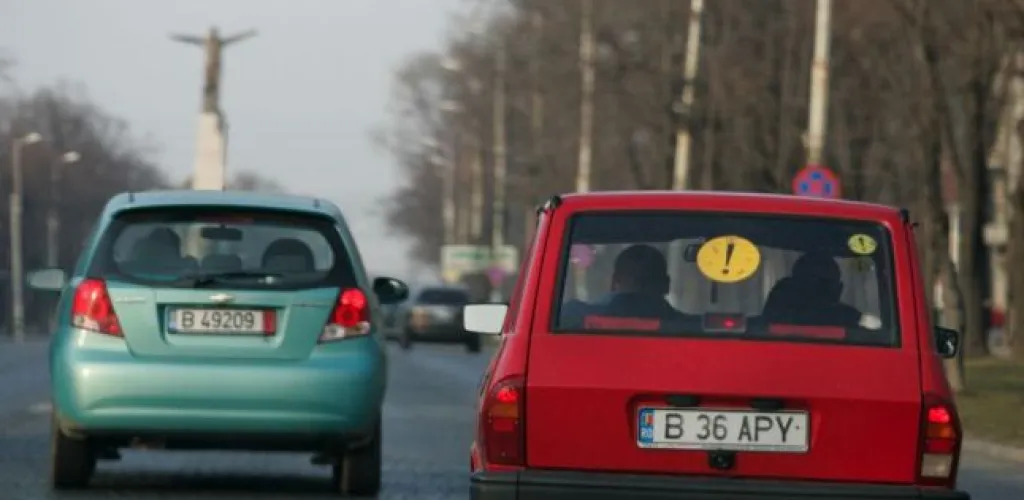
- Beginner drivers must display a yellow exclamation sign for the first year.
- Prohibited in year one: goods or dangerous substances, testing, and taxis.
- You can drive abroad; Romanian license valid in the EU and many others.
- Prepare before travel: check local rules, speed limits, equipment, and alcohol limits.
Becoming a newly licensed driver brings the thrill of independence behind the wheel, but also new responsibilities. Many beginner drivers wonder whether they can travel abroad in their own car within the first year after obtaining the license. The good news is that Romanian law does not prohibit this, but there are important rules to know and follow.
This article explains the current regulations for the first year and provides practical guidance for safe international driving.
What restrictions do beginner drivers have in Romania
Obligation to display the distinctive sign
According to Article 149 of Emergency Ordinance no. 195/2002, any driver with less than one year of driving experience must display a distinctive sign in the form of a yellow disc with a diameter of 100 mm. This sign contains in the center a black exclamation mark, with a height of 60 mm and a dot diameter of 10 mm.
Placing the sign varies depending on vehicle type:
- Motorcycle: at the rear, next to the license plate
- Automobile: on the windshield at the bottom right and on the rear window at the bottom left
- Automobile without rear window: on the windshield at the bottom right and on the body at the rear left upper
- Tram: on the windshield at the bottom right and on the rear window of the last carriage at the rear left upper
- Automobile with trailer: on the windshield of the vehicle at the bottom right and on the trailer’s body at the rear left upper
Restrictions regarding vehicle types
In the first year of experience, beginner drivers are prohibited from:
- Driving vehicles that transport goods or dangerous substances
- Driving vehicles intended for testing or trials
- Driving vehicles intended for public transport of people, including taxis
Speed limits for beginners
Although not explicitly mentioned in the quoted fragment of law, beginner drivers must respect the speed limits specific to the first year of experience. It is important to verify these restrictions and to comply with them at all times.
Can you drive abroad as a beginner driver?
Yes, you can drive abroad even if you are a beginner. Romanian law does not prohibit this anywhere. Your driving license is valid in all European Union countries and in many other states with which Romania has bilateral agreements.
However, there are a few important aspects to consider:
Preparation before travel
Inform yourself about local laws. Each country has its own traffic rules, and some may have special regulations for beginner drivers. Check:
- Speed limits in the destination country
- Priority and parking rules
- The equipment that must be in the car
- Whether you must display the beginner sign according to local rules
- The maximum blood alcohol level (may be zero for beginners)
Assess your abilities. Driving abroad can be challenging even for experienced drivers. Consider:
- The distance you plan to travel
- The type of road (highway, main roads, mountain routes)
- Expected traffic during the trip
- Weather conditions
- The possibility of driving on the opposite side of the road (in countries like the United Kingdom)
Specific challenges for beginner drivers
Even if the law allows you to drive abroad, limited experience can make the trip more demanding:

Fatigue at the wheel. Long distances and the concentration required can be exhausting. Take frequent breaks (every 2 hours or 150 km) and don’t push yourself if you feel it’s too much. It’s better to split the journey into two days than risk an accident.
Busy highways. High European highway traffic can be overwhelming for a beginner. The emergency lane isn’t always present, and cars travel at high speeds. Prepare mentally and avoid peak times if possible.
Navigating in new cities. Navigation systems help, but it’s easy to miss an exit or end up in the wrong lane in an unfamiliar city. Plan the route in advance and identify critical junctions.
Tips for your first international journey
Before departure
- Check the car’s technical condition (tires, brakes, fluids, lights)
- Ensure you have all necessary documents (driving license, identity card, insurance valid abroad)
- Install a reliable navigation app with offline maps
- Inform someone about your route and expected arrival
During the journey
- Strictly respect speed limits and local rules
- Do not push yourself if you feel tired – stop and rest
- Maintain a longer safety distance from the vehicle in front
- Be attentive to road signs, which may differ from those in Romania
- Do not be intimidated by drivers who flash or horn – drive at your safe pace
Importance of obeying the law from the start
It is essential to develop good driving habits from the start. Many studies show that habits formed in the first year of experience stay with the driver long-term. If you get used to speeding or ignoring rules, it will be much harder to change these behaviors later.
License suspension for beginners. One important point to remember: if your license is suspended in the first year, you do not have the option to take an exam to reduce the suspension period. This means you will have to serve the entire period, which could be one month, three months, or even longer, depending on the severity of the violation.
Conclusions
Yes, you can drive abroad as a beginner – Romanian law does not prohibit this. However, the decision must be informed and responsible. Assess your abilities honestly, prepare properly, and don’t rush to cover very long distances if you don’t feel comfortable.
Defensive driving and adherence to traffic rules are fundamental, especially in the first year. Each safe kilometer adds to your experience as a driver. Don’t be swayed by other drivers who seem more confident or faster – your safety and that of other road users is the number-one priority.
Always consult official sources and do not rely on advice from social networks without verification. Traffic legislation is clear and publicly available, and obeying it is not optional – it is a responsibility you assume when you get behind the wheel.