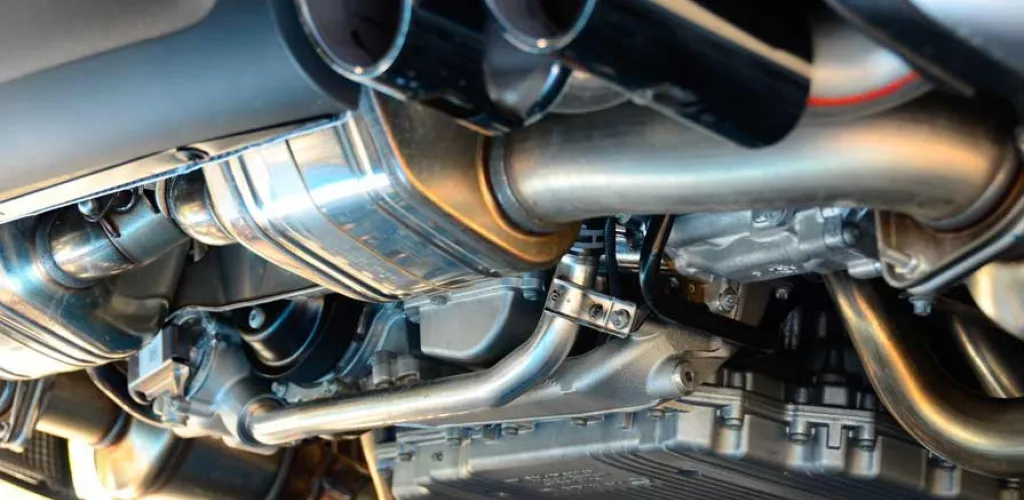
- The secondary air pump injects fresh air into exhaust to cut pollutants.
- It operates during cold starts, early catalyst warm-up, and sudden accelerations, ECU-controlled.
- Benefits include emissions compliance, better fuel efficiency, and catalytic converter protection.
- Symptoms of failure include reduced power, misfires, unstable idle, and vibrations.
The secondary air pump is a key component in modern vehicle emissions control systems, often referred to as the ‘smog pump’ for its role in treating exhaust gases. It injects fresh, oxygen-rich air directly into the exhaust manifold, significantly reducing pollutant emissions.
Developed to meet progressively stricter European emission standards, its primary function is to supply additional oxygen to the burnt gases in the exhaust, enabling post-combustion that converts hydrocarbons and carbon monoxide into less harmful compounds.
How the secondary air pump works
The secondary air pump operates on the principle of injecting fresh air into the flow of exhaust gases. It is powered electrically or mechanically, depending on the vehicle’s system, and is controlled by the engine control unit (ECU).
Operating phases
The system operates under the following conditions:
- During cold starts: When the engine is cold, combustion is not optimal and more pollutants are produced
- In the first minutes of operation: Until the catalyst reaches its optimal operating temperature (about 400°C)
- During sudden accelerations: When the air-fuel mixture becomes temporarily rich
The post-combustion process enables complete or near-complete combustion of the fuel before the exhaust gases exit the exhaust system. Incomplete combustion produces hydrocarbons as pollutants, which can be significantly reduced by installing an efficient air pump.
Benefits of a functional system
- Emissions compliance: Strict vehicle emission rules require a functional air-pumping system
- ITP test success: If emissions do not meet standards, the vehicle may fail the regulated emissions test at ITP
- Improved fuel efficiency: An optimized system contributes to more complete combustion
- Protection of the catalytic converter: Reducing the load on the catalyst extends its life
Symptoms of a faulty secondary air pump
Early detection of failure signs can prevent more serious and costly issues. The vehicle requires sufficient air to run optimally, and a faulty air pump manifests through several characteristic symptoms.
Reduced engine power
A faulty air pump can cause a noticeable drop in engine power. This performance decrease is especially evident:
- During acceleration: The engine seems to lug and responds poorly
- When climbing hills: The vehicle becomes sluggish and requires higher RPMs
- During overtaking: Power is noticeably lacking during rapid acceleration
Overall engine performance will be affected, and the driver may experience a car that seems to suffer from misfires during acceleration, with fluctuations and jolts.
Uneven engine operation
This symptom appears as:
- Fluctuations in acceleration: When the accelerator is pressed, the response is irregular
- Unstable idle: The engine cannot maintain a steady idle
- Abnormal vibrations: The vehicle vibrates more than normal
These issues arise either from insufficient fuel delivery or inadequate air supply. In most cases, the first diagnosis should target the air pump, though in some situations the problem may be related to the fuel system.
Check engine light on the dashboard
In most modern vehicles, the on-board diagnostic system can detect a faulty air pump. When this happens:
- The light comes on: You will see the check engine light illuminated on the dashboard
- Error codes: The system will store specific codes in the ECU memory
- Delayed detection: The light may illuminate only for a complete fault, not for a marginal issue
It is important to note that a check engine light does not indicate only a problem with the air pump—there can be multiple faults. For an accurate diagnosis, a professional auto scanner is required.
Lifespan of the secondary air pump
Under normal usage, the secondary air pump has remarkable durability:
New vehicles
If you own a new vehicle, you should not expect to replace the air pump within the normal lifespan of the car, except in special cases:
- Accidents: Direct impact to the exhaust system
- Water intrusion: Water ingress into the internal system
- Premature wear: Due to inadequate maintenance
Lifespan-influencing factors
- Fuel quality: Poor fuel quality can accelerate wear
- Operating conditions: Driving in harsh conditions (dust, extreme temperatures)
- Regular maintenance: Regular air and oil filter changes
Replacing a faulty air pump
Replacing the air pump varies by vehicle, but general principles apply to most cases.
Preparation for intervention
Before starting work, the following precautions are necessary:
- Disconnect the battery: Remove the negative terminal to avoid short circuits
- Cool the engine: Let the engine cool completely
- Prepare the tools: Ensure you have all necessary tools
Replacement steps
Removing components:
- Remove the belt from the pump by releasing its bracket
- Inspect both the belt and electrical connections for damage
- Replace the belt or electrical connections if needed
- Create space to gain optimal access to the air pump
Disconnecting the pump:
- Remove protective caps and covers
- Disconnect all electrical connections from the pump
- Remove the faulty pump from its mount
Installing the new pump:
- Install the new pump in the same orientation as the old
- Reconnect all connections in the same configuration
- Reinstall covers and shielding
- Install the belt and adjust its tension

Final checks:
- Reconnect all electrical connections
- Reconnect the negative battery terminal
- Start the engine and check operation
- Use a test unit to confirm the repair
Estimated costs
Costs to replace the air pump vary widely:
- Parts: 300-800 lei, depending on the make and model
- Labor: 150-300 lei, depending on the complexity of the job
- Diagnostics: 50-100 lei for problem identification
Preventing failures
To avoid issues with the secondary air pump, follow these recommendations:
Regular maintenance
- Air filter replacement: At the manufacturer’s recommended intervals
- Use of quality fuel: Avoid fueling at stations with a questionable reputation
- Periodic checks: Regular inspections at authorized service centers
Early warning signs
- Unusual noises from the engine area
- Increased fuel consumption
- Odd smells from the exhaust system
- Irregular operation at idle
Conclusion
The secondary air pump functions as the lungs of the exhaust system, being essential to keeping a vehicle in compliance with emission standards. The importance of this component goes beyond mere operation, directly affecting:
- Legal compliance: Meeting European emission standards
- ITP success: Avoiding failures at emission tests
- Environmental protection: Significantly reducing pollutants
- Economic efficiency: Optimizing fuel consumption
A functional secondary air injection system is not just a technical requirement but an investment in the vehicle’s durability and environmental protection. Early diagnosis and repair can prevent costly failures in other exhaust system components, such as the catalytic converter or lambda sensors.
For precise diagnosis and professional repair, it is recommended to consult an experienced technician who can perform specialized tests and identify the exact cause of your vehicle’s emission issues.
Photo source: philkotse.com, knowhow.napaonline.com