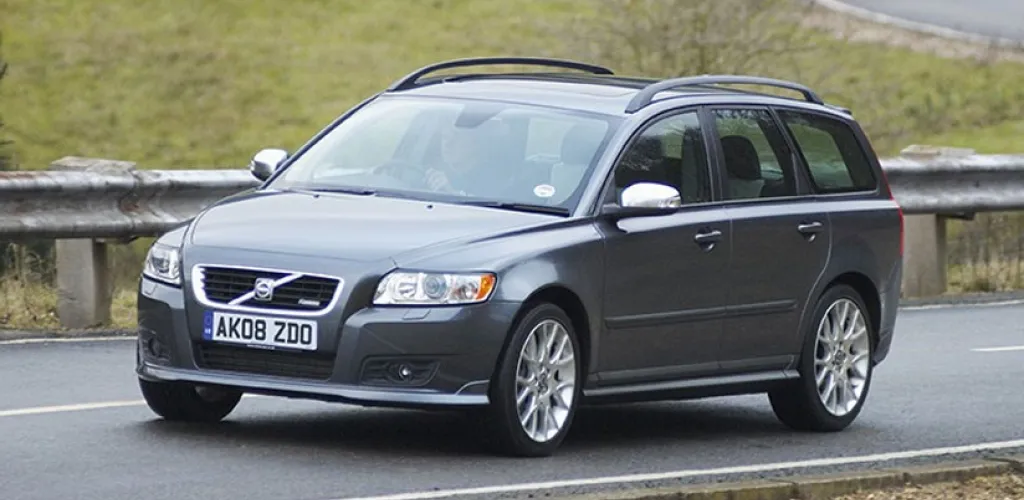
- 2008 facelift updated styling with optional active xenon headlights.
- 2009 T5 AWD available in the US; 2010 diesel 2.0 dropped.
- Common problems, especially on diesel: ECU, automatic gearboxes, turbo, DPF, injectors.
- Owners praise space, safety, reliability; easy city driving, comfortable long trips.
Volvo V50 represents the wagon version of the S40, introduced for the first time at the Bologna Motor Show in 2003. Built on the Ford C1 platform alongside the European Ford Focus and Mazda 3, this compact family car benefited from Volvo Intelligent Vehicle Architecture technology and the safety systems the Swedish brand is known for.
Throughout its lifecycle, the V50 received several important updates: in 2008 it gained a facelift with revised front styling and optional active xenon headlights, while in 2009 the T5 version became available in the US only with all-wheel drive. From 2010, the 2.0 diesel engine was no longer offered in the range.
Real Owner Experiences with the Volvo V50
Reasons for choosing a V50 2.0D (136 HP)
Pipas Mihai: “Because I needed a car that was both practical and comfortable. Being engaged, I needed a trunk large enough for all the future wife’s luggage, without sacrificing power or comfort.”
Nicu Popa: “For interior space, engine, power, reliability, safety.”
Man Horațiu: “I bought it for looks, safety, stability, etc.”
Common Problems Volvo V50 (2004-2012)
Based on owner feedback and technical data, the following recurring issues have been identified:
- ECU: engine control unit can develop faults that affect performance
- Automatic gearboxes: the automatic transmission system shows vulnerabilities over time
- Turbocharger: the turbocharger can have issues on high-mileage vehicles
- DPF: the diesel particulate filter requires regular maintenance
- Injectors: the fuel injection system can develop costly faults
These problems are particularly common on diesel models and may appear after the first 150,000–200,000 km, depending on the maintenance history.
Full Engine Range
The V50 benefited from a diversified range of engines, tailored to different needs and markets.
Gasoline engines:
- 1.6 B4164S2: 99 HP, 150 Nm - entry-level option
- 1.8 B4184S2: 123 HP, 165 Nm - balance between economy and performance
- 2.0 B4204S3: 143 HP, 185 Nm - the reference naturally aspirated engine
- T5 B5254T7: 227 HP, 320 Nm - performance turbo version
Diesel engines:
- 1.6D D4164T: 108 HP, 230 Nm - economical diesel for city driving
- D2 D4162T: 113 HP, 270 Nm - improved variant of the small engine
- 2.0D D4204T: 134 HP, 320 Nm - balanced diesel motor
- D5 D5244T8: 178 HP, 350 Nm - high-performance diesel with five cylinders
- D5 D5244T13: 178 HP, 400 Nm - final version of the D5 engine
The T5 AWD engine offers all-wheel drive and represents the top of the range, equipped with a DOHC system with variable cam timing.
Driving Experience and Real-World Fuel Economy
The Volvo V50 delivers a balanced driving experience, combining the comfort of a family car with the dynamics of a compact sedan.
On-Road Behavior
Man Horațiu: “In the city it’s very easy to drive. On long trips it’s even easier than in town.”
Pipas Mihai: “In the city it feels smooth, especially since it’s a diesel and the car is surprisingly quiet. Outside the city it’s fun to drive, and when it comes to overtaking with the accelerator pinned, it really puts you in the seat.”
The suspension is tuned for comfort, and Volvo safety systems provide confidence in all road conditions. The high level of sound insulation makes the V50 an excellent choice for long-distance travel.
Practical fuel consumption for V50 2.0D (136 HP)
Owners report the following real-world consumptions:
Man Horațiu: “About 7 L/100 km on rough roads where you can’t maintain a constant speed for more than a few kilometers.”
Pipas Mihai: “Acceptable around 5 L/100 km outside the city and 7 L/100 km mixed, based on trips in Brașov and surroundings.”
Nicu Popa: “About 5 L/100 km mixed. It depends on how you drive, if you have injector/vacuum/turbo issues, and if you keep the vehicle with a high mileage—don’t expect 2 L/100 km.”

Reliability and Build Quality
Volvo V50 inherits the brand’s reputation for safety, offering a level of protection comparable to larger models in the range. The construction is solid, and the materials used meet Volvo’s premium standards.
Model Technical Evolution
The 2007 facelift brought:
- Updated exterior design (especially for the R-Design version)
- Improved infotainment system
- Optional manual transmission for the D5 engine
The 2010 updates included:
- Replacing the 2.0 four-cylinder diesel with Volvo’s five-cylinder unit
- Introduction of the new 1.6-litre diesel engine (D2)
- Discontinuation of the 5- and 2.4-litre D5 engines from the range
Owners’ Reliability Experiences
Man Horațiu: “Major issue: starts hard when cold, emits choking white smoke, sounds like a tractor for 20-30 seconds before it runs well. I’ve been looking for the problem for a long time, but no solution.”
Pipas Mihai: “I haven’t had any problems so far, no matter how hard I’ve driven it or how little I’ve cared for it.”
Nicu Popa: “Quite reliable. It largely depends on how the previous owner cared for it. I’ve had injector issues.”
Used Prices (2024)
The Romanian market offers a wide range of prices for the V50, depending on year, engine, and vehicle condition:
Current price examples:
- V50 2.0 diesel, 2010, 220,000 km: about €4,800
- V50 1.6 diesel facelift, 2008, 233,000 km: about €3,500
- General price range: €3,000 - €5,000
Prices vary significantly depending on service history, mechanical condition, and additional equipment.
Buying Tips
Advice from experienced owners:
Man Horațiu: “Be careful who you buy from and have it checked at a service before purchasing. Pay attention to engine operation— a small scratch or dent can be fixed easily and won’t leave your car parked because it won’t start.”
Pipas Mihai: “Don’t skimp on the diesel you pour in and pay that extra 20-30 RON for premium diesel. Make sure the climate control, seat heating, turbo, and service book are functioning.”
Key checks:
- Service history: verify regular maintenance, especially for the DPF system
- Turbocharger operation: listen for unusual noises on acceleration
- Climate control system: test both air conditioning and seat heating
- Injectors: check cold starts and exhaust smoke
- Gearbox: test all gears, including reverse
The Volvo V50 remains a solid choice for those seeking a family car that is safe, comfortable, and cost-effective to run, provided it is chosen carefully and properly maintained.