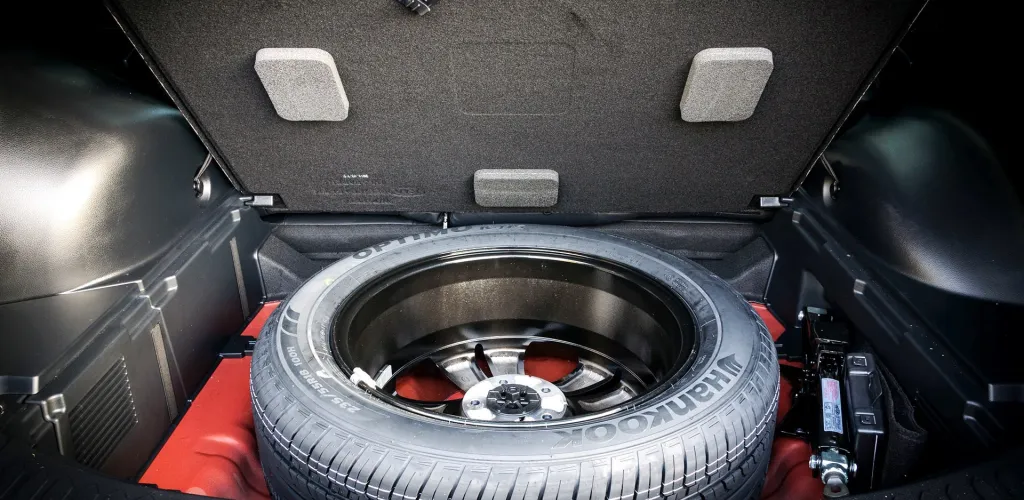
- Visually inspect spare tire for cracks, bulges, or rim corrosion.
- Check tire pressure cold and inflate to manufacturer specs.
- Spare tires have a 10-year lifespan; replace after then.
- Read DOT date on sidewall to confirm age.
Spare wheels are among the vehicle’s most important safety devices, yet they are often the most neglected. They sit in the trunk or under the rear of the car, and we usually think about them only when we truly need them. They can sit for years or even decades before being used in an emergency.
To avoid uncomfortable situations on the road, make checking your spare wheel a regular habit.
Visual inspection — the essential first step
In an ideal world, you should not wait until the moment you need to use the spare tire to find out whether it looks good.
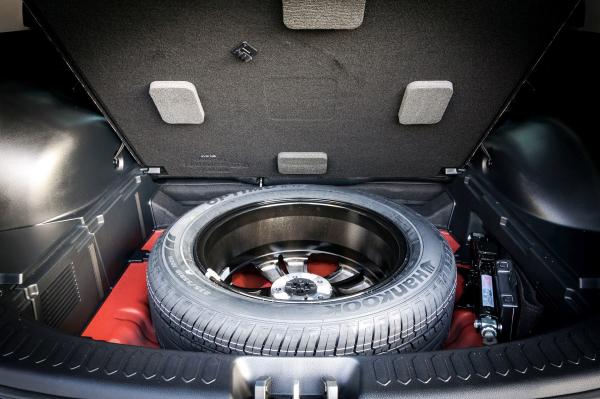
What to look for during the visual inspection:
- Cracks in the sidewalls — indicate damage to the tire’s structure
- Cracks on the tread surface — can compromise grip and stability
- Deformations or bulges — signal dangerous internal defects
- Signs of corrosion on the rim — can affect tire sealing
If you notice minor cracks, you can use the spare tire in an emergency, but you must replace it immediately after use. However, if there are deeper cracks, the tire is not safe for use — there is a risk of a blowout while driving.
Pressure check — the most important aspect
The spare tire pressure should be checked when you change the oil, but unfortunately this step is often overlooked.
How to check the pressure correctly:
- Use a gauge to measure the current pressure
- Compare the result with the manufacturer’s specifications
- Find the recommended pressure on the label on the driver’s door
- Check the tire temperature — measure only when the tire is cold
If the tire is far below the recommended pressure, do not drive with it. Inflate it to the correct pressure before use. Low pressure can cause:
- Instability at the steering wheel
- Uneven and accelerated wear
- Increased risk of blowouts
- Higher fuel consumption

Manufacturing date — tires also have a shelf life
Surprisingly, tires have a limited lifespan. They are not intended for use more than 10 years from the manufacturing date, regardless of how little they have been used.

Why tires age:
- Rubber degradation — compounds in rubber break down over time
- Exposure to the elements — temperature, humidity, and ozone accelerate aging
- Loss of elasticity — rubber becomes rigid and prone to cracking
- Layer separation — internal structure can become compromised
How to read the manufacturing date:
The manufacturing date is stamped on the tire sidewall with a four-digit code in DOT format. The first two digits represent the week, and the last two the year of manufacture. For example, the code “2419” means week 24 of 2019.
If the manufacturing date is older than 10 years, replace the spare tire immediately, even if it looks in good condition visually.
Tread depth — safety in grip
If you bought a new vehicle, it is unlikely the spare tire was replaced without your knowledge. However, if you purchased a second-hand car, the spare tire may have been replaced with a lower-quality one.
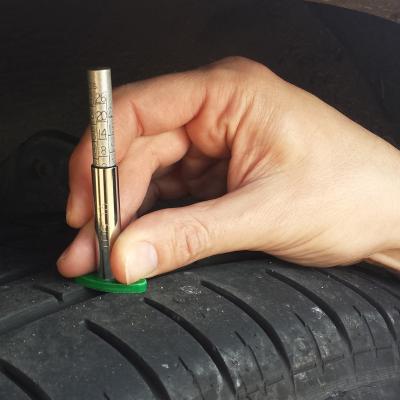
Measuring tread depth:
- Use a coin — insert a 1 leu coin into the main grooves
- Measure with a ruler — the legal minimum depth is 1.6 mm
- Check uniformity — wear should be even across the surface
Critical safety limits:
- Below 1.6 mm — illegal to drive on
- Below 3 mm — poor performance on wet roads
- Below 4 mm — snow grip is compromised
If the tread depth is less than 2–3 mm, the tire should be replaced immediately, even if it still meets the legal limit.
Checking the rim and mounting hardware
In addition to the tire itself, it’s important to check the rim and the mounting hardware:
Rim inspection:
- Corrosion — can affect seal and safety
- Deformations — can cause vibrations and instability
- Cracks — pose a major safety risk
Checking the tools needed:
- The jack — test functionality and lifting capacity
- Lug bolts/wrench — ensure a perfect fit
- Reflective triangles — make sure they are in good condition
Recommended inspection schedule
To keep the spare wheel always ready, follow this schedule:
Monthly:
- Quick visual check
- Pressure check
Quarterly:
- Detailed tire inspection
- Tools and accessories check
Annual:
- Complete rim check
- Manufacturing date check
- Jack and tools test
Tips for proper storage
How you store the spare wheel significantly affects its lifespan:
- Avoid extreme temperatures — don’t leave the wheel in direct sun for long periods
- Protect from moisture — ensure the storage area is dry
- Check the position periodically — rotate the wheel occasionally to prevent deformation
By making spare wheel checks a routine, you’ll be prepared for any unforeseen situation and avoid many headaches during trips. Remember that a spare wheel in good condition can make the difference between a minor breakdown and a dangerous situation on the road.
Photo sources: wired.com, yourmechanic.com, pclairtechnology.com