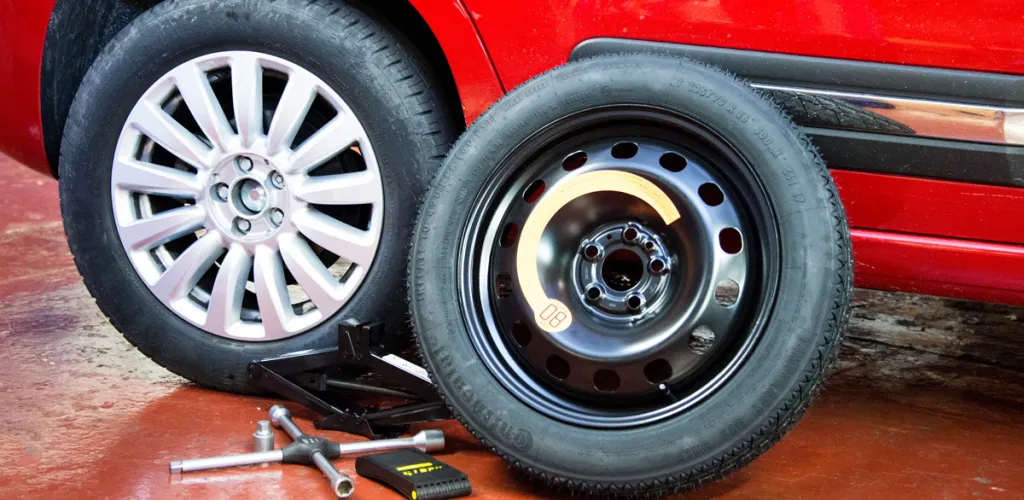
- Compact spares are undersized donuts requiring higher pressure and have limited road use.
- Maximum 110 km distance and 80 km/h speed for compact spares.
- Normal-size spares match regular tires and have no speed or distance limits.
- Check pressure and lug nuts before mounting; drive carefully at reduced speeds.
Situations where you need to mount a spare tire can occur at any time — whether you get a flat on the road or notice a puncture in a parking lot. While it may seem like a simple temporary solution, there are important rules about how far and how fast you can drive with a mounted spare.
Understanding the limitations and specifications of the spare tire is essential for your safety and that of other road users. Let’s analyze in detail what you need to know about using the spare tire.
Types of spare tires
Compact spare tires (slim)
Compact spare, also known as a “donut” or “slim,” is the most common spare tire type found in modern cars. These tires have the following characteristics:
- Reduced dimensions: they are undersized in both height and width compared with standard tires
- Reduced tread depth: around 4–6 mm, compared to 8–10 mm on a normally new tire
- Steel wheel: usually mounted on steel rims to reduce cost and weight
- Higher pressure: requires a higher inflation pressure (up to 4.1 bar) to compensate for the smaller size
Normal-size spare tires
These tires are identical in size to the vehicle’s standard tires and are more common in:
- High-performance sports cars
- SUVs and trucks
- All-wheel-drive vehicles
- Off-road and utility vehicles
The major advantage is that they can be used without speed or distance restrictions, being identical to regular tires.
Limitations for compact spare
Maximum distance
The general rule for compact spares is a maximum of 110 km. This limitation is due to:
- The tire’s more fragile construction
- The shallower tread depth that wears quickly
- The use of less durable materials in manufacturing
- The diameter difference from other tires
Maximum speed
The recommended maximum speed with a compact spare is 80 km/h. Exceeding this speed can lead to:
- Overheating of the tire
- Accelerated wear
- Risk of tire blowout
- Vehicle handling instability
- Damage to the differential or traction system
Why these limits?
Diameter differences
The compact spare has a smaller external diameter than the regular tires, which means that:
- It rotates faster than the other wheels
- It puts extra pressure on the differential
- It can affect ABS and ESP systems
- It creates an imbalance in the vehicle’s dynamic behavior
Handling in turns
With the spare mounted, the car may have:
- Understeer or oversteer tendencies
- Uneven braking
- Reduced traction, especially on wet surfaces
- Reduced stability at higher speeds
Tips for driving with the spare
Checks before starting
- Check the pressure: compact spares require higher pressure (check the label)
- Visual inspection: look for cracks, deformations, or excessive wear
- Check fastening: ensure lug nuts are properly tightened
While driving
- Respect the maximum speed of 80 km/h
- Avoid rapid accelerations and hard braking
- Increase following distance
- Be very careful in turns
- Avoid rough surfaces or potholes
What to avoid
- Driving on highways for long distances
- Overloading the vehicle
- Sudden avoidance maneuvers
- Parking on surfaces that could damage the tire
Normal-size spare tires
If your car is equipped with a normal-size spare, you have the advantage that you can drive:
- Without distance limitations (within reasonable limits)
- At normal cruising speed
- Without major changes to the vehicle’s handling
Attention: Even with a normal-size spare, it’s advisable to repair or replace the defective tire as soon as possible, to have all tires identical on the vehicle.

Remember to periodically check the spare’s condition and pressure, even if you don’t use it — when you need it, it must be ready to provide the necessary safety.
When to replace the spare
A compact spare tire should be replaced if:
- It has been used for more than 110 km
- It shows uneven or excessive wear
- It has sidewall cracks or other damage
- It has been used at speeds above 80 km/h
- It is more than 6–8 years old (even if not used)
Conclusion
The compact spare is a temporary solution that allows you to reach the nearest service or tire shop safely. Adhering to the 110 km and 80 km/h limits isn’t just a recommendation — it’s essential for your safety. If you have a normal-size spare, you have more flexibility, but it’s still advisable to repair the defective tire as soon as possible.
Remember to periodically check the spare’s condition and pressure, even if you don’t use it — when you need it, it must be ready to provide the necessary safety.