- Stay calm, keep steering steady, and avoid panicking to maintain control
- Do not brake immediately; ease off the accelerator to help control
- The car may pull to the failed-tire side; keep the wheel straight
- Slow down gradually, then brake gently once you’re stable
Tires are the only point of contact between your car and the road, representing a critical component for your safety and that of other road users. A tire blowout while driving, especially at high speeds, can turn a routine trip into a highly dangerous incident. In just a few seconds, you can lose full control of the vehicle, and the consequences can be severe.
In this guide, we will explain step by step how to react correctly if you face a tire blowout and what preventive measures you can take to minimize the risk of this happening.
What happens when a tire blows out
A tire blowout instantaneously affects the vehicle’s stability and your ability to control it. The car will tend to pull strongly toward the side where the tire has failed, and if you do not respond correctly, you can quickly end up in the oncoming lane or off the road. Speed plays a crucial role – the faster you are going, the more dangerous the situation becomes.
Keep in mind that no one is immune to this situation. Even with well-maintained tires, unforeseen factors such as a sharp object on the road or a deep pothole can cause a blowout. The difference between a controlled incident and a serious accident lies in how you react in the first seconds.
How to react when a tire blows out
Stay calm and in control
The first and most important rule is not to panic. We know it is easier said than done, but panic is the number one enemy in such situations. Take a deep breath and focus on the following steps:
- Keep the steering wheel firmly with both hands
- Avoid abrupt movements
- Don’t panic and don’t react instinctively
Do not brake immediately
Contrary to natural instinct, you should not press the brake pedal when you feel the blowout. In fact, in the initial moments you should keep your foot on the accelerator. It may seem counterproductive, but this helps you maintain control of the vehicle. Sudden braking transfers weight to the front and worsens the loss of stability.
Maintain a straight line
The car will tend to pull strongly toward the side where the tire has failed. You must counter this force by keeping the wheel straight and applying a firm, but not abrupt, correction in the opposite direction. Your goal is to keep the vehicle in your lane, not immediately try to reach the road edge.
Do not make sudden turns or take evasive maneuvers. Even if the car does not steer perfectly straight, focus on keeping it as close to a straight trajectory as possible. Sudden steering inputs can lead to a complete loss of control.
Slowing down
After you have stabilized the direction, very slowly lift your foot off the accelerator. Let the vehicle slow down naturally. This method is safer than braking, especially at high speeds.
Only after the speed has decreased noticeably and you have full control of the car should you begin to brake gently. Apply the brake pedal progressively, without stabbing it. Braking hard on a defective tire can cause loss of grip and uncontrolled vehicle movement.
Find a safe stopping place
Once your speed has reduced to about 30-40 km/h, start looking for a safe place to stop completely. Ideally, use an emergency lane or a wider area on the roadside. Activate hazard lights to warn other drivers.

Position yourself as far to the right as possible, but be mindful of the difference in level between the road surface and the shoulder – a large step up can worsen the problem or damage the rim.
What to do after stopping
Secure the scene
After you have stopped safely:
- Turn on hazard lights
- Put on reflective vests
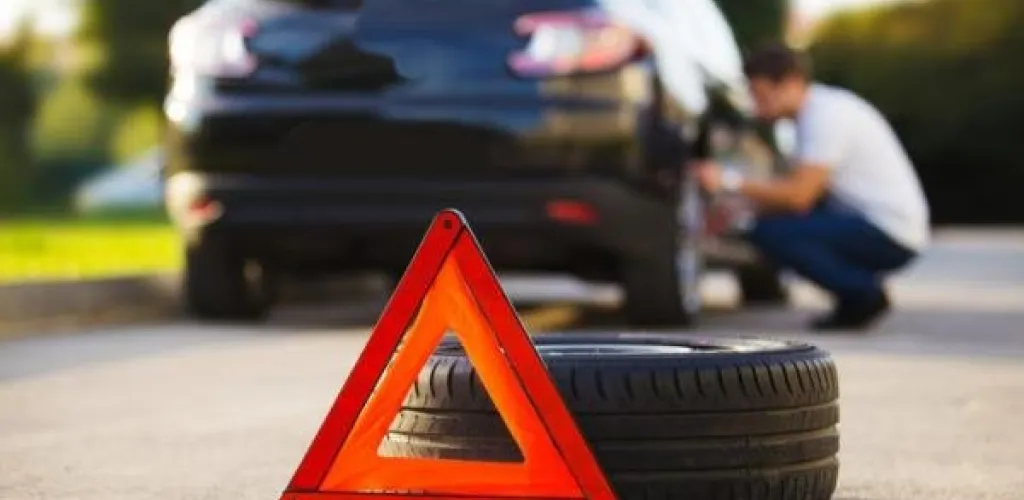
- Place the reflective triangle at least 50 meters behind on a normal road or 100 meters on a highway
- Evacuate all passengers to a safe area, behind the guardrail if available
Assess the situation
Check the extent of the tire damage and look for signs of further damage – scratches on the rim, damage to the wheel arch or suspension. If you have a spare tire and the necessary tools, you can proceed to change it, but only if you are in a safe location.
Even if you manage to change the wheel yourself, it is advisable to stop at the nearest service for a full check. A tire blowout can cause imbalances, affect steering, or damage suspension components that you might not notice immediately.
How to prevent tire blowouts
Prevention is always better than dealing with the consequences. Although there is no absolute guarantee against tire blowouts, you can significantly reduce the risk through proper maintenance and regular checks.
Check tire pressure
Incorrect pressure is one of the main causes of tire blowouts. An underinflated tire:
- overheats due to increased friction
- deforms excessively, weakening the internal structure
- wears unevenly and more rapidly
- may suffer internal damage that leads to a sudden blowout
Check pressure at least once a month and before long trips. The correct pressure is indicated on the door jamb sticker or in the owner’s manual. Measure the pressure when the tires are cold, because pressure rises with temperature.
Visually inspect the tires
At least once a week, take a close look at the tires:
- Tread depth: the legal minimum is 1.6 mm, but for optimal safety they should be replaced at 3 mm
- Uneven wear: may indicate suspension or steering problems
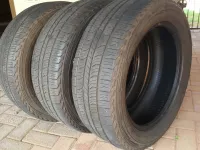
- Cracks on the sidewalls: signal aging of the rubber
- Bubbles or bulges: indicate dangerous internal structural damage
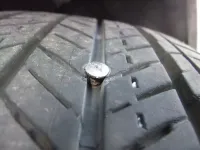
- Embedded objects: nails, screws or stones lodged in the tread
Pay attention to tire age
Even with low mileage, tires age. Sun exposure, temperature variations, and simply the passage of time degrade rubber compounds. Manufacturers recommend replacing tires after a maximum of 6-7 years, regardless of wear.
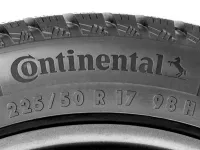
You can find the exact age from the DOT code on the sidewall. The last four digits indicate the week and year of manufacture (for example, 2319 means week 23 of 2019).
Wheel balance and alignment
Unbalanced wheels or incorrect alignment cause vibrations and uneven wear that can weaken the tire structure:
- Balance wheels after mounting new tires and every 10,000-15,000 km
- Check and adjust alignment annually or after hitting a large pothole
- Watch for signs of imbalance: steering wheel vibrations at certain speeds
Avoid overloading
Each tire has a maximum load rating. Constant overloading or carrying very heavy loads:
- dramatically increases pressure and temperature inside the tire
- pushes the internal structure beyond its design limits
- accelerates wear and increases blowout risk
Consult the load rating in the car manual and always respect it.
Adopt a defensive driving style
Your driving style directly affects tire health:
- Avoid potholes and large bumps whenever possible
- Do not run over curbs or obstacles at speed
- Slow down on rough roads
- Do not accelerate or brake abruptly repeatedly
- In corners, keep speeds reasonable to avoid excessive tire stress
Common causes of tire blowouts
Excessive wear
When tread depth drops below the minimum, the tire cannot evacuate water effectively, grip falls dramatically, and the weakened structure can fail suddenly, especially at high speeds or in heat.
Impact damage
Hitting a deep pothole, curb, or driving over a sharp object can cause internal damage that isn’t immediately visible but weakens the structure and leads to a blowout later.
Overheating
In hot weather, after extended high-speed driving (especially on highways), underinflated tires can overheat and fail abruptly.
Manufacturing defects
Although rare, defects can exist. This is why it’s important to buy tires from reputable manufacturers and keep receipts for warranty.
Conclusion
A tire blowout while driving is a stressful and potentially dangerous situation, but knowing how to respond correctly can prevent a serious accident. Remember: stay calm, control the direction, don’t brake hard, and slow down gradually.
However, the most important thing you can do is to prevent this situation through proper maintenance and regular checks. Invest time in tire inspection—those few minutes per month can save your life.