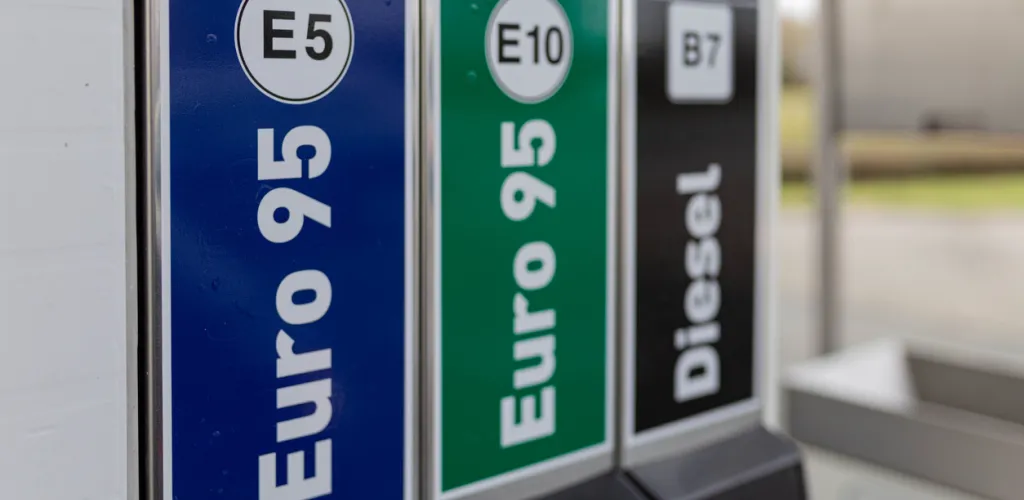
- E5 is 95% gasoline and 5% ethanol; E10 is 90% gasoline and 10% ethanol.
- Ethanol blends aim to reduce fossil fuel use and CO2 emissions.
- About 95% of gasoline cars (from 2011 onward) can safely use E10.
- Some older vehicles (pre-2000), classics, and certain equipment may be incompatible; check manual.
In recent years, E10 gasoline has become increasingly common at fueling stations across Romania and Europe. This shift is part of a broader effort to reduce CO2 emissions from transport and to improve sustainability in the automotive industry. If you’ve ever wondered what these designations mean and what the real differences between E5 and E10 are, this article provides the information you need to choose the right option for your car.
Before diving into details, it’s important to clarify the terminology. The letter “E” stands for ethanol, and the number represents the percentage of ethanol in the final blend. Thus:
- Gasoline E5 is composed of 95% unleaded gasoline and 5% ethanol. This is the standard gasoline most drivers have used for years.
- Gasoline E10 contains 90% unleaded gasoline and 10% ethanol, effectively doubling the biofuel content compared to E5.
The ethanol used in these blends is a alcohol produced from the fermentation of crops such as corn, sugarcane, or beet. Its addition to gasoline aims to reduce dependence on fossil fuels and lower greenhouse gas emissions.
Important: These specifications apply only to gasoline. If you own a diesel vehicle, you don’t need to worry about this for now, although in the future similar alternatives for diesel may appear.
Theoretical advantages of E10 gasoline
By increasing the ethanol content from 5% to 10%, E10 gasoline promises several benefits:
- CO2 emission reductions: Studies suggest that switching to E10 could reduce CO2 emissions from transport by about 750,000 tonnes per year at the European level. This is equivalent to removing around 350,000 cars from the road.
- Increased sustainability: Ethanol, being produced from renewable sources, reduces oil dependence proportionally to the rise in biofuel content.
- Higher octane rating: Theoretically, ethanol has a higher octane rating than gasoline, which could improve engine performance and combustion efficiency.
Vehicle compatibility with E10 gasoline
Before switching to E10, it is essential to check whether your car is fully compatible with this fuel type. Here are some guidelines:
Vehicles compatible:
- All gasoline cars manufactured from 2011 onward are compatible with E10
- Approximately 95% of gasoline-powered vehicles on the road today can safely use E10
- Most automakers have explicitly approved the use of E10 for recent models
Vehicles incompatible:
- Some older cars, especially those produced before the year 2000
- Classic or vintage vehicles
- Certain models of motorcycles, lawn tractors, and other small equipment
If your car is among the 5% that are not compatible with E10, you can still fuel with E5 by buying premium-grade gasoline at most stations.
How to check compatibility: Consult the owner’s manual, check the fuel cap (where the recommended fuel type should be listed), or contact the vehicle manufacturer directly.
Real-world driver experiences with E10 gasoline
Although E10 seems like a superior choice on paper, real-world feedback from drivers who have already used this fuel presents a more nuanced picture.
Where E10 was first introduced:
- United Kingdom
- France
- Germany
- Other Western European countries
Common complaints from drivers:
Increased fuel consumption: Contrary to expectations, many drivers report that their cars consume more with E10 than with E5. This is due to ethanol having a lower energy density than gasoline—about 33% less. Thus, even a 5% increase in ethanol content can noticeably affect consumption, especially in urban driving.
Reduced performance: Some users notice a slight drop in engine power and throttle response. This can be related to engine electronics calibration, which in older vehicles may not be optimized for high-ethanol blends.
Issues in older vehicles: Ethanol can be corrosive and may affect certain rubber or plastic components in the fuel system of older cars, potentially leading to leaks or failures.
Important technical considerations
For readers interested in mechanical aspects, here are a few points to consider:
Ethanol properties:
- Has a calorific value of around 26.8 MJ/kg, compared with 44 MJ/kg for gasoline
- RON octane rating of about 109, higher than standard gasoline
- Hygroscopic properties — absorbs moisture from the air
Impact on the engine:
- In modern engines with direct injection and advanced electronic control, differences are minimal
- In older engines with carburetion or indirect injection, tuning issues may arise
- Modern fuel systems are built from ethanol-resistant materials
Practical recommendations for drivers
For vehicles manufactured after 2011: You can try E10 without major concerns. Monitor fuel consumption and engine behavior over the first few fill-ups to assess any notable differences.
For vehicles manufactured between 2000–2011: Check compatibility explicitly in the owner’s manual or on the manufacturer’s website. If clear information isn’t available, stay with E5.
For vehicles older than 2000: Generally, it is recommended to use E5 or premium gasoline to avoid potential fuel-system issues.
For occasional use (classic cars, equipment): Gasoline without ethanol or with minimal ethanol content remains the safest option, especially for equipment that sits unused for long periods.
The future of ethanol-based fuels
The auto and petrochemical industries continue investing in research and development of alternative fuels. In the near future:
- Similar variants for diesel may appear (for example B7, B10 with biodiesel content)
- Auto manufacturers will continue to optimize engines for E10
- We may also see the introduction of E15 or E20 gasoline in certain markets
Conclusion
While the concept behind E10 is sound and can deliver real benefits in CO2 reduction, practical implementation still raises questions. For now, our recommendation is to continue using E5, especially if you have an older vehicle or if you notice higher consumption or performance issues after switching to E10.
As technology evolves and engines become better optimized for high-ethanol fuels, E10 could become a viable and beneficial alternative. Until then, the choice between E5 and E10 depends on your vehicle’s compatibility, your priorities, and your own practical experience with each fuel type.
Most importantly: regardless of fuel type, ensure you follow your vehicle manufacturer’s recommendations and monitor engine behavior after any fuel change.