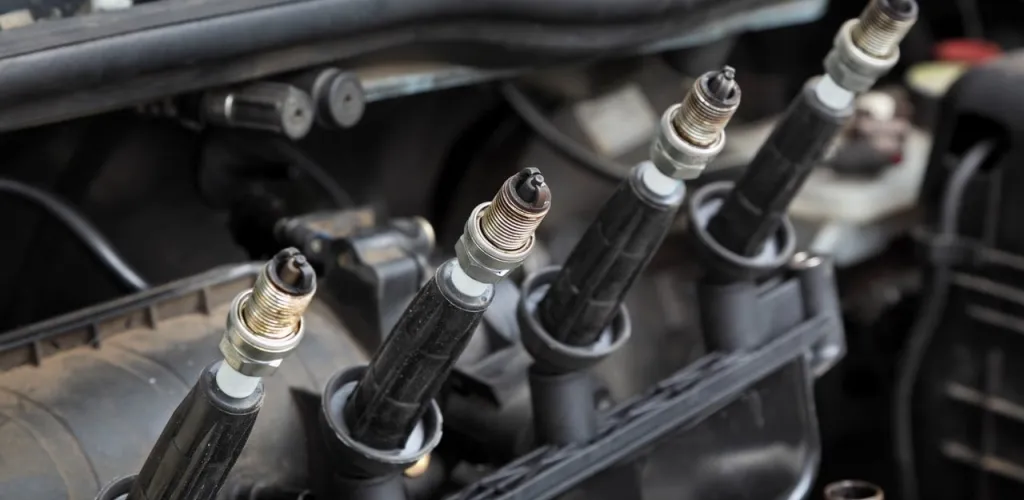
- Spark plugs ignite the air-fuel mix via a high-voltage spark at TDC.
- They have a central electrode, ceramic insulator, metal shell, and side electrode.
- Faulty plugs cause a check engine light, rough idle, power loss, and higher fuel consumption.
Spark plugs are essential components of the ignition system, responsible for initiating the combustion process in gasoline engines. Positioned strategically in the cylinder head, they reach into the combustion chamber where they perform their vital role: generating the spark that ignites the air–fuel mixture.
Spark plug components and operation
The structure of a spark plug is deceptively simple, but highly efficient. Each spark plug consists of:
- Central electrode - surrounded by a ceramic insulator (porcelain) that prevents current leakage
- Metal shell - provides mounting in the cylinder head and ground connection
- Side electrode - located at the lower end, forms the gap where the spark occurs

The operation of the spark plug is based on fundamental electrical principles. The ignition coil generates a high voltage current (up to 40,000 volts) that is transmitted through the lead to the central electrode of the spark plug. When this current reaches the end of the spark plug, the short distance to the side electrode creates the perfect conditions for an electrical discharge.
The spark produced must occur exactly when the piston reaches the top dead center (TDC) and the mixture is compressed to maximum. The resulting controlled explosion pushes the piston down with force, the energy being transferred to the crankshaft and ultimately to the vehicle’s wheels.
Symptoms of faulty spark plugs: 7 warning signs
1. Check engine light comes on

Check engine light illumination
Warning: If the check engine light blinks intermittently, the situation is critical. Blinking signals severe misfires that can damage the catalytic converter — a very expensive component. In this case, stop the engine and seek emergency assistance.
2. Rough running and excessive vibrations
A healthy engine runs smoothly, each cylinder contributing evenly to total power. A burnt-out spark plug can no longer ignite the mixture in its cylinder properly, creating a mechanical imbalance.

Consequence are:
- Vibrations felt in the steering wheel and body
- Engine lurching at idle
- Unusual engine noise
- Instability at low RPM

3. Power loss and sluggish acceleration
When you press the accelerator pedal, you expect a linear and progressive response from the engine. Faulty spark plugs disrupt this normal behavior:
- The car bogs down during acceleration
- Sudden power dips across the entire rev range
- Delayed response to acceleration
- Inability to reach high revs
These symptoms intensify in situations that demand maximum power: overtaking, climbing hills, or starting from a stop.
4. Increased fuel consumption
A faulty spark plug disrupts the combustion process. When the mixture is not fully and correctly burned, the engine compensates by:
- Injecting more fuel
- Keeping higher revs for the same power
- Operating under a more demanding regime to compensate the defective cylinder
If you notice a significant fuel economy increase (15-20% or more) without an obvious cause, check the spark plugs. Other causes may include a clogged air filter or engine sensor faults.
5. Hard starting
A spark plug in good condition starts immediately, within 2-3 turns of the starter. Worn plugs considerably extend this process:
- The engine turns over several times before starting
- Rough starts, especially in the morning or when the engine is cold
- In extreme cases, the engine refuses to start
The problem worsens in cold weather, when weak spark cannot reliably ignite the cold air–fuel mixture.

6. Unusual odors in the cabin
A less obvious but revealing symptom is the appearance of specific odors:
- Smell of sulfur or rotten eggs
- Smell of burnt gasoline
- Black smoke from the exhaust
These odors occur because the unburned or partially burned mixture reaches the exhaust system. The catalyst tries to burn the residues, generating these characteristic odors. Prolonged exposure to this regime can damage the catalyst.
7. Visual appearance of the spark plugs
Visual inspection provides valuable information about the spark plugs and engine operation:
- Black and sooty deposits — too rich fuel mixture
- Melted or burnt electrode — faulty plug or incorrect heat range
- White deposits — overheated engine or improper lubricant
- Oily deposits — problems with rings or valve guides
- Normal appearance — grey-beige color on the insulator
Spark plug maintenance and replacement

Maintenance of spark plugs is essential for optimal engine performance:
Replacement intervals:
- Copper-core plugs: 20,000-30,000 km
- Platinum plugs: 60,000-80,000 km
- Iridium plugs: 100,000-120,000 km
Checks required:
- Spark gap – measured with a special gauge and adjusted per the manufacturer specifications (usually between 0.6-1.3 mm)
- Electrode condition – should not be worn, melted or coated with deposits
- Ceramic insulation – no cracks or chips
- Thread – clean and undamaged
Tips for replacement:
- Always replace all spark plugs at the same time, not just the faulty ones
- Use only manufacturer-recommended plugs (correct heat range)
- Tighten to the specified torque (using a torque wrench)
- Apply anti-seize paste on the threads for future removal
- Some modern engines have two spark plugs per cylinder for maximum efficiency
When to go to service: Although spark plug replacement seems simple, there are situations where it’s better to call a professional:
- Engines with hard-to-reach spark plugs (removal of multiple parts)
- Lack of special tools (torque wrenches, electrode gauge)
- Uncertainty about correct specifications
- Engines with complex configurations (V6, V8, boxer)
The cost of a spark plug varies significantly depending on:
- Electrode type (copper: 10-20 RON, platinum: 30-50 RON, iridium: 50-150 RON)
- Make and model of the vehicle
- Year of manufacture (modern engines require stricter specifications)
Important: Neglecting spark plug changes can lead to:
- Catalytic converter damage (2,000-5,000 RON)
- Premature wear of ignition coils
- Excessive fuel consumption
- Damage to combustion chambers
An investment of a few hundred RON in new spark plugs can prevent thousands of RON in major repairs. Following service intervals and using quality parts ensures optimal operation and engine longevity.