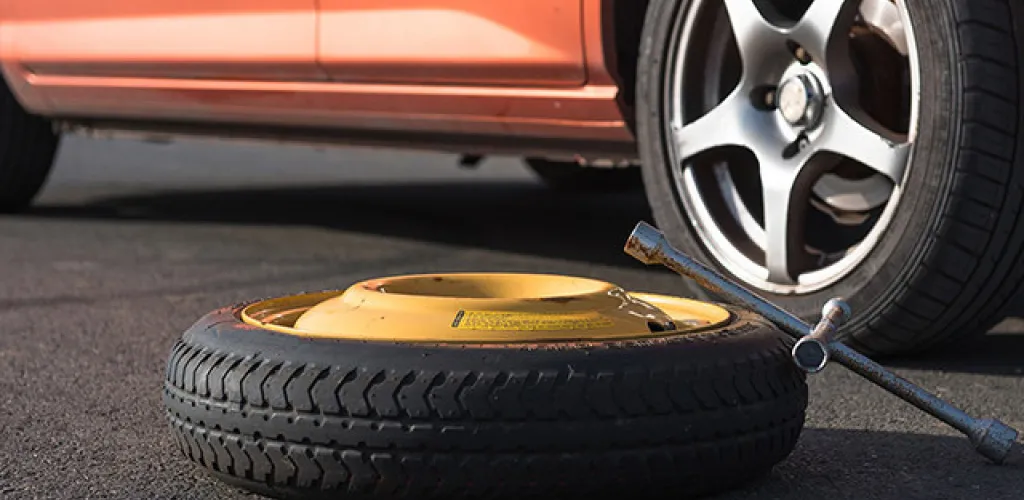
- Compact donuts limited to 80 km/h, 80 km distance, not for AWD.
- Normal-size spare should be replaced soon; replace if worn or over 10 years.
- Check spare age via sidewall date code; replace if older than 10 years.
- Signs needing replacement: cracks, tread under 1.6 mm, bulges, leaks.
Spare tires are a safety-critical component for any vehicle, but using them incorrectly can lead to serious accidents or damage to the car’s transmission system. Understanding the limitations and the specific requirements for each type of spare tire is crucial for safe driving.
Whether you carry a compact spare or a normal-size spare, knowing when and how to use it helps you reach a safe location and avoid costly repairs.
Types of spare tires and their limitations
Compact spare tires (donuts)
Compact tires, known in English as “donuts,” are narrow tires with a design intended to take up as little space in the trunk as possible. Because they have such a small amount of rubber to cushion potholes and so little tire, they are designed for extremely limited use. In principle, the installed spare wheel should be replaced as soon as possible.
Specifications for compact spare tires:
- Maximum speed: Should not be used at speeds above 80 km/h
- Maximum distance: Should not be used for a cumulative distance greater than 80 km
- Important restrictions: Should not be used on AWD (all-wheel drive) or 4WD vehicles
These limitations are due to significant differences in diameter and width compared to standard tires. On all-wheel drive or 4x4 vehicles, the size difference can cause serious problems for the center differential, transfer case, or electronic coupling system, leading to costly repairs.
Normal-size spare tires
Normal-size spare tires used to be more common than they are now, because they adapt better to the vehicle’s characteristics. In many cases, the spare could be installed on the vehicle and used in rotation with the other tires.
Requirements for normal-size spare tires:

- Should not be used longer than necessary due to mismatches between speed rating and load parameters
- Must be replaced when the rubber wears down or when they are older than 10 years, according to the date on the side
- Regular tire pressure checks are essential
Over time, they have been replaced by compact spares, which take up less space and are lighter. If your vehicle has a normal-size spare wheel, it is most likely designed as a spare tire and not for long-term passenger transport.
When and how to replace the spare wheel
Checking the tire age
It should not be used as a long-term replacement in case of a puncture or damaged tire. Check the manufacturing date on the sidewall to see if it is older than 10 years.
Date code on the tire appears as 4 digits in an oval (for example: 2318 means week 23 of the year 2018). If the spare tire is older than 10 years, for your safety replace it immediately, even if it seems visually in good condition.
Signs that the spare tire needs replacement
- Cracks on the sidewalls: Rubber degraded by aging
- Tread wear: Under 1.6 mm tread depth
- Deformations: Bulges or flat spots
- Air leaks: If it no longer holds air
- Age: Over 10 years since manufacture
Tips for proper use of the spare tire
Before installation
- Check the pressure – Compact spares typically require higher pressures (up to 4.1–4.5 bar)
- Inspect visually for cracks or damage
- Make sure you have the necessary tools – wheel wrench, jack, warning triangle
After installation
- Drive cautiously and adhere to speed limits
- Avoid rapid acceleration and braking
- Plan for a quick replacement with a new tire
- Regularly check the pressure if you will be using the tire for several days
Spare tire maintenance
If you have a puncture and have used the spare, check the sidewall specifications to see whether it should be replaced or if you can keep it in the trunk for future use. It is recommended to check the spare tire pressure every 3 months and inspect it visually to ensure it will be functional when you need it.
Photo source: wired.com, mynrma.com.au