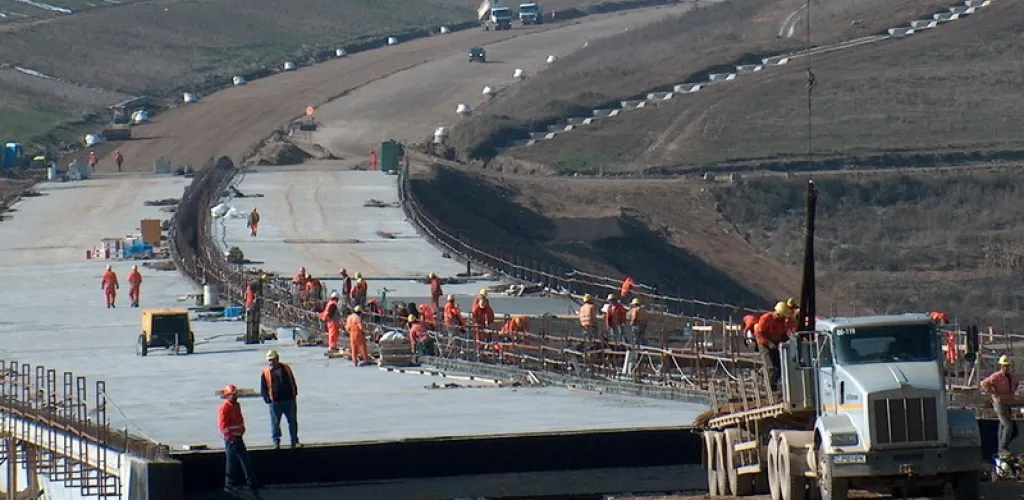
- Highway cost depends on terrain, with mountains needing bridges, tunnels, and piers.
- Asphalt is cheaper than concrete, which is more expensive and less efficient.
- Bitumen and gravel dominate materials; bitumen binds surfaces but can wear.
- Total cost includes materials, labor, and equipment/machinery expenses.
When it comes to the real price of a kilometer of highway, opinions are heavily divided, and every contractor will present a different figure. The cost is strongly influenced by the conditions under which it will be built, the technologies used, and sometimes even political factors and the source of investment. Let us analyze in detail what highway construction truly entails and how the final price is formed.
Factors influencing construction cost
It is evident that a kilometer of highway built on a flat field, on a straight and level road, will always be cheaper than a kilometer of highway that passes through a mountain, requiring bridges, viaducts, and tunnels, as well as support piers for the road. Nevertheless, the price between two works can differ significantly, even when soil conditions are similar.
Contractor Stefan Mandachi, dissatisfied with how highways are built in Romania, carried out in 2021 a project titled “A meter of highway” to demonstrate how cheap a highway could be built if procedures were carried out correctly and the firms that win contracts did not try to profit from public funds. This project gained a very large following among the public and, in 2022, it even reached the screen with the help of the renowned Netflix platform.
Materials used in highway construction
Comparison between asphalt and concrete
From a cost perspective, asphalt is by far the cheapest material that can be used to build a road. On the other hand, concrete is the most expensive material used for paving roads. Depending on the type of materials used and the land mapping, it is possible for the square meter of concrete to reach a price between 10-50 lei.
In the past, the first highways constructed in our country were designed using concrete, but it was found that they are not as efficient as asphalt ones and are much more expensive. Even though asphalt is less resistant and more prone to potholes and cracks, it allows for faster and safer travel, and asphalt highway construction is carried out much more quickly.
What is bitumen and why is it important?
Often when a highway is being built, bitumen is used. It is a viscous liquid material, so it becomes very sticky and is obtained from natural deposits. Bitumen is used in highway construction because it has unique properties not found in other materials.
In addition to using bitumen, constructors also rely heavily on gravel, which is essentially an aggregate that binds to the emulsion, and after rolling and curing, provides a strongly anti-slip surface to offer a high level of safety. Periodically, this aggregate can detach after long-term use and will need replacement.

Components of the total cost
When we want to calculate the construction cost of a highway, we must consider all subunit costs that arise from the road construction activities:
- Construction materials – asphalt, concrete, bitumen, gravel, reinforcement
- Labor – wages of workers and specialists
- Equipment and machinery – purchase or rental
- Permits and licenses – legal and environmental documentation
- Technical consulting – design, expertise, supervision
- Excavations and earthworks – site preparation
- Civil works – bridges, viaducts, passages
- Safety systems – barriers, markings, lighting
The total cost will be divided by the number of kilometers constructed, and thus we can determine the cost per kilometer.
Detailed prices for works
To estimate the price to be paid for constructing a highway, we must first consider the excavation cost. Generally, we will pay around 40-50 lei per cubic meter excavated, but this price can be negotiated depending on the scale of the project.
As for the cost of paving, there are many factors that influence its value, so we cannot determine exactly what the final value will be, nor can we offer a standard price. In general, the price per square meter should vary between 10-25 lei. Regarding the asphalt itself, hot mix asphalt has an average price in the range of 200-400 lei per ton.

It is advisable to pave when outdoor temperatures are high in order to achieve the strongest bond with the pavement. If the temperature is low, it will be mandatory to use certain additives to ensure proper paving.
International cost comparisons
How much does a kilometer of highway cost in Europe?
Although material costs, fuel, and labor costs are very similar in most countries, we often find with astonishment that there are enormous price differences in highway construction when comparing two similar projects that would normally require similar resources.
For example, according to statistics from the United Kingdom, the average construction cost for a kilometer of highway is about £25 million. If an additional lane is added to an existing highway, the average price will be about £10 million per kilometer.
On the other hand, in countries like France or Italy, the price for a kilometer of highway is only €20 million, and in Germany it even reaches €15 million. Of course, we are talking about cases where construction is carried out on normal terrain, such as hills or plains. For highways requiring complex structural constructions or built on hard-to-reach roads, costs can even double.
How much does a kilometer of highway cost in Romania?
On the other hand, when we reach Romania, we notice that most of the time a kilometer of highway on a perfectly straight road—which in another country would have cost around €10 million—here reaches an approximate price of €25 million, and we rightly wonder what causes this exorbitant price increase. Moreover, the quality of Romania’s highways leaves much to be desired and often requires interventions after only a few years.
Let us not forget that annexes and parking areas, and in some cases even gas stations, are sometimes absent. This raises serious questions about the efficiency of public spending and the need for reforms in the public procurement system for infrastructure.
Conclusion
That being said, we cannot provide an exact answer to the question, “How much should a kilometer of highway cost?”, but we can certainly form an initial impression to be as close as possible to the real value, which will only be determined at the end of construction. To know whether the estimated price is correct, we can always compare it with the amount paid in the past for similar works.
Transparency in the procurement and construction process of highways is essential to ensure that public funds are spent efficiently and that Romania can develop a network of highways comparable with other European countries, both in terms of quality and cost.
photo source: https://ziare.com/