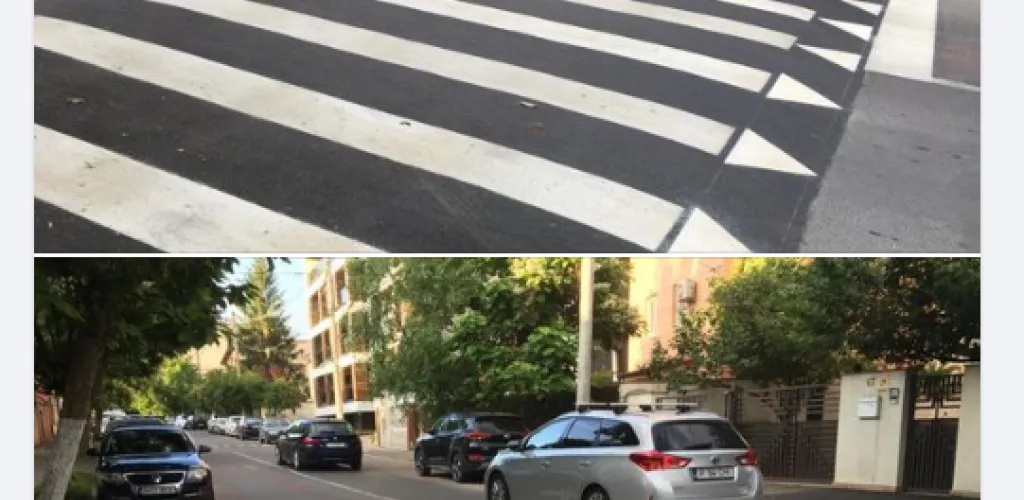
- Raised crosswalks equalize road height to sidewalk, forcing vehicles to slow for pedestrians
- They improve pedestrian visibility and reduce accident risk near schools, hospitals; now implemented in Romania
- Recommended at busy pedestrian corridors, intersections, and areas changing street function
- Not advised on transit routes, steep slopes, or tight curves with limited visibility
Raised crosswalks are a safety measure that has long been used abroad and has recently been implemented in Romania. These special installations are strategically placed in busy areas, near schools or hospitals, and in residential neighborhoods, with the main objective of reducing vehicle speeds and preventing road accidents.
The main advantage is that the platform brings the roadway to the level of the sidewalk, creating a flat crossing for pedestrians and thereby forcing vehicles to slow down before crossing.
Operation and benefits of raised crosswalks
Raised crosswalks operate on a simple yet effective principle: by raising the roadway to the level of the sidewalk, a physical barrier is created that forces vehicles to slow down. This arrangement ensures a continuous and safe path for pedestrians, eliminating the height difference between the sidewalk and the street.
In the case of intersections, the raised area can be extended to include the entire intersection, turning it into a safe platform for pedestrians to cross from all directions. This design improves pedestrian visibility and significantly reduces the risk of accidents.
Although for many drivers the experience of crossing these zones can be surprising, especially the first time they encounter such an installation, the forced slow-down effect is exactly the purpose for which they were created. The substantial reduction in speed is essential for pedestrian safety, especially in areas with heavy pedestrian traffic.
It is essential that every driver understands that they are also a pedestrian when outside the vehicle, and the existence of these safety zones is to the advantage of all road users. Implementing raised crosswalks represents an investment in community safety, demonstrating that accident prevention and the protection of human life must take precedence over the temporary comfort of drivers. In the long term, these installations contribute to a more responsible and safer road culture for everyone.
When and where raised crosswalks are installed
Studies conducted by road safety specialists have established clear criteria for the optimal placement of raised crosswalks. These conclusions are based on solid data regarding their effectiveness in reducing accidents.
Locations recommended for installation:
- On busy pedestrian corridors and public roads with heavy foot traffic
- At intersections where low-traffic streets meet high-traffic streets, such as driveways, residential neighborhood streets, and local access lanes of boulevards
- In points where a street changes function, for example from commercial to residential street
- In key civic locations such as parks, schools, hospitals, and other public institutions frequented by pedestrians
Locations where they should not be installed:
- On designated transit routes where a constant traffic flow must be maintained
- On roads with steep slopes where safety could be compromised
- In areas with tight curves where visibility is limited
Technical features and design requirements
For a raised crosswalk to be effective and safe, it must meet certain technical standards. These requirements have been established based on road engineering studies and international experience.
Height and dimensions
- The platform must be at the same level as the sidewalk
- The width should be at least equal to that of the crossing or intersection
- The length in the travel direction should be approximately 3 meters, so that both the front and rear wheels of a vehicle are on the platform at the same time
Safety and comfort
- The vertical transition must be designed to avoid excessive jolts when vehicles pass at appropriate speeds
- Special paving treatments or the same material as the adjacent sidewalks must be used for visibility
- There must be detectable tactile warnings for pedestrians, especially for those with visual impairments
- The design must consider drainage patterns – depending on the level, additional catch basins or other drainage systems may be required
Impact on road safety
Specialist studies show that raised crosswalks have a significant impact on reducing road accidents. By forcing vehicles to slow down, the risk of impact and the severity of potential accidents are substantially reduced.

Although for many drivers these installations may seem annoying and require frequent braking, their essential role is to exponentially increase traffic safety. It is important that every driver understands that they are also a pedestrian when outside the vehicle, and the existence of these safety zones benefits all road users.
The implementation of raised crosswalks represents an investment in community safety, demonstrating that preventing accidents and protecting human life must take precedence over the temporary comfort of drivers. In the long term, these installations contribute to a more responsible and safer road culture for everyone.