- Timing belts and chains synchronize camshaft and crankshaft to prevent engine damage
- Warning signs include unusual timing area noises, vibrations, oil leaks, poor starting, and low performance
- Replacement intervals vary: belts commonly around 60,000 km, some models at 90k–120k
- When buying used cars, replace timing belt if no service records exist
The timing system in an internal combustion engine is one of the most critical subsystems, and it can be implemented either with a chain or with a belt. Both technical solutions fulfill the same essential function: precisely synchronizing the crankshaft and camshaft, ensuring that the engine valves open and close at the optimal moments during the piston stroke.
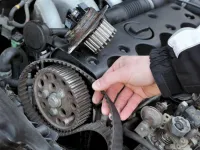
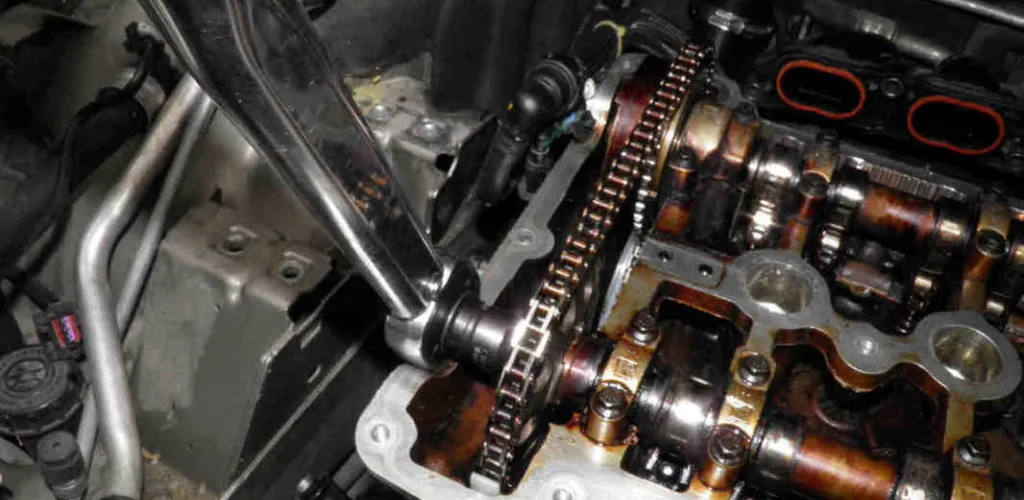
Without perfect synchronization, there is a risk that the piston could strike the valves, causing serious engine damage. The timing belt is usually toothed, with teeth on the inside of the belt, while the timing chain is a chain with rollers, similar to a bicycle chain but much tougher.

Principle of operation of the timing system
To understand the importance of the timing system, we look at how the engine operates in a four-stroke cycle. This cycle repeats thousands of times per minute and requires perfect synchronization:
-
Intake: the piston moves down, and the intake valves open to allow the air–fuel mixture into the chamber. During this phase, the exhaust valves remain fully closed to ensure an optimal vacuum;
-
Compression: the piston rises and compresses the fuel–air mixture, with all valves closed to maximize the pressure in the chamber. This compression is essential for efficient combustion;
-
Combustion: the moment when the engine generates its effective power. The spark plug ignites the compressed mixture, and the piston is driven downward by the explosion. All valves remain closed to exploit the entire energy;
-
Exhaust: the exhaust valves open to remove the burnt gases, while the intake valves remain closed. The piston rises again, pushing the gases toward the exhaust system.
Throughout the entire cycle, the camshaft operates in perfect synchronization with the crankshaft. Any deviation from this synchronization can cause catastrophic engine damage.
Warning signs of the timing system
An unusual noise from the timing area should raise concerns and requires immediate investigation. The noises can range from a metallic tapping (typical of worn chains) to a squeak (typical of worn belts).
Other warning signs include:
- Abnormal vibrations at idle
- Oil leaks in the timing cover area
- The engine that does not start smoothly
- A decrease in engine performance
- Check engine light illuminated on the dashboard
Timing belt replacement interval
Most manufacturers recommend replacing the timing belt at around 60,000 kilometers, but this interval can vary significantly depending on the make and model of the car. Some manufacturers recommend replacement at 90,000 or even 120,000 kilometers, while others have shorter intervals.
The safest approach is to replace it when buying a used car, even if the seller claims it was replaced recently. Lack of clear documentation represents too big a risk for the engine’s health. After the first replacement, strictly follow the intervals stated in the vehicle’s technical manual.

Difference between timing belt and chain
Timing belt:
- Requires periodic replacement
- Is quieter in operation
- Easier to replace and cheaper
- Sensitive to extreme temperatures
- Does not require lubrication
Timing chain:
- Significantly higher durability, theoretically for the engine’s lifetime
- Requires constant lubrication with engine oil
- Louder in operation
- Replacement is more expensive and more complex
- Can stretch over time, requiring adjustment
- More resistant to extreme temperatures
Consequences of a faulty timing system
If the timing system fails while the engine is running, the consequences can be devastating. In interference engines (most modern engines), the pistons will strike the valves, causing:
- Bent or broken valves
- Piston damage
- Camshaft damage
- Possible cylinder head damage
- Very high repair costs, sometimes exceeding the car’s value
In non-interference engines (less common), the consequences are less severe, but the engine still won’t run until repaired.
Practical aspects for owners
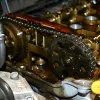
It is essential to know how your car’s engine is mounted — transversely or longitudinally — to quickly identify the timing system’s location. This knowledge helps you react promptly if the timing begins to produce suspicious noises.
When planning a timing belt/chain replacement, ensure the mechanic also replaces:
- The tensioner pulley and idler pulleys
- The water pump (if it is driven by the timing system)
- The gaskets and seals in the area
- Any vibration dampers or mounts
Replacing all of these components along with the timing belt helps prevent future failures and saves labor costs, since access to these parts usually requires removing the timing system.