Replacing the Timing System in an Hyundai Terracan
The timing system plays a crucial role in a vehicle. Failure of the timing system can cause significant damage to the car, which is why checking and replacing it are mandatory. It’s essential to remember that if the timing system fails while the car is running, the engine can suffer damage that will cost the owner a substantial amount of money. This is why timing system replacement should not be delayed, as it can weaken or break.
It’s important to note that the least harmful scenario occurs when the engine does not have a combustion chamber in the same location as the valves.
This article aims to provide you with information about the importance of the timing system and the maintenance of your vehicle, how the timing system works, its components, the technical malfunctions it can cause if not serviced in time, the types of timing systems available on the market, and when the timing system should be replaced.
General Information about the Timing System in Hyundai Terracan
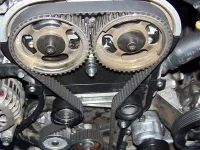
The timing system plays an extremely important role in the configuration of an Hyundai Terracan. When we talk about the timing system, we are referring to a complete assembly within the engine, composed of several parts that serve a control function.
The timing system coordinates the engine’s components. The timing belt/chain transmits motion to the crankshaft and camshaft, and then activates the two pumps, the injection pump, and the water pump. The timing system is responsible for synchronizing the valve openings with the piston’s position and the injection timing, depending on the engine’s specifics.
Failure to replace the timing system in a timely manner can lead to belt or chain breakage, improper operation of the crankshaft and camshaft, in other words, desynchronization. If the vehicle is in motion when this happens, the severity of the situation increases, with engine components suffering damage (open valves, piston head damage, and cracked cylinder heads).
Components of the Timing System Kit in Hyundai Terracan
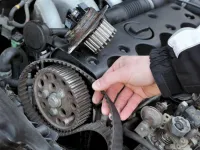
The timing system kit for an Hyundai Terracan consists of several components. The primary component is the timing chain/belt. Here, the material makes a difference: the belt is made of steel wires and synthetic and rubber materials, while the chain is made of alloys/steel.

In addition to the chain/belt, the kit includes tensioner pulleys (which stabilize the belt/chain to eliminate weak points). Proper tension of the belt/chain is crucial; any slackness can lead to it jumping off the pulleys. On the other hand, excessive tension of the belt/chain is not recommended, as it can break under pressure.
As part of the kit, there is also a guide pulley that helps guide the belt/chain and a water pump. The water pump, whether made of metal or plastic, facilitates the movement of coolant through the engine.
Types of Timing Systems
Timing systems come in several types:
Belt-based Timing System: This is the most common type, prevalent in the automotive industry since 1960. When properly maintained, it can be highly reliable.
Chain-based Timing System: This is the oldest type, dating back to 1890. It has evolved over time and is still found in some vehicle models. It is known for its durability.
Gear-based Timing System: This is less common and is typically used in vehicles that require higher durability, such as trucks and vans. Gear-based timing systems are very robust and durable.
Choosing Between the Three Types
When choosing between the three types of timing systems, it’s important to understand that they serve different purposes. However, some general observations can be made:
Belt-based timing systems are cost-effective due to their lower production cost (rubber material). Rubber is also quieter, effectively dampening noise.
Chain-based timing systems are known for their durability, though they are not as quiet as belts. They require replacement much less frequently than belts.
Gear-based timing systems are very noisy but prioritize durability and cost-efficient maintenance. They rarely experience issues, and apart from the water pump, there are no components that require replacement.
When to Replace the Timing System in an Hyundai Terracan
The importance of optimal timing system function depends directly on the maximum number of kilometers it should go before being checked by a specialized workshop.
For a belt-based timing system in an Hyundai Terracan, the first replacement should be at 90,000 km, followed by replacements every 60,000 km. There is an exception: if the vehicle has not been driven extensively, the belt can be replaced once every five years. When replacing the timing system, it is recommended to use a complete kit, including the belt, pulleys, water pump with gasket, and other components.
For a chain-based timing system in Hyundai Terracan, it should be checked around 250,000 km for older models. For newer models, checks can start at 150,000 km or higher. There have been unfortunate cases of chain breakage and engine damage, so such checks are highly recommended.
In the case of a gear-based timing system, it is advisable to replace the water pump at around 100,000 km.
Components to Purchase When Replacing the Timing System in an Hyundai Terracan
As mentioned earlier, replacing a belt-based timing system requires the purchase of a complete kit, including the belt, pulleys, tensioners, water pump, and gasket.
For replacing a chain-based timing system, you should buy the chain, tensioner, gears (in certain models), and the water pump. If you own a vehicle with a chain-based timing system, it is recommended to have it checked in a service center or listen to the engine when it’s cold. A metallic sound indicates the need for replacement.
Our recommendation for drivers who have acquired a second-hand car is to proactively replace the timing system using a complete kit. The costs of a timing system kit for an Hyundai Terracan range from 100 euros to 300 euros, which is a reasonable expense compared to the cost of repairing engine damage caused by a malfunctioning timing system.
If you are in the process of choosing a car based on its timing system, our recommendation is to opt for a belt-based system if you don’t drive long distances, while a chain-based system is ideal for long-distance drivers.