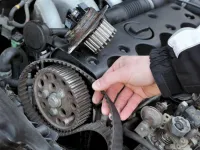
The Number of Kilometers at Which Timing Belt Replacement is Recommended for Audi A4
The timing belt, as a whole, is fundamental in an Seat Terra, especially considering the malfunctions it can cause if not replaced on time.
It’s important to remember that the failure of the timing belt during vehicle operation can lead to quite expensive damages.
As a rule of thumb, the timing belt should be replaced in a timely manner to avoid arriving too late at a service center when the timing belt is already broken. A broken timing belt can cause engine damage, and the only few cases where this doesn’t happen is when the car’s engines have a different combustion chamber location than the valves.
To ensure the proper maintenance of your personal vehicle, it’s important to understand the role, function, the type of timing belt you have, the replacement components it consists of, and, last but not least, what technical issues can be avoided by simply changing the timing belt at the right time.
The Role and Importance of the Timing Belt in Audi A4
The timing belt is one of the essential parts of the engine in Audi A4 because it consists of multiple components with a vital role in the engine’s operation.
The primary role of the timing belt is to harmonize the proper operation of the engine’s components using the timing belt/chain. It manages to coordinate movements; the chain/belt transmits messages to the crankshaft and the camshaft, then the injection pump and the water pump are actuated.
Delaying the replacement of the timing belt can lead to its rupture, resulting in the improper operation of the crankshaft and camshaft. If the timing belt breaks while the vehicle is in motion, other engine parts can be damaged. In this situation, the remaining open valves, the piston head, and the cylinder head will be damaged.
Timing Belt Kit in Audi A4
A timing belt kit consists of multiple parts, but the primary component is the belt/chain. The belt is composed of steel wires, rubber, and synthetic material, while the chain is made of alloy or steel. In the case of timing belts with gears, the belt is made of alloys that resist mechanical wear.
The timing belt/chain is held in place by tensioner pulleys to create tension on the belt/chain, preventing it from jumping off the pulley due to slackening. Tensioning the timing belt/chain should be done at a medium tension; if they are too tight, they can break.
The timing belt kit includes, besides the tensioner pulley, a guide pulley that directs the timing belt, and a water pump. The role of the water pump is to maintain a stable coolant flow through the engine block. Nowadays, water pump materials are primarily plastic. Although pumps used to be made of metal, progress has led to their production from plastic, which involves reduced costs.
Variants of Timing Belts
Regarding the variants available in the auto market, we can mention timing belts, chains, or gears.

The most commonly used timing belt is the one with a reference dating back to the 1960s, as evidenced by the large number of cars still using it. This type of timing belt is a good choice today as long as it is well-maintained.
The timing chain has been around since 1890, making it the oldest type of timing belt. It has continuously improved and is still found in many vehicles. This type of timing belt is durable, but in recent times, it has become a consumable product, so its durability has decreased.
Regarding timing belts with gears, they are the least common because they are used in vehicles with high resistance, such as trucks and vans. This type of timing belt is durable and robust and is found in VOLKSWAGEN engines, vans, and VOLKSWAGEN MAN partner vehicles.
Advantages and Disadvantages of Different Types of Timing Belts
Each type of timing belt has its pros and cons, which is why we will attempt to highlight the essential aspects of the three variants mentioned above.
Timing belts involve the lowest costs among timing belts. As for the materials used, rubber is primarily used, making it silent and a good shock absorber.
Timing chains have a remarkable lifespan, with chain replacements taking place at long intervals. However, one of the disadvantages is the noise they produce.
Timing belts with gears also generate a strong noise, which is why they are found in larger vehicles that require strength or are used for heavy-duty work. This type of timing belt has a longer lifespan than timing chains, requiring very little maintenance. There is a possibility of the water pump failing, as it is the only component that may require replacement.
The Timing for Replacing the Timing Belt in Audi A4
Drivers should pay close attention to when the car’s timing belt needs replacement; otherwise, they may experience timing belt rupture and, consequently, engine damage.
For timing belts, it’s recommended to visit a service center at 90,000 kilometers, with a return visit at another 60,000 kilometers, or the replacement of the timing belt should be considered after five years if the car is not driven that much.
Timing belt replacement should be carried out comprehensively, requiring the ordering of a complete kit, which includes, besides the belt, a water pump and tensioner pulleys, among other components.
For Audi A4 vehicles with timing chains, they should be checked at 250,000 kilometers for older-generation cars or at 150,000 kilometers for newer-generation ones.
Ultimately, timing belts with gears have the longest lifespan. In this case, it may be necessary to replace the water pump at around 100,000 kilometers.
Components That Need Replacement During Timing Belt Maintenance in Audi A4
Regardless of the type of timing belt in an Audi A4, it is advisable to invest in a complete timing belt kit to ensure that you are taking care of the engine and avoiding unnecessary risks. For the same reasons, it is also a good idea to replace the timing belt on a second-hand car.
If you are replacing a timing belt, it is advisable to replace the entire assembly, including the belt, tensioners, pulleys, gaskets, water pump, and more.
From a financial perspective, you will need between 100 to 200 euros for timing belt replacement in an Audi A4, which is an insignificant expense compared to the costs of repairing engine problems caused by timing belt failure.
In conclusion, we advise that if you are the type of driver who drives frequently, consider purchasing a car with a timing chain, while timing belts are recommended for drivers who do not use their cars as often.