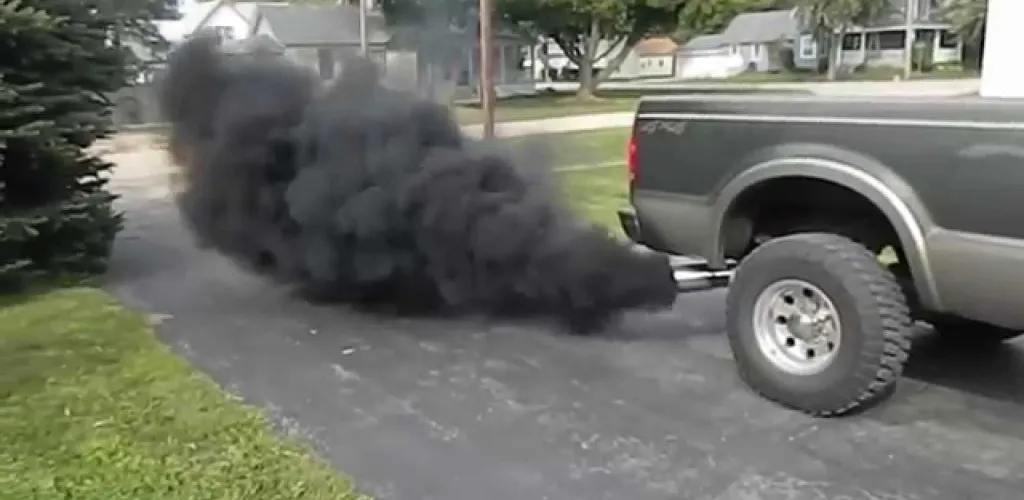
- Black smoke means too much fuel relative to air, causing incomplete combustion
- Common causes include defective injectors, clogged air filter, faulty MAF sensor
- Worn piston rings can cause compression loss and oil burning in the mix
- A stuck-open EGR valve can cause excessive exhaust gas entry and smoke
Smoke from the exhaust is always a warning signal and can indicate problems of varying severity. While in the past black smoke was sometimes considered a sign of a healthy engine, today any type of exhaust smoke signals a problem that requires immediate attention.
Each color of smoke — black, white, or blue — points to specific causes and requires different diagnostic and repair approaches. Understanding these differences is crucial for maintaining engine health and avoiding major repair costs.
Black exhaust smoke: when the air–fuel mixture is not correct
What black smoke indicates mechanically
Black smoke is the direct result of incomplete combustion of fuel, caused by an incorrect air/fuel mixture. Technically, the engine runs a rich mixture — too much fuel relative to the available air. This excess fuel cannot burn completely in the combustion chambers and exits the exhaust as unburned black carbon particles.
Important note: If the smoke is more gray than intensely black, the issue may be located at the turbocharger or turbo hoses, indicating possible oil leaks in the boost system.
Main technical causes of black smoke
1. Defective or worn injectors
Injectors are responsible for precisely spraying fuel into the combustion chambers. When they are faulty, they can present:
- Not sealing shut in time: injectors stay partially open, allowing excess fuel to pass
- Fuel leakage: seals are worn and allow internal fuel leaks
- Incorrect atomization: the fuel spray is no longer finely atomized, creating fuel-rich zones
- Altered injection pressure: can cause incorrect dosing of fuel
2. Clogged air filter — restricted air
A clogged air filter is one of the most common and easy-to-fix causes:
- Airflow restriction: dirty filter greatly reduces the amount of air reaching the engine
- Air–fuel ratio shift: the ECU cannot sufficiently compensate for the air shortage
- Volume efficiency impact: the engine cannot breathe properly
- Increased fuel consumption: the engine uses more fuel for the same power
3. Faulty MAF sensor (Mass Air Flow)
The MAF sensor is crucial for accurately calculating the amount of fuel needed:
- Incorrect measurements: transmits false information to the ECU about air quantity
- Fuel over-fueling: the ECU miscalculates the fuel requirement
- Oil contamination: can affect the hot-wire sensor
- Worn sensing element: reduces measurement accuracy
4. Worn piston rings — loss of compression
Worn rings affect engine performance in several ways:
- Compression loss: reduces combustion efficiency
- Oil passing into the combustion chamber: oil burns with the fuel mixture
- Reduced cylinder pressure: incomplete burning
- Excess play: allows gas blow-by and oil ingress
5. Faulty EGR valve
The Exhaust Gas Recirculation valve can cause black smoke when:
- Stuck open: allows excessive exhaust gas to enter the intake
- Carbon contamination: affects proper operation
- Vacuum leaks: control signals are no longer correct
- Position sensor failure: the ECU cannot know the exact valve position
6. Carbon deposits and their impact
Over time, carbon deposits accumulate on critical components:
- Injectors: alter the fuel jet shape
- Intake valves: reduce air flow
- Combustion chambers: modify the compression ratio
- Rings: may clog ring grooves in the piston channels
- Turbocharger: reduces boost efficiency
Other possible technical causes
- Vacuum leaks in the intake: cracked hoses or loose clamps
- Faulty ECU (PCM): software or hardware issues
- Miscalibrated MAP sensors: incorrect intake pressure readings
- Faulty fuel pressure regulator: too high pressure in the injector rail
- Worn or faulty spark plugs: incomplete ignition
- Clogged intake manifold: restricted air path
- For diesel engines: DPF regeneration ongoing or blocked particulate filter
Diagnostic and repair procedure
1. OBD2 scanner diagnostic
The first step is reading error codes:
- P0101: MAF sensor circuit problem
- P0116: coolant temperature sensor circuit problem
- P0171/P0174: too lean (may indicate air issues)
- P0172/P0175: too rich
- P0401: insufficient EGR flow
2. Basic systematic checks
Air filter check:
- visually inspect dirt level
- check filter housing for leaks
- replace if needed
MAF sensor testing:
- clean with special MAF spray
- check electrical continuity
- test with a multimeter (voltage changes with air flow)
Vacuum system inspection:
- check all hoses for cracks
- test with smoke tester for leaks
- replace faulty components
3. Injector interventions
Cleaning with additives:
- use specialized injector cleaners
- perform treatment over several fill-ups
- monitor improvements
Professional cleaning:
- ultrasonic cleaning at a specialized shop
- bench testing
- replace internal filters
Injector replacement:
- when cleaning no longer helps
- for heavily worn injectors
- use genuine or high-quality equivalent parts
4. Advanced issues resolution
Engine compression testing:
- measurements across all cylinders
- compare results (differences under 10% good; larger gaps indicate issues)
- oil test to identify cause
Decarbonization:
- hydrogen cleaning
- specialized chemical treatments
- disassembly and manual cleaning
White exhaust smoke: when coolant reaches the cylinders
Understanding white smoke from a mechanical perspective
Dense, persistent white smoke (not the normal cold-start vapor) indicates the presence of coolant in the combustion chambers. This occurs when the cooling system communicates abnormally with the combustion chambers, allowing antifreeze to reach places it shouldn’t be.
Crucial distinction: Do not confuse persistent white smoke with the normal steam seen on cold starts that disappears as the engine warms up. Problematic white smoke persists and has a sweetish odor.
Mechanical causes of white smoke
1. Defective head gasket — the most common cause
Head gasket failure can occur for several reasons:
- Overheating: excessive expansion deforms the gasket
- Wear over time: materials degrade and lose elasticity
- Improper machining: non-flat surfaces on the head or block
- Improper torquing: incorrect bolt torque during assembly
- Poor gasket material quality
2. Cracked or deformed cylinder head
- Cracks between cooling channels: coolant enters the combustion chamber
- Deformations: overheating may warp the head
- Erosion: cavitation in cooling channels
- Manufacturing defects: hidden internal cracks
3. Cracked engine block — the most severe scenario
- Cracks in cylinder walls: direct communication with cooling passages
- Deck cracks: affect sealing with the head gasket
- Severe wear: material degradation
- Antifreeze freezing: ice expansion can crack the block
Associated symptoms and diagnostic steps
Visual indicators:
- Gradual coolant level drop
- Milky oil in the sump
- Foaming in the expansion tank
- Air bubbles in the cooling system
Functional symptoms:
- Repeated overheating
- Significant power loss
- Rough running, especially when cold
- Temperature gauge warning light
Diagnostic tests:
- Gas detector test: identifies combustion gases in the coolant
- Pressure test: pressurize the cooling system
- Compression test: check cylinder sealing
- Exhaust gas analysis: detects coolant vapors
Blue/gray smoke: when oil burns in the engine
Mechanism of oil burning
Blue or gray smoke indicates burning engine oil in the combustion chambers. This occurs when oil leaks from its normal lubrication circuit into the combustion chamber, where it mixes with the air–fuel mix and burns, producing blue smoke.
Detailed technical causes
1. Excessive oil in the engine
- Overfill: oil level above the MAX mark
- Excessive crankcase pressure: pushes oil to improper places
- Oil foaming: reduces lubrication quality
2. Worn piston rings — the most frequent problem
Types of rings and functions:
- Compression rings: seal the combustion chamber
- Oil control ring: controls oil film on the cylinder wall
- Wear of rings: loss of elasticity and sealing capacity
Wear process:
- Abrasive wear: metal particles wear surfaces
- Corrosive wear: oil acidity attacks materials
- Fatigue wear: repetitive loading cycles
3. PCV (Positive Crankcase Ventilation) valve blocked
- Role of PCV: vents oil vapors from the crankcase
- Blockage: creates excessive crankcase pressure
- Effect: forces oil out through any available path
- Symptoms: crankcase pressure, oil leaks, blue smoke
4. Worn valve guides and seals
Valve guides:
- Function: guide valve movement
- Wear: allows oil to pass around the valve stem
- Materials: bronze, cast iron, or synthetic materials
Valve seals:
- Types: O-rings or valve stem seals
- Wear: lose elasticity with temperature and time
- Replacement: requires removing the cylinder head(s) and/or the head gasket
5. Worn or oval cylinder walls
- Ovalization: cylinders become oblong
- Taper: diameter varies from top to bottom
- Scoring: surface damage
- Measurement: requires precision tools (dial bore gauge)
6. Faulty turbocharger — a specific cause
Critical components:
- Turbo seals: seal the oil circuit
- Center housing: contains bearings and lubrication system
- Rotor: spins at very high speeds (up to 200,000 rpm)
Failure modes:
- Bearing wear: excessive play allows oil leaks
- Seal wear: no longer seals properly
- Coking: carbon deposits block components
Systematic diagnosis of blue smoke
1. Engine compression test
Procedure:
- Engine warm, spark plugs removed
- Throttle fully open
- Measurements across all cylinders
- Compare results
Interpretation:
- Normal values: 12–16 bar petrol, 22–35 bar diesel
- Large differences: indicate issues with rings or valves
- Low overall values: uniform engine wear
2. Leak-down test
- Principle: introduce compressed air into a cylinder
- Localization: identifies exact air leakage path
- Advantages: more precise than simple compression test
- Results: leakage percentage indicates wear level
3. PCV system check
- Vacuum test: checks PCV valve function
- Visual inspection: look for deposits and blockages
- Smoke test: locate system leaks
4. Engine oil analysis
- Viscosity: changes indicate contamination
- Metal particles: internal component wear
- Acidity: oil degradation state
- Contaminants: coolant or fuel presence
Recommendations for car owners
When to go urgently to a service
- Smoke persists for more than 2–3 consecutive days
- Check Engine or temperature warning lights illuminate
- Rapid drops in levels (oil, coolant)
- Engine runs very irregularly or loses significant power
- Unusual noises from the engine
- Engine temperature climbs above normal
Strategies to prevent problems
Preventive maintenance
- Change the air filter according to service schedule
- Use high-quality fuel from trusted suppliers
- Adhere to service intervals without delays
- Monitor warning lights on the dash daily
- Check fluid levels weekly
Healthy driving practices
- Warm up the engine gradually
- Avoid high revs when the engine is cold
- Drive with even acceleration and deceleration
- Turbo maintenance: let the engine cool before turning off
Approximate repair costs in Romania
Black smoke problems (low–medium complexity)
- Fresh air filter: 50–200 RON (depends on car make)
- Professional injector cleaning: 200–500 RON
- MAF sensor replacement: 300–800 RON
- EGR valve cleaning: 150–400 RON
- Diesel injector set replacement: 2,000–6,000 RON
White smoke problems (high complexity)
- Head gasket replacement: 1,500–4,000 RON (labor included)
- Cylinder head resurfacing: 1,000–2,500 RON
- Cylinder head replacement: 3,000–8,000 RON
- Cracked engine block repair: 5,000–12,000 RON
Blue smoke problems (advanced engine wear)
- PCV valve replacement: 100–300 RON
- Valve seal replacement: 800–1,500 RON
- Ring replacement: 2,000–6,000 RON
- Complete engine rebuild: 8,000–20,000 RON
- Turbo reconditioning: 1,500–4,000 RON
Choosing the right service
Selection criteria
- Brand-specific specialization: relevant experience
- Diagnostic equipment: professional scanners, oscilloscope
- Certified mechanics: appropriate technical training
- Work warranty: minimum 6 months
- Cost transparency: clear detailing of procedures
Questions to ask at the service
- What specific tests will be performed?
- Which components require replacement?
- Are there alternatives to the proposed repair?
- How long will the intervention take?
- What warranty is offered?
Conclusion
Exhaust smoke is a natural warning system of the car and should never be neglected. Each smoke color — black, white, or blue — tells a different story about the engine’s internal state and requires specific diagnostic and repair approaches.
While black smoke often points to relatively affordable issues (air filter, injector cleaning), white and blue smoke frequently signals more serious engine deterioration that can involve considerable repair costs.
The key to maintaining engine health lies in quick diagnosis and timely intervention. Early diagnosis can turn a minor problem into a simple service operation, while neglect may lead to major damage and repair costs that could exceed the car’s value.
For any uncertainty related to exhaust smoke, consulting an auto-diagnostics specialist is the most prudent investment. A professional diagnosis can save thousands of lei and considerably extend the engine’s life.
Photo sources: hansonsubaru.com, carfromjapan.com, autobutler.co.uk, autoblog.com, nst.com.my