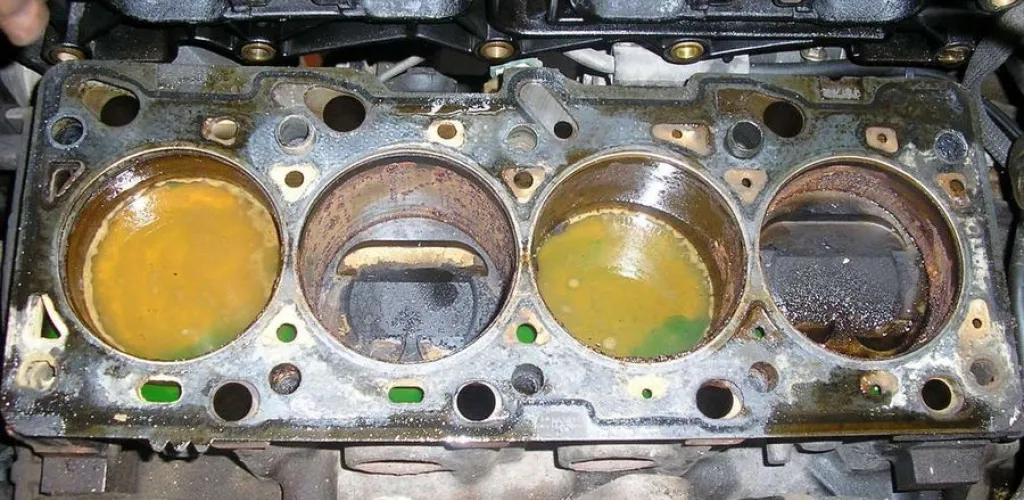
- Hydrolock occurs when liquids in the combustion chamber prevent piston movement, causing extreme forces.
- Water ingress from floods, deep water, or stalled in flooded zones is the most common cause.
- Coolant entering cylinders via head gasket, cracked head, or cracked block can occur.
- Symptoms include rough running, white exhaust smoke, power loss, and sudden engine stoppage.
The engine is the heart of any vehicle, composed of hundreds of components that work in sync to generate the power needed to move. Among the faults that can affect an engine, hydrolock is one of the most severe and costly. Although rare, the consequences can be devastating, potentially requiring a complete engine replacement.
This article explains what hydrolock is, its main causes, symptoms and damages, and how to prevent this expensive failure. It also covers what options you have if hydrolock occurs.
What is engine hydrolock
An engine hydrolock is an engine in which one or more pistons can no longer move freely due to the presence of an incompressible liquid in the combustion chamber. Unlike the air–fuel mixture that compresses easily, water or other liquids cannot be compressed. When the liquid occupies the cylinder space, the piston continues its upward stroke but hits a rigid liquid barrier.
In a functioning engine, the piston travels a precise stroke inside the cylinder, with minimal clearance. Each piston rises and falls thousands of times per minute, compressing the air–fuel mixture before ignition. When liquid enters the chamber, this cycle is violently interrupted — the piston cannot compress the liquid and stops abruptly, transmitting huge forces through the entire mechanical drivetrain.
Main causes of hydrolock
Water ingress into the engine
The most common cause of hydrolock is water entering the intake system. This happens most often in the following situations:
- Crossing flooded areas: When water depth exceeds the intake height, water can be sucked directly into the engine
- Driving through deep water: Even at low speeds, water can infiltrate through the air filter and intake tubing
- Stalling in flooded zones: If the car is parked in a flooded area and water reaches the engine level
An engine inhales hundreds of liters of air per minute. If water replaces air, even small amounts (50–100 ml) can cause hydrolock.
Cooling system failures
The second major cause is coolant entering the combustion chambers:

- Blown head gasket: Allows coolant to pass from cooling passages into the cylinders
- Cracked cylinder head: Cracks in the head can create passages between the cooling system and the combustion chambers
- Cracked engine block: Cracks in the block can permit coolant intrusion
These failures allow coolant to accumulate in the cylinders when the engine is off, leading to hydrolock on the next start.
Symptoms and detection
Hydrolock is difficult to anticipate because there are few warning signs:
Before complete blockage:
- Engine runs rough or misfires
- White smoke from the exhaust (indicating the presence of water)
- Sudden loss of power
- Unusual engine noises (metallic clanging)
At the moment of hydrolock:
- Engine stops abruptly
- Inability to start the engine (starter cannot rotate the crank)
- Loud metallic noise before stopping
Diagnostic test: If suspicion arises, remove the spark plugs and attempt to rotate the engine manually. If water comes out of the spark plug holes when rotating the engine, hydrolock is confirmed.
Damages caused by hydrolock
Stopping the engine abruptly transmits huge forces through the entire mechanical drivetrain. Weaker or worn components fail first:
Damages to the piston–connecting rod system
- Bent or broken connecting rods
- Cracked or fractured pistons
- Piston/connecting rod ejection through the block
- Broken piston pins or connecting-rod bolts
Damages to the engine block and cylinder head
- Cracked cylinder head
- Cracked cylinder walls
- Damaged sealing surfaces requiring machining or replacement
Damages to the crankshaft and bearings
- Bent or cracked crankshaft
- Worn or seized bearings
- Damaged flywheel
Secondary damages
- Cracked timing cover
- Damaged timing chain or belt
- Faulty oil pump
Severity depending on engine RPM
Damage scales with the engine speed at the moment of hydrolock:
Idle (800–1000 rpm):
- Potentially minor damages
- Possible recovery with limited repairs
- Forces are relatively low
Medium RPM (2000–4000 rpm):
- Moderate to severe damages
- Likely bent rods and damaged pistons
- Possible cracks in the block or head
High RPM (>4000 rpm):
- Catastrophic damage almost guaranteed
- High likelihood of block perforation
- Often requires complete engine replacement
Can an engine hydrolocked be repaired?
Damage assessment
The first step is a full inspection to determine:
- How many cylinders are affected
- The extent of damage to components
- Structural integrity of the block and head
Repair scenarios
Favorable cases (repair possible):
- Only one cylinder affected
- No cracks in the block or head
- Crankshaft intact
- Damage limited to pistons and connecting rods
- Repair cost: 5,000–15,000 lei
Unfavorable cases (replacement required):
- Multiple cylinders affected
- Block or head cracked
- Crankshaft deformed
- Piston/connecting rod ejected through the block
- Cost of a used engine: 8,000–25,000 lei
- New engine: 15,000–50,000+ lei (depending on model)
The financial decision
In many cases, the cost of repair exceeds the value of a used engine in good condition. It’s necessary to compare:
- Total repair cost (parts + labor)
- Price of a tested used engine
- The overall value of the vehicle
- Downtime
Preventing hydrolock
Essential preventive measures
On the road:
- Never cross water deeper than 30–40 cm (below door sills)
- If you must cross water, proceed very slowly to avoid waves
- Stop the engine immediately if you enter deep water by accident
- Do not attempt to start the engine if water has entered it
Preventive maintenance:
- Regular cooling system checks
- Monitoring coolant level
- Checking the head gasket condition
- Annual cooling system pressure test
- Checking air filter condition (a clogged filter can cause problems)
Warning signs:
- Coolant level drop without visible leaks
- White smoke from exhaust
- Engine overheating
- Milky-looking oil (sign of coolant contamination)
What to do in case of hydrolock?
Immediate steps
- Do not attempt to start the engine — every attempt to start worsens the damage
- Remove the keys from the ignition — prevents accidental starting
- Call a tow service — do not try to move the vehicle yourself
- Document the situation — take photos for insurance
At the service center
- Complete diagnostic — visual and technical inspection
- Spark plug removal — to vent the liquid and allow turning the engine
- Endoscopic inspection — check the internal condition of the cylinders
- Financial evaluation — compare repair costs vs replacement
Insurance considerations
Many comprehensive insurance policies cover hydrolock under certain conditions:
- Check coverage on your policy
- Document the circumstances (photos, witnesses)
- Promptly report the incident to the insurer
- Keep all documents and invoices
Some insurers may exclude coverage if driving negligently through deep water.
Conclusion
Engine hydrolock represents one of the most severe faults that can affect a vehicle. Prevention is essential—avoiding deep water and proper cooling system maintenance can prevent this costly issue. If you face hydrolock, do not attempt to start the engine and contact specialists promptly to minimize damage and accurately assess remediation options.