- Car washes are safe for EVs thanks to IP protection and sealed batteries.
- Most EVs use IP67/IP68 sealing with fully enclosed battery packs.
- Thermal management systems are isolated and unaffected by water exposure.
- Europe and US standards require immersion, high-pressure jet tests, and insulation checks.
As the number of electric cars on Romania’s roads grows, many questions arise in the minds of owners of these modern vehicles. One of the most common concerns revolves around washing the car — is it safe to take an electric vehicle through a car wash?
The question is perfectly legitimate, especially when we talk about substantial investments in advanced technology. Electric cars are significantly more expensive than internal-combustion ones, and their costliest component—the battery—raises questions about exposure to water.
If water were to enter the battery compartment, the consequences could be devastating:
- Irreversible damage to battery cells
- Corrosion of connectors and electronic components
- Short circuits that can affect the entire electrical system
- Loss of the manufacturer’s warranty
The official answer: washing at a car wash is perfectly safe
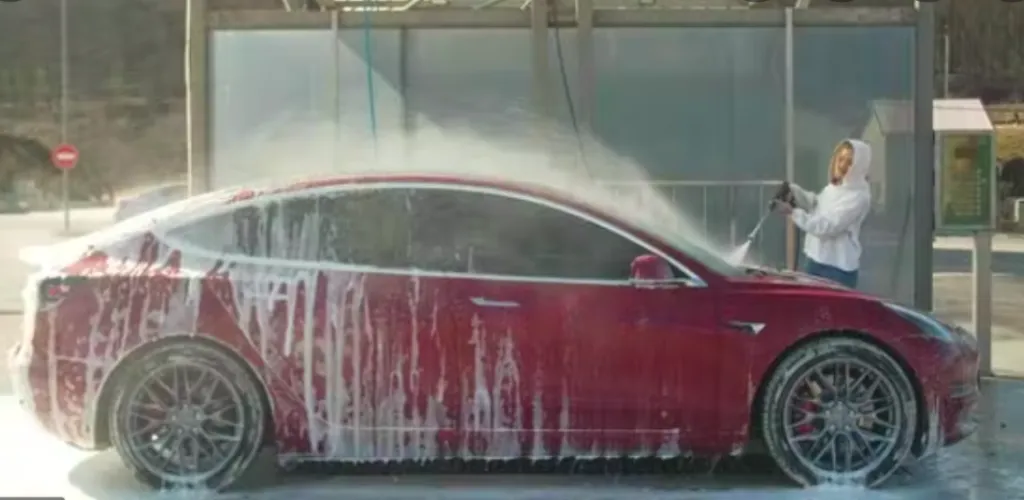
The good news is that you can drive an electric car through a car wash without worry. Electric vehicles are designed from the factory with advanced protection systems against water.
How do manufacturers protect the electrical components?
Manufacturers take strict measures to ensure compliance with safety standards:
IP (Ingress Protection) certification: The batteries and electrical components of electric cars receive an IP rating that certifies the level of protection against water and dust. Most EVs have batteries with IP67 or IP68 ratings, which means:
- Complete protection against dust
- Resistance to temporary submersion in water
- Ability to operate after exposure to high-pressure water jets
Sealed encapsulation: The battery pack is enclosed in a fully sealed housing, with special gaskets that prevent water infiltration. This housing is rigorously tested during development to resist:
- High-pressure water jets
- Prolonged heavy rain
- Crossing streams and puddles
- Steam cleaning
Thermal management systems: Batteries have cooling systems that use coolant, but they are fully isolated and sealed. These systems are designed to operate without issues even when the car is exposed to water.
How this compares to driving in the rain
Passing an electric car through a car wash is not significantly different from driving it in rain or a storm. Yes, car washes use higher-pressure water jets than natural rain, but the protection systems are sized for such demands.
Think about it: if electric cars could not withstand water contact, they wouldn’t be legally drivable on public roads, where they may encounter:
- Torrential rain
- Flooded streets and spray from other vehicles
- Melted snow and de-icing solutions
- Manual washing with a hose
What do international standards say?
All electric vehicles sold in Europe and the US must meet strict electrical safety and water-resistance standards. These include:
- Immersion tests at various depths
- High-pressure water jet tests from multiple angles
- Operational tests after exposure to water
- Electrical insulation checks in wet conditions
These tests guarantee that the vehicle can operate safely in normal weather conditions and in commercial car washes.
The situation with hybrid cars
Hybrid cars benefit from the same protection systems as fully electric vehicles. Even though they have both an internal-combustion engine and an electric motor, the electrical components are just as well protected against water.
The hybrid battery system, while typically smaller than that of a pure EV, is equally well sealed and insulated. Manufacturers use the same encapsulation and protection technologies to ensure safe operation in all conditions.
Practical recommendations for washing an electric car
Although it is safe to wash an electric car at a car wash, here are some practical tips:
At the automated car wash:
- Make sure all doors and the trunk are fully closed
- Ensure the charging port cover is firmly secured
- Keep the windows fully up
- Disable automatic wipers if you have this feature
At a manual wash:
- Do not direct the water jet at the charging port
- Avoid washing the engine compartment with a very high-pressure jet
- Use cleaning products recommended for electric cars
- Dry the charging port area thoroughly after washing
Conclusion
Concerns about washing electric cars at a car wash are natural but completely unfounded. Auto manufacturers have invested heavily in protection systems that make these vehicles perfectly safe when in contact with water.
You can confidently go to any car wash — automatic or manual — without worrying about the battery or electrical components of your car. The sealing and protection systems are so effective that your electric car can handle even conditions more extreme than a simple wash.
Thus, maintaining the aesthetic appearance of your electric vehicle can be as straightforward as with a conventional internal-combustion car.