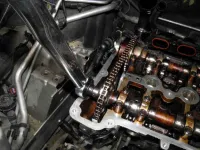
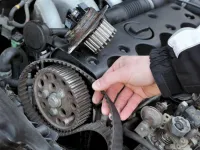
- Drives alternator, A/C, power steering, water pump, and other accessories.
- Replacement intervals vary: gasoline 60k-100k km, diesel 80k-150k km.
- Audible signs include persistent squeal, sharp whine, or intermittent noise.
- Visual wear: cracks, worn or missing ribs, torn edges, elasticity loss.
The serpentine belt is a critical component that drives the engine’s accessories — the alternator, the air conditioning compressor, the power steering pump, and other auxiliary systems. When it starts to make noise, it’s a clear sign that replacement is due, because under normal conditions this belt should be inaudible.
Early recognition of wear signs and understanding the belt’s role can prevent more serious problems and higher repair costs.
What is the serpentine belt and how it works
The serpentine belt, also known as the serpentine belt, is made from reinforced rubber with ribs on the inner side. These ribs ensure optimal grip on the pulleys of the engine’s accessories.
The term “serpentine” comes from its specific routing — it weaves around multiple pulleys in different directions, forming a complex circuit that can resemble the movement of a serpent. In Romania, the term “serpentine belt” is the most commonly used.
Accessories driven by this belt:
- Alternator - charges the battery and powers the electrical system
- Air conditioning compressor - provides cooling for the cabin
- Power steering pump - provides steering assist
- Water pump - circulates coolant (on some engines)
- Vacuum pump - assists braking (on diesel engines)
Replacement intervals and durability
Unlike the timing belt, the accessory belt does not have a guaranteed lifespan and is subject to continuous wear due to exposure to external factors.
Replacement intervals vary significantly:
- Gasoline engines: 60,000 – 100,000 km
- Diesel engines: 80,000 – 150,000 km
- Vehicles with heavy use: more frequent replacement
The most reliable guideline is the vehicle’s technical manual, where the manufacturer specifies the exact interval for the specific model.
How to tell the serpentine belt needs replacing
Audible signs
Noise is the main indicator of a problem with the serpentine belt:
- Persistent squeal - indicates advanced material wear
- Sharp whine - may signal incorrect tension or contamination with fluids
- Intermittent noise - often related to humidity or dirt particles
Visual signs of wear
Visual inspection can reveal:
- Cracks lengthwise or crosswise
- Worn or missing ribs
- Torn or deformed edges
- Loss of material elasticity
- Pieces of rubber missing

Factors that accelerate wear
Fluid contamination:
- Water - temporary cause, dries out and the noise disappears
- Engine oil - permanently damages rubber, requires urgent replacement and source of the leak
- Coolant - can cause slipping and premature wear
Operating conditions:
- Extreme temperatures
- Heavy urban use (frequent starting/stopping)
- Improper maintenance
Replacement procedure and related components
Replacing the tensioner pulley
A crucial aspect of belt replacement is checking and potentially replacing the tensioner pulley. This component:
- Maintains the correct belt tension
- Wears along with the belt
- If not replaced simultaneously, can cause premature failure of the new belt
- Subsequent replacement entails again paying labor costs
Checking other components
When replacing the belt, the mechanic will check:
- The condition of all pulleys
- Alignment of components
- Correct tension after installation
- The operation of all accessories
What happens if the belt fails
Unlike the timing belt, a breakage of the accessory belt does not cause engine damage, but it has immediate safety and comfort consequences:
Immediate effects:
- Alternator stops functioning - the battery discharges rapidly
- Air conditioning system stops
- Power steering becomes very heavy
- Water pump stops (on engines where it is driven by this belt)
Emergency measures:
If the belt breaks while driving:
- Stop the engine immediately and remove the broken belt
- Drive to the nearest service - the battery will power essential systems for a short period
- Avoid using nonessential electrical devices to extend the vehicle’s range
Maintenance and prevention tips
Regular inspections
- Visually inspect the belt at every oil change
- Pay attention to unusual noises from the engine bay
- Request tension checks during periodic service
Preventive measures
- Avoid contact of the belt with oils or fuels
- Replace preventively if signs of wear appear
- Do not ignore persistent noises
- Replace the tensioner pulley simultaneously
Choosing the right belt
When replacing:
- Ensure the belt has the exact dimensions specified by the manufacturer
- Buy from a trusted supplier
- It should carry the vehicle’s homologation mark
- Include the manufacturer’s warranty
Preventive maintenance of the serpentine belt is a small investment that prevents major inconveniences and additional costs. A seemingly minor noise can quickly escalate into a breakdown that leaves you stranded on the road, so never ignore the signals your car gives you.