- Monitors steering angle and sends data to the ECU for stability and control
- Two types: analog resistance sensors and digital LED-based sensors
- Dashboard warnings like Check Engine or traction control light appear
- Symptoms include stiff steering, delayed response, instability in corners, or steering vibrations
Modern vehicle steering relies on a complex network of sensors that continuously monitor operating parameters and transmit vital information to the engine control unit (ECU). Among them, the steering column sensor plays a crucial role in maintaining on-road stability and safety.
This specialized sensor detects changes in the steering angle and transmits these data to the vehicle’s electronic systems, enabling precise control of stability and traction. A failure of this component can significantly compromise vehicle handling, so understanding how it works and recognizing early problems is essential for every driver.
What is the steering column sensor?
The steering column sensor is a sophisticated electronic component that continuously monitors the position and movement of the steering wheel. Its main role is to detect changes in the steering angle that occur when the wheel is turned and to transmit this information to the ECU in real time.
There are two main types of steering column sensors:
Analog sensors
These sensors operate on a principle based on the variation of electrical resistance according to the steering wheel position. Although less precise, they are still found on some older vehicle models.
Digital sensors
More commonly used in modern cars, these sensors use LED technology to accurately detect the steering position. A LED light beam is modulated according to the rotation of the steering wheel, providing highly precise data to the system.
The information collected is transmitted to the ECU, which interprets it and applies the necessary control measures to maintain vehicle stability, adjust the driver assist systems, and optimize response to commands.
Symptoms of Steering Column Sensor Failure
Early recognition of a steering column sensor fault can prevent more serious and costly issues. Here are the main warning signs:
Dashboard warning lights
The most evident symptom is the Check Engine light or the traction control indicator on the instrument cluster. These yellow lights indicate a problem in the vehicle’s electronic system and require immediate diagnostic with an error code scanner.
The traction control indicator lights up because the system no longer receives correct information about the steering position, which affects the operation of electronic stability systems.

Steering wheel hard to operate or abnormal behavior
A faulty sensor can cause:
- Stiff steering: The power steering system may function deficiently
- Delayed response: The vehicle does not respond immediately to steering inputs
- Instability in corners: The car may feel unstable when changing direction
- Unusual vibrations: Transmitted through the steering wheel during driving
These problems occur because the traction control indicator attempts to compensate for erroneous or missing information from the sensor.
Abnormal behavior after wheel balancing
A specific clue of a problem with the steering column sensor is the persistence of stability issues even after a professional wheel balancing. In this case:
- The vehicle continues to pull to one side
- The steering wheel does not return to the centered position
- Vibrations appear at certain speeds
Important: After any intervention to the steering or wheel system, it is essential to request a steering column sensor reset to avoid these problems.
Locating and Diagnosing the Sensor
Where is the steering column sensor located?
The exact location varies by brand and model, but common spots include:
- Near the steering box: The steering box is the most frequent location
- On the steering column: Under the steering wheel
- In the suspension area: On some models, near the steering joints
Consulting the vehicle’s technical manual is essential for precise identification of the sensor’s location.
Diagnostic methods
For precise diagnostics, the following steps are required:
1. Error code scanning
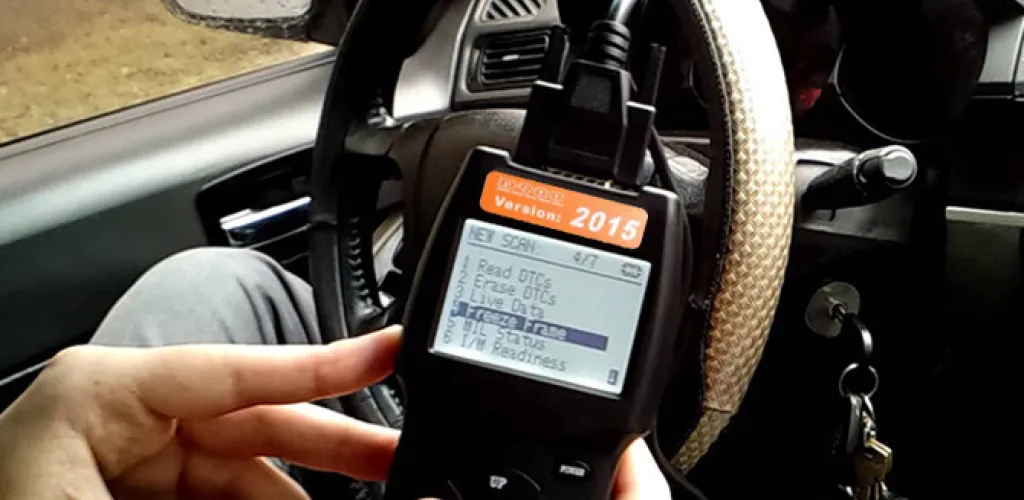
Using a professional OBD-II scanner to read error codes. The code P0126 is the most commonly associated with steering column sensor problems.

2. Testing with a voltmeter
A high-impedance voltmeter can be used to:
- Measure the sensor supply voltage
- Check the output signal
- Compare measured values with the manufacturer’s specifications
3. Dynamic test
During the test, the steering wheel should be rotated to verify that the sensor correctly transmits changes in angle to the ECU.
Cleaning and Maintenance Procedure
Before considering replacement, a cleaning procedure can be attempted:
Materials needed:
- Appropriate screwdriver bits
- Contact cleaner (ethanol or isopropyl alcohol)
- Plastic bags
- Clean, lint-free rags
Cleaning steps:
- Disconnect the battery: For safety, disconnect the negative battery terminal
- Locate the sensor: Refer to the technical manual for the exact position
- Disassembly: Carefully remove mounting screws and connectors
- Cleaning: Use alcohol to clean contacts and components
- Drying: Allow the part to dry completely before reassembly
- Reassembly: Reconnect in the reverse order

Replacing the Steering Column Sensor
When is replacement necessary?
Replacement becomes mandatory when:
- Cleaning does not solve the problem
- The sensor shows physical damage
- Error codes persist after reset
- Electronic tests confirm a fault
Replacement procedure:
- Accurate diagnosis: Confirm that the issue originates from the steering column sensor
- Acquiring the part: Ensure the new part is compatible with the vehicle
- Removing the faulty sensor: Follow the procedure described above
- Comparing parts: Verify that the new part is identical to the faulty one
- Installation: Install the new sensor with the correct torque specifications
- Connection: Reconnect all electrical connections
- Test: Start the engine and check operation
- Resetting codes: Use a scanner to clear errors
- Calibration: Some vehicles require calibration of the new sensor
Replacement costs
Total replacement costs include:
Parts:
- Aftermarket sensors: 150-400 lei
- OEM parts: 300-800 lei
- Premium parts: 500-1200 lei
Labor:
- Time: 1-3 hours
- Labor cost: 100-300 lei
Additional costs:
- Diagnostics: 50-150 lei
- Calibration/reset: 50-100 lei
The Importance of Preventive Maintenance
To prevent premature failure of the steering column sensor:
- Regular checks: Include electronic system checks in routine maintenance
- Pay attention to warning indicators: Do not ignore dashboard warnings
- Calibrate after work: Request a sensor reset after any steering-related work
- Driving conditions: Avoid strong shocks to the steering system
The steering column sensor is a vital component for the vehicle’s active safety. Keeping it in good working condition contributes not only to the car’s performance but also to the safety of all road users. Early diagnosis and repair can prevent more expensive issues in related systems.